33rd Sunday in Ordinary Time: US Catholic Homily for November 15, 2026
Lectionary Year A · Ordinary Time · Lectionary 157
Readings: Proverbs 31:10–13, 19–20, 30–31 | Psalm 128:1–2, 3, 4–5 | 1 Thessalonians 5:1–6 | Matthew 25:14–30 (or the shorter form, 25:14–15, 19–21)
Also this weekend: the 10th World Day of the Poor (theme from Pope Leo XIV: “The Lord is the refuge of the poor”), and the Catholic Campaign for Human Development collection in many US parishes. Next Sunday is the Solemnity of Christ the King, and Thanksgiving follows on Thursday, November 26.
Sunday Homilies Year A Sunday Homilies Year B Sunday Homilies Year C
What Did You Do With What You Were Given?
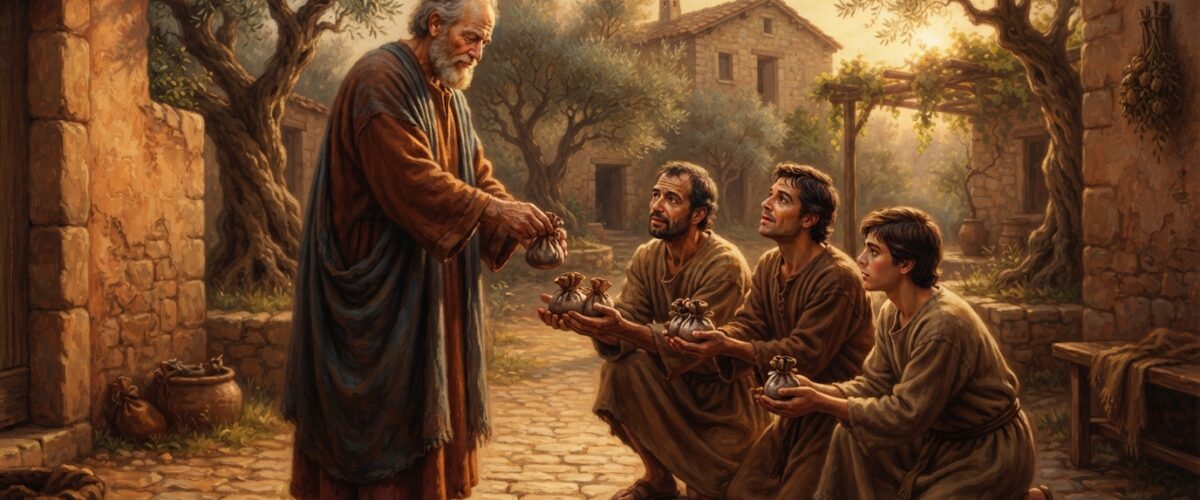
Good morning, brothers and sisters. Today’s Gospel is about a man who received a great gift, took excellent care of it, and handed it back in perfect condition. And he was thrown out for it.
That sounds unfair until we listen closely. The servant did not steal, waste, or gamble anything. He dug a hole, put the treasure in it, and kept it safe. Jesus tells this story in the last days before his Passion, and he wants us to feel the surprise: safe is not the same as faithful.
So the question underneath all of today’s readings is a searching one: what are you doing with what you were given?
A Hand Stretched Out
First Reading: Proverbs 31:10–13, 19–20, 30–31
The book of Proverbs closes with a poem, an acrostic that runs through the Hebrew alphabet from aleph to tav, praising the eshet chayil, the woman of strength. The word chayil is the same word used for a warrior’s valor. This is no decorative portrait. It describes a person of energy, skill, and wisdom, who works with willing hands, whose household can trust her, and whose life bears fruit.
The poem is meant for all of us, men and women alike, as a picture of wisdom in action. And right in the middle is the line that matters most this weekend. She opens her hand to the poor and reaches out her arms to the needy.
The gifts of the strong woman do not end with her. Her skill, her work, her resources all flow outward to someone who has less. The poem ends by saying that charm is deceptive and beauty fleeting, and that the person who reveres the Lord is the one worth praising. Her worth does not come from how she looks. It comes from what she does with her hands.
The Fruit of Your Hands
Responsorial Psalm: Psalm 128
The psalm sings the same truth in a gentler key. Blessed are those who fear the Lord and walk in his ways. You shall eat the fruit of your labor. Your wife will be like a fruitful vine, your children like olive shoots around your table.

Notice that in the Bible, blessing and work are not opposites. God does not bless the buried talent. He blesses labor that is carried out in reverence and trust. And “fear of the Lord” in these readings does not mean cowering. It means a deep respect for who God is, and, as we will see, it is the very opposite of the servant’s kind of fear.
Children of the Light
Second Reading: 1 Thessalonians 5:1–6
Paul’s earliest letter deals with a community that is anxious about when the Lord will return. Paul gives them a calm answer. The day of the Lord will come like a thief in the night, and no one can predict it. But, he says, you are not in darkness. You are children of the light and children of the day. So let us not sleep as others do. Let us stay alert and sober.
Paul’s advice to people who do not know the hour is not to panic and not to hide. It is to stay awake and keep doing good. A faithful servant lives as though the master could return at any time, and so lives well every day.
Here is the connection to the Gospel. The third servant buried his talent and, in effect, went to sleep. The first two stayed awake. They were busy and watchful, and they were ready when the master came back.
“Come, Share Your Master’s Joy”
Gospel: Matthew 25:14–30
Let’s walk through the parable slowly.
A man is going on a journey. He calls his servants and entrusts his property to them: five talents to one, two to another, one to a third, “each according to his ability.” We should not rush past the size of the gift. A talent was not pocket money. It was well over a decade of a day laborer’s wages. Even the servant who received only one was handed a fortune. (Our English word “talent,” meaning a natural gift or ability, comes from this very parable.)
Notice also that the master gives according to ability. No one is overloaded. No one is set up to fail. Each receives what he can handle, and each is trusted.
The first two servants go to work at once, and each doubles what he was given. When the master returns after a long time, which Matthew’s first readers would have heard as a hint about the long wait for Christ’s return, he gives both of them exactly the same praise: “Well done, good and faithful servant.” The one who made two more talents hears the same words as the one who made four more. In God’s accounting, the measure is not how much we produce, but whether we were faithful with what we were given. And the reward is not a day off. It is more responsibility and a seat at the table: “Come, share your master’s joy.”
Then comes the third servant. He is not defiant. He is afraid. “Master, I knew you were a demanding person… so out of fear I went off and buried your talent.” Look at what he reveals. He has a picture of the master in his head, a hard and grasping man waiting to catch him out, and he built his whole response on that picture. Fear told him a story about God, and he believed it.
The master’s answer is sharp, and it turns the servant’s own words back on him. If you really believed I was that demanding, you would at least have put the money in the bank. The sin is not a failed investment. The sin is that he refused to risk anything, because he did not trust the one who had trusted him.
The great sin in this parable is not wasting the gift. It is being too afraid to use it.
Preaching This Gospel Carefully
Two cautions, so that we do not twist this parable.
First, the master is not a portrait of a cruel God. The servant’s fearful image of the master is exactly what the parable corrects. The God who hands over a fortune before leaving on a journey is the most trusting God imaginable. The darkness at the end is real, because Jesus warns us that we can refuse the gifts we were given, but it is the result of a choice, not the whim of a tyrant.
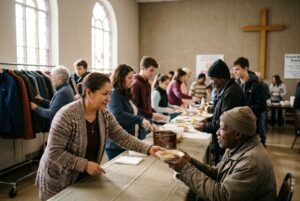
Second, the line “to everyone who has, more will be given” is not an economic law, and it does not bless the rich getting richer. It is a statement about spiritual life: when you spend the gifts of God, they grow, and when you hoard them, they shrivel. And we should read it in its place in Matthew. The very next scene, which we will hear next Sunday on Christ the King, shows the King identifying himself with the hungry, the thirsty, the stranger, the sick, and the prisoner. The talents are meant to be invested in them.
And a word to anyone sitting here who thinks, “I only have one talent, and not a very impressive one.” The man with one talent was handed a fortune too. No one in this parish has been given nothing.
A Story for This Sunday: The Mending Table
(An illustrative story, not a historical account.)
Marguerite was in her late seventies, a widow in a mid-sized Pennsylvania parish, and for fifty years she had been the person everyone brought their torn hems and broken zippers to. After her husband died and her eyes began to fail, she folded up her sewing machine, put it in the hall closet, and told her daughter, “Nobody mends anymore. It’s all throwaway now.”
The machine sat there for three years.
Then a refugee family joined the parish. The mother, Amira, had been a seamstress at home, but she had no tools and no work. She was invited to a job interview and had only one jacket that fit badly. Someone mentioned this to Marguerite, almost in passing. Marguerite stood in her hall, looked at the closet, and did not say anything. The next Tuesday she carried the machine to the parish hall and set it up on a folding table with a hand-lettered sign: Mending. Free.
Amira came, and the two women, who shared hardly a dozen words of English between them, spent the afternoon hemming the jacket side by side. Amira got the job. The next week four more people came with torn coats and loose buttons. By spring, the Tuesday table had three machines, a handful of volunteers, and a small paid training program run through the parish’s outreach ministry.
When asked, Marguerite says she hadn’t done anything special. “I just got it out of the closet.”
That is the whole parable in one sentence. Most of what God has entrusted to us is sitting in some closet, waiting for someone who needs it to walk in.
A Saint for This Weekend: St. Albert the Great
November 15 is the memorial of St. Albert the Great (c. 1200–1280), though the Sunday takes precedence this year. He is a good companion for today’s Gospel.
Albert was a German Dominican friar with a wide and restless mind. He studied plants, animals, minerals, and the stars, and he insisted that the study of creation was a way of knowing the Creator. He taught at Paris and Cologne, and his most famous student, a quiet young friar nicknamed “the Dumb Ox,” was Thomas Aquinas. Albert is said to have predicted that the Ox’s bellowing would one day be heard throughout the world.
He was asked to serve as bishop of Regensburg and did so for a short time, but he resigned in order to return to teaching and preaching. He did not bury what he had been given, and he did not cling to a title either. He spent himself in teaching and writing, and he trained a generation of thinkers who changed the Church. In 1931 Pope Pius XI named him a Doctor of the Church, and in 1941 he was named patron of natural scientists.
Albert reminds us that “talent” includes the mind, and that faith is no enemy of curiosity. Whatever you are good at, whether it is mathematics, carpentry, cooking, listening, or organizing a spreadsheet, it came from God and was meant to be given back with interest.
The Parable and the American Catholic in 2026
1. Our gifts are on loan, and they were never meant for us alone.
American culture trains us to ask, “How do I build my own life?” The Gospel asks, “What has been entrusted to you, and for whom?” Your skills, time, income, faith, and experience all came from someone, and all of them are meant to flow outward, like the woman in Proverbs whose hands reach to the poor. Parish life is the first place to ask the question. Where in this parish is a need that only you can fill?
2. The real buried treasure is fear.
The third servant was not lazy by temperament. He was afraid. Many of us are too. We are afraid of failing, of looking foolish, of being turned down, of not being good enough to teach the class, lead the group, visit the neighbor, or speak about our faith. Fear is persuasive because it sounds like prudence. Paul’s answer is to stay awake as children of the light. Fear says, “Keep it safe.” Faith says, “Spend it, because the Master is generous.”
3. This is the World Day of the Poor.
Pope Leo XIV, in his message for today, asks all of us a pointed question: are we a sign of a God who is a refuge for the poor? He describes the poor of our time as the forgotten and the marginalized, people robbed not only of bread but also of a voice and a face. And he reminds us that the poor are not just the recipients of our charity. Because they live on the essentials, they are often the ones who teach us where our true refuge is.
The talents of this Gospel have an address. This weekend, many parishes also take up the collection for the Catholic Campaign for Human Development, which funds community-led efforts to help people rise out of poverty. But a collection is only the beginning. Learn one name, hear one story, and be a refuge for one person this week.
4. Faithfulness is measured by effort, not by outcome.
The servant with two talents received exactly the same praise as the servant with five. Some of us will stand in front of thousands, and some of us will make a hundred sandwiches for a shelter that nobody notices. God sees both and says the same thing: well done, good and faithful servant. Stop comparing your talents. Start spending them.
Homily in Five Minutes (Short Version)
For a shorter Mass or a time-pressed preacher.
Brothers and sisters, today’s Gospel is about a man who received a fortune, kept it perfectly safe, and was thrown out for it.
A master going on a journey entrusts his property to three servants, according to each one’s ability. Two of them put it to work and double it. The third, out of fear, buries it in the ground. When the master returns, he gives the first two the very same praise, “Well done, good and faithful servant,” and invites them to share his joy. The third is rebuked, not because he lost anything, but because he refused to risk anything.
The heart of the parable is that fear told the servant a story about the master, and he believed it. He thought God was a hard man looking to catch him out. But the God of this Gospel is the one who trusts us with a fortune before he even leaves the room.
Proverbs gives us the other picture, a woman of strength whose hands are busy and who reaches out to the poor. St. Paul says we are children of the light, so let us stay awake and keep working. And today, on the World Day of the Poor, Pope Leo asks whether we are a sign of a God who is a refuge for the poor.
So here is my question for you this week. What has God put in your hands that is sitting in a closet? And who is waiting for it?
Scriptures to Carry Into This Week
- Luke 12:48: “Much will be required of the person entrusted with much.” Stewardship in a single line.
- 1 Peter 4:10: Each one should use whatever gift he has received to serve others, as good stewards of God’s varied grace.
- Matthew 25:31–46: Next Sunday’s Gospel, the judgment of the nations. Read it early and notice where the talents end up.
- 1 Corinthians 12:4–7: There are different gifts but the same Spirit, and each is given for the common good.
- Psalm 14:6: The theme of this World Day of the Poor: the Lord is the refuge of the poor.
Conclusion: Spend It
Brothers and sisters, the Master has gone on a journey, and he has left us in charge of a fortune. He trusted us before we proved anything. He will come back, perhaps late, perhaps sooner than we expect, and he will not ask whether we kept everything clean and safe. He will ask what we did with what we were given.
So this week, take one thing out of the closet. Make the phone call. Offer the skill. Give the hour. Put your hand on a poor person’s shoulder and be a refuge. And when you are afraid, remember that the God who gave you the talent is far more generous than the one you were imagining.
On that day, may we hear what the faithful servants heard: Well done. Come, share your Master’s joy. Amen.
Take-Home for Families
- Talk at dinner: What is one thing each person in our family is good at, and who could we share it with this week?
- Do together: Gather canned goods, warm clothing, or hygiene items and bring them to the parish pantry, or choose a family member or neighbor to cook for.
- Pray together: Before Thanksgiving, add a blessing that names one gift each person received and one way to pass it on.
- For children: Hand every child a coin or small object, and ask them to “invest” it by the end of the week in something kind. Share the stories on Sunday.
Reflection Questions for Personal Prayer or Group Discussion
- The servants were entrusted with different amounts but received the same praise. Where are you tempted to compare yourself with others?
- What is your “buried talent,” the gift you have been keeping safe rather than using?
- What fear is behind it? What picture of God does that fear assume?
- Proverbs says the strong woman reaches out to the poor. Who is the poor person God has placed within your reach?
- Pope Leo asks, “Are we a sign of a God who is a refuge for the poor?” What would it take for your parish to answer yes?
Prayers of the Faithful: 33rd Sunday in Ordinary Time
Presider: Brothers and sisters, God has entrusted us with every good thing we have. Let us bring our needs to the Lord, who is generous beyond measure.
- For Pope Leo XIV, our bishops, priests, and deacons: that they may be faithful stewards of the gifts entrusted to them and lead God’s people with courage. We pray to the Lord. Lord, hear our prayer.
- For all who serve in government, business, and education: that they may use their authority to protect the vulnerable and build a just society. We pray to the Lord. Lord, hear our prayer.
- On this World Day of the Poor, for the hungry, the homeless, the unemployed, and the forgotten: that they may find in us a true refuge, and in Christ the one who never abandons them. We pray to the Lord. Lord, hear our prayer.
- For all who are afraid to use their gifts: that the Holy Spirit may drive out fear and give them courage to serve. We pray to the Lord. Lord, hear our prayer.
- For our parish: that every member may discover and use their talents for the good of others. We pray to the Lord. Lord, hear our prayer.
- For the supporters and participants of the Catholic Campaign for Human Development, and for all who work to help families rise out of poverty. We pray to the Lord. Lord, hear our prayer.
- In gratitude as Thanksgiving approaches: for our families, our harvest, and our daily bread. We pray to the Lord. Lord, hear our prayer.
- For the sick, the grieving, and the lonely, and for our beloved dead: that they may rejoice in the joy of their Master. We pray to the Lord. Lord, hear our prayer.
Presider: Father, you entrust us with more than we deserve. Give us the courage to use your gifts, the wisdom to share them, and the joy of hearing you say, “Well done.” We ask this through Christ our Lord. All: Amen.
A Few Things to Check Before Sunday
- Readings: please confirm the exact Lectionary text on the USCCB site (bible.usccb.org). I quoted Scripture briefly and loosely, so check wording against the approved translation before proclaiming or printing.
- Lectionary year: the 2026 calendar places this Sunday in Year A. Matthew 25:14–30, with the optional shorter form, is the Gospel.
- World Day of the Poor and CCHD: the theme and Pope Leo’s message come from the Vatican. Confirm with your diocese whether the CCHD collection is scheduled this weekend in your parish.
- St. Albert the Great: his memorial is on November 15 but is superseded by the Sunday this year. Mention it as a “companion saint” rather than the saint of the day.
- Story: “The Mending Table” is invented and marked as illustrative. Swap in a real parish story if you have one.

💬 Share Your Reflection