Wednesday: Homily for December 2, 2026
Wednesday of the First Week of Advent: Homily for December 2, 2026. On the mountain, God prepares a feast, wipes away every tear, and teaches us to give what little we have.
Wednesday of the First Week of Advent · Weekday Cycle: Year II
Readings: Isaiah 25:6–10a | Psalm 23:1–3a, 3b–4, 5, 6 | Gospel: Matthew 15:29–37
Sunday Homilies Year A Sunday Homilies Year B Sunday Homilies Year C
Also today: the optional memorial of St. Bibiana, a fourth-century martyr of Rome.
Good Morning: The Table God Sets
Good morning, brothers and sisters. After Thanksgiving, many of us have had our fill of turkey, but today’s readings are about a different table. It is the one God himself sets for all peoples, and it is the Church’s picture of what Advent is aiming at.
“On This Mountain the Lord of Hosts Will Provide”
First Reading: Isaiah 25:6–10a
Isaiah sees a mountain, and on it a banquet: “a feast of rich food and choice wines, juicy, rich food and pure, choice wines.” This is no meager meal. And it is for all peoples, not just a favored few.
Then the prophet says what God will do at that table. He will tear away the veil that covers all peoples, he will destroy death forever, and he will wipe away the tears from all faces. This is Advent in a single sentence: God does not simply explain our suffering. He wipes away the tears.
The passage ends with a sentence the Church loves: “This is our God, in whom we hoped; let us rejoice and be glad that he has saved us!”
“The Lord Is My Shepherd”
Responsorial Psalm: Psalm 23
The psalm gives us the same picture in a smaller frame: the shepherd who leads, the table prepared in the presence of my foes, the cup that overflows. And it ends with confidence: goodness and mercy will follow me. Notice the verb. They follow us, and they are always a step behind us.
“My Heart Is Moved With Pity”
Gospel: Matthew 15:29–37
Isaiah’s prophecy comes down the mountain. Jesus goes up on a mountain by the Sea of Galilee, and great crowds bring the lame, the blind, the mute, and the maimed and “place them at his feet.” He heals them, and the crowds glorify the God of Israel.
Then Jesus calls the disciples and says something remarkable: “My heart is moved with pity for the crowd, because they have been with me now for three days and have nothing to eat. I do not want to send them away hungry.” The disciples object, as we all would: Where could we get enough bread in a deserted place? And Jesus asks the simplest of questions: “How many loaves do you have?”
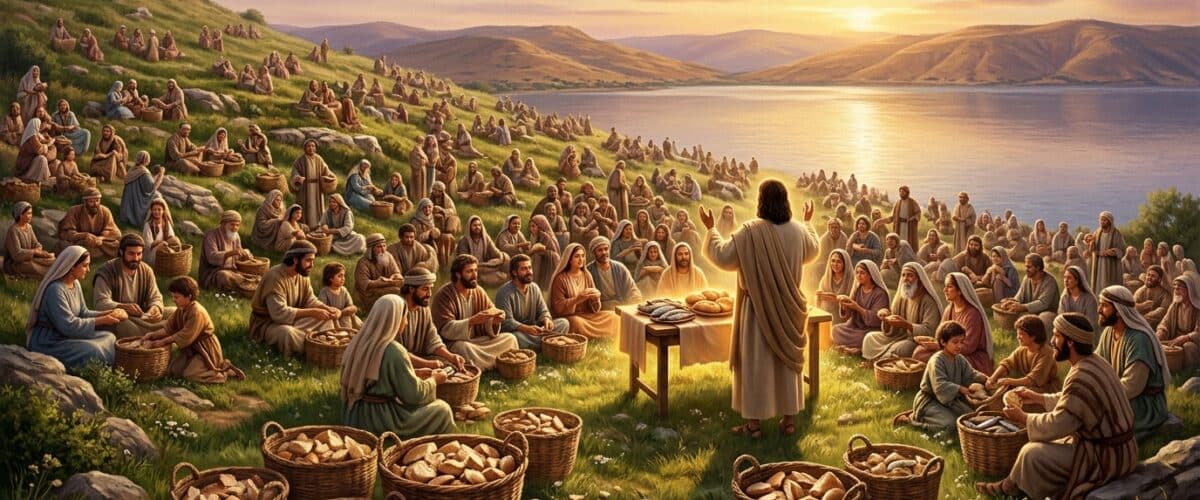
Seven, and a few fish. It is nowhere near enough. Jesus takes them, gives thanks, breaks them, and gives them to the disciples, who give them to the crowd. They all eat and are satisfied, and seven baskets of fragments are left over.
Take, give thanks, break, give: those are the verbs of the Mass. Matthew wants us to see the Eucharist in this scene. The mountain feast Isaiah promised has begun.
Preaching This Gospel Carefully
There are two easy mistakes with this passage. One is to treat it only as a nice story about sharing, as if the miracle were that everyone pulled sandwiches out of their pockets. The other is to treat it only as a miracle, with no demand on us. But Jesus asks the disciples what they have. He does not act without us.
And be honest about pain. Isaiah promises that God will wipe away tears. He does not say we will never cry. If someone in the pew is grieving this Advent, they do not need to be told to cheer up. They need to hear that God notices the tears and has promised to wipe them away himself.
A Story for This Wednesday: The Soup Pot
(An illustrative story, not a historical account.)
A parish in Cleveland ran a Wednesday soup kitchen out of its basement. One cold December morning the coordinator, a retired schoolteacher named Rose, counted the pots and said, “We don’t have enough. There are sixty people on the line and I made forty portions.”
They prayed a short prayer and started serving. A man in line, who looked as if he had slept outside, took one bowl and then pushed the next one back. “I’m good,” he said. “Give it to someone else.” The woman behind him did the same. By the end of the line everyone had eaten, and there were bowls left over. Rose said she could not explain it and would not try.
She told the story at Mass the following Sunday. “I think,” she said, “we just started with what we had.”
A Saint for This Day: St. Bibiana
Bibiana was a young Roman woman who, according to tradition, was martyred in the fourth century under Julian the Apostate. A church in Rome has honored her since the fifth century. Her story is a reminder that the feast Isaiah promises is for those who keep faith even when the veil of death seems closest.
Midweek in Advent and the American Catholic
Start With What You Have
The disciples had seven loaves and a few fish. We tend to think we need more time, more money, or more talent before we can help. Jesus asks, “How many do you have?” and then starts there.
Come to the Table
Every Mass is a taste of Isaiah’s banquet. If you can, attend a weekday Mass this Advent. It is a quiet and powerful way to prepare.
Be the Hand That Wipes a Tear
God promises to wipe away every tear, and he often does it through us. Who is crying quietly this Advent? A call, a card, or a visit may be the hand he uses.
Homily in Three Minutes (Short Version)
For a weekday Mass.
Brothers and sisters, Isaiah sees a mountain and a feast for all peoples. God will remove the veil, destroy death, and wipe away the tears from every face. “This is our God, in whom we hoped.”
In the Gospel the mountain feast begins. Jesus heals the sick and then, moved with pity for a hungry crowd, asks his disciples, “How many loaves do you have?” Seven, and a few fish. He takes, gives thanks, breaks, and gives, and everyone is fed with seven baskets left over. It is the pattern of every Mass.
This Advent, do not wait until you have more. Offer what you have. And come to the table, where the Lord still feeds the hungry and wipes away tears.
Scriptures to Carry Into This Week
- Revelation 21:4: “He will wipe every tear from their eyes.”
- Revelation 19:9: The wedding feast of the Lamb.
- Matthew 14:13–21: The earlier feeding of the five thousand.
- Luke 22:19: “He took bread, said the blessing, broke it, and gave it.”
Conclusion: Come to the Mountain
Brothers and sisters, the feast is already being prepared. The Lord who feeds us today in the Eucharist is the Lord who will wipe away every tear. Bring him what you have, however little, and let him do the rest.
Come, Lord Jesus. Amen.
Take-Home for Families
- Talk at dinner: What is one small thing we have that we could share this week?
- Do together: Donate food to a parish pantry, or invite someone who eats alone to a meal.
- Pray together: Psalm 23 before the evening meal.
Reflection Questions
- What are your “seven loaves” right now?
- Whose tears might God be asking you to help wipe away?
- How does the Mass prepare you for the feast Isaiah describes?
Prayers of the Faithful: Wednesday, First Week of Advent
Presider: Brothers and sisters, we pray to the Lord who feeds his people.
- For Pope Leo XIV, our bishops, and all who serve at the altar. We pray to the Lord. Lord, hear our prayer.
- For the hungry, the homeless, and all who serve them. We pray to the Lord. Lord, hear our prayer.
- For the sick, the disabled, and those who care for them. We pray to the Lord. Lord, hear our prayer.
- For all who weep this Advent: that God may wipe away their tears. We pray to the Lord. Lord, hear our prayer.
- For our beloved dead: that they may sit at the banquet of the Lord. We pray to the Lord. Lord, hear our prayer.
Presider: Father, you prepare a feast for all peoples. Feed us with your Son, and make us generous with what we have. We ask this through Christ our Lord. All: Amen.
Wednesday of the First Week of Advent
Lectionary: 177
Reading 1
Isaiah 25:6-10a
On this mountain the LORD of hosts
will provide for all peoples
A feast of rich food and choice wines,
juicy, rich food and pure, choice wines.
On this mountain he will destroy
the veil that veils all peoples,
The web that is woven over all nations;
he will destroy death forever.
The Lord GOD will wipe away
the tears from all faces;
The reproach of his people he will remove
from the whole earth; for the LORD has spoken.
On that day it will be said:
“Behold our God, to whom we looked to save us!
This is the LORD for whom we looked;
let us rejoice and be glad that he has saved us!”
For the hand of the LORD will rest on this mountain.
Responsorial Psalm
Psalm 23:1-3a, 3b-4, 5, 6
R. (6cd) I shall live in the house of the Lord all the days of my life.
The LORD is my shepherd; I shall not want.
In verdant pastures he gives me repose;
Beside restful waters he leads me;
he refreshes my soul.
R. I shall live in the house of the Lord all the days of my life.
He guides me in right paths
for his name’s sake.
Even though I walk in the dark valley
I fear no evil; for you are at my side
With your rod and your staff
that give me courage.
R. I shall live in the house of the Lord all the days of my life.
You spread the table before me
in the sight of my foes;
You anoint my head with oil;
my cup overflows.
R. I shall live in the house of the Lord all the days of my life.
Only goodness and kindness follow me
all the days of my life;
And I shall dwell in the house of the LORD
for years to come.
R. I shall live in the house of the Lord all the days of my life.
Alleluia
R. Alleluia, alleluia.
Behold, the Lord comes to save his people;
blessed are those prepared to meet him.
R. Alleluia, alleluia.
Gospel
Matthew 15:29-37
At that time:
Jesus walked by the Sea of Galilee,
went up on the mountain, and sat down there.
Great crowds came to him,
having with them the lame, the blind, the deformed, the mute,
and many others.
They placed them at his feet, and he cured them.
The crowds were amazed when they saw the mute speaking,
the deformed made whole,
the lame walking,
and the blind able to see,
and they glorified the God of Israel.
Jesus summoned his disciples and said,
“My heart is moved with pity for the crowd,
for they have been with me now for three days
and have nothing to eat.
I do not want to send them away hungry,
for fear they may collapse on the way.”
The disciples said to him,
“Where could we ever get enough bread in this deserted place
to satisfy such a crowd?”
Jesus said to them, “How many loaves do you have?”
“Seven,” they replied, “and a few fish.”
He ordered the crowd to sit down on the ground.
Then he took the seven loaves and the fish,
gave thanks, broke the loaves,
and gave them to the disciples, who in turn gave them to the crowds.
They all ate and were satisfied.
They picked up the fragments left over–seven baskets full.

💬 Share Your Reflection