HomilySunday.com › Homilies › Parish Homily
Parish Homily: Preaching to the Community of Faith
📅 June 2026 · ⏱ 30 min read
“You are no longer foreigners and strangers, but fellow citizens with God’s people and also members of his household.” — Ephesians 2:19
The parish is not merely a building or an administrative unit. It is a living Body — the local expression of the universal Church, the family of God gathered in a particular place, at a particular time, to worship, serve, and grow together in Christ. A Parish Homily speaks to the heart of this community: its struggles, its graces, its calling, and its future. It is perhaps the most ordinary and the most extraordinary form of preaching — ordinary because it happens every week, extraordinary because it happens to the same people, week after week, year after year, across the whole arc of their lives.
📋 Outline — Parish Homily
- The Parish as the Body of Christ in a Local Place
- The History of Parish Preaching in the Catholic Tradition
- Knowing Your People — The Preacher’s First Task
- Scripture and the Parish — Lectio and Life Together
- The Domestic Church and the Parish Church
- Parish as School of Discipleship
- Preaching Through the Seasons of Parish Life
- When the Parish Struggles — Honest Homilies
- The Parish and Mission — Sent from Here
- Seven Marks of an Excellent Parish Homily
- A Complete Parish Homily — Homily Text
- Closing Prayer for the Parish Community
Related Homilies on HomilySunday.com
- Discipleship Homily
- Homily on Prayer
- Eucharist Homily
- Evangelization Homily
- Stewardship Homily
- Sunday Homilies Year A
1 The Parish as the Body of Christ in a Local Place
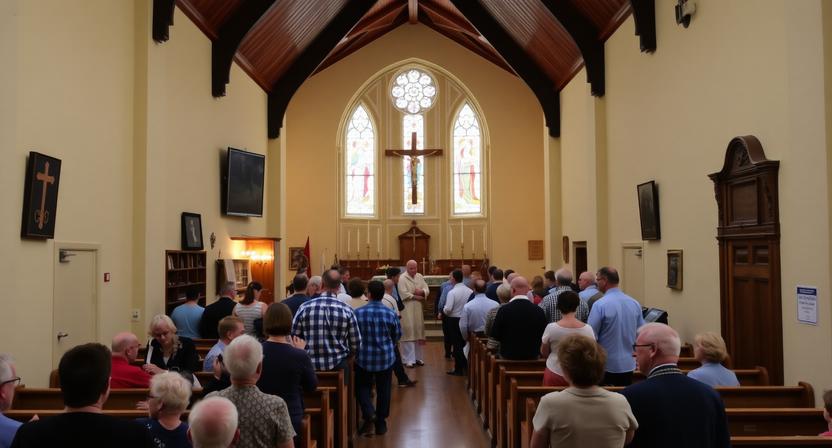
Every Sunday, across thousands of parishes throughout the world, the same mystery unfolds. A diverse group of people — young and old, prosperous and struggling, certain and doubting — gathers in the same building, around the same table, to hear the same Word and receive the same Eucharist. They did not choose each other. They were given to each other. This is what makes the parish unlike every other human community: it is a community of gift, not of preference.
The Second Vatican Council’s Lumen Gentium describes the Church as the People of God — a pilgrim community journeying through history toward the fullness of the Kingdom. The parish is where this grand theological vision becomes concrete and personal. It is where the sacraments are celebrated, where the poor are served, where children are formed in faith, where the grieving are accompanied, where the dying are anointed. It is the front line of the Church’s mission, and the primary community in which most Catholics will live their entire Christian lives.
“Where two or three gather in my name, there am I with them.” — Matthew 18:20
A Parish Homily, therefore, is never delivered into a vacuum. It is spoken to a specific community with a specific history, specific wounds, specific gifts, and a specific calling in a specific neighbourhood. The preacher who knows their parish — who has sat with their sick, celebrated their marriages, buried their dead, and baptised their children — preaches from a depth that no visiting preacher can replicate. This is the gift and the weight of parish preaching.
2 The History of Parish Preaching in the Catholic Tradition
Parish preaching has a long and rich history in the Catholic Church. The great patristic preachers — Augustine, Chrysostom, Gregory the Great — did not deliver their homilies in lecture halls or on broadcast media. They preached to their own congregations, people they knew by name, whose situations they understood, whose questions they were answering week by week. Augustine’s Sermones are famous precisely because they are so situational, so responsive to the lives of the people before him.
In the medieval period, the rise of the mendicant orders — the Dominicans and Franciscans — revitalised parish preaching, bringing the Gospel back to the people in their own languages and from their own experience. The Council of Trent, responding to the Reformation, mandated regular preaching in every parish — recognising that the parish pulpit was the primary means by which the faith was transmitted and renewed.
“Preach the word; be prepared in season and out of season; correct, rebuke and encourage — with great patience and careful instruction.” — 2 Timothy 4:2
The Second Vatican Council’s Sacrosanctum Concilium restored the homily to its proper place within the liturgy, describing it as part of the liturgical action itself — not an optional addition but an intrinsic element of the Sunday celebration. And Pope Francis, in Evangelii Gaudium, devoted an entire chapter to the art of preaching, calling the homily “the touchstone for judging a pastor’s closeness and ability to communicate to his people.” Good parish preaching, the Church insists, matters enormously.
3 Knowing Your People — The Preacher’s First Task
The first preparation for a Parish Homily is not exegesis. It is attention. The preacher who knows their congregation — who has spent time with them outside the liturgy, who has listened to their joys and their fears, who knows which families are struggling, which young people are searching, which elderly parishioners are lonely, which new arrivals are still finding their feet — that preacher has already done the most important homiletic work.
📖 A Story for the Homily
A newly ordained priest arrived at his first parish eager to preach profound, well-researched sermons. His first homily ran thirty-five minutes and covered three councils, two encyclicals, and the Greek etymology of five key words. The congregation was respectful but unmoved. An elderly deacon took him aside afterward and said gently: “Father, you preached to the Church you wish we were. Come and visit us in our homes. When you know who is sitting in those pews, you will know what to say.” The priest spent the next month in parishioners’ kitchens. His second sermon ran twelve minutes and three people wept. He had learned the first lesson of parish preaching: know your people.
Pope Francis describes the ideal preacher as one who has been “kissed by God” — who has had a genuine encounter with the living Christ — and who then goes to encounter the people with the same attentiveness that Christ showed to every person he met. The preacher stands in the middle: one foot in the Word, one foot in the lives of the people, building the bridge between them every week.
4 Scripture and the Parish — Lectio and Life Together
The Sunday Lectionary is one of the greatest gifts the Church has given to parish preaching. Over a three-year cycle, it exposes the community to the great sweep of Scripture — the Law and the Prophets, the Gospels and the Epistles, the Psalms and the wisdom literature. A parish community that has been faithfully preached to over decades has been formed by this great canon of Scripture in ways that are subtle, cumulative, and profound.
The art of the parish preacher is to bring the specific text of the day into conversation with the specific lives of the people before them. This requires both faithful exegesis — understanding what the text meant in its original context — and faithful application — discerning what God is saying through this text to this community, in this moment of their common life. Neither alone is sufficient. Exegesis without application is scholarship; application without exegesis is merely opinion.
“The word of God is alive and active. Sharper than any double-edged sword, it penetrates even to dividing soul and spirit, joints and marrow; it judges the thoughts and attitudes of the heart.” — Hebrews 4:12
Lectio Divina — the ancient practice of slow, prayerful reading of Scripture — can transform parish preaching when it becomes not merely the preacher’s private preparation but a shared practice of the community. Parishes that hold midweek Scripture groups, that practise shared reflection on the Sunday readings, that encourage families to read the Gospel at table before Sunday — these parishes come to Mass already in conversation with the Word, and the homily becomes the continuation of a dialogue rather than the start of one.
5 The Domestic Church and the Parish Church
The parish does not exist in isolation. It is a community of communities — a gathering of households, each of which is itself a “domestic church,” as Vatican II called the family. The Parish Homily serves both: it speaks to the gathered community in the pew, and it sends that community back to their homes with a word that will continue to form them in the week ahead.
This means the parish preacher must be attentive to the full range of family experience in the congregation. Married couples with young children hear differently from elderly widows. Young adults searching for faith hear differently from lifelong parishioners who have never questioned it. Immigrants far from home hear differently from families who have been in the parish for generations. The great gift of parish preaching is its breadth: to preach to all of these, with one voice, in one homily, in a way that each person receives something particular and personal.
“From him the whole body, joined and held together by every supporting ligament, grows and builds itself up in love, as each part does its work.” — Ephesians 4:16
6 Parish as School of Discipleship
The parish is, above all, a school of discipleship. It is where people learn what it means to follow Jesus — not in the abstract, not in theory, but in the concrete practicalities of ordinary life: how to forgive an injury, how to serve without recognition, how to pray when prayer feels empty, how to give generously when resources are tight, how to remain faithful when the culture pulls in the opposite direction.
The Parish Homily is the primary instrument of this formation. Week by week, the Sunday homily forms the congregation’s imagination — giving them images, stories, frameworks, and convictions that shape how they see the world and how they act in it. A parish that has been faithfully preached to over decades is a parish whose imagination has been shaped by the Gospel. This is a slow work, and an essential one.
“The Sunday homily is not a performance — it is the continuation of a formation that began at baptism and will end only at death.”
7 Preaching Through the Seasons of Parish Life
The parish has its own rhythms and seasons that layer over the liturgical calendar. There are times of growth and times of struggle. There are seasons of joy — First Communions, Confirmations, weddings, baptisms — and seasons of grief: the sudden death of a beloved parishioner, a scandal, a closure, a division. The parish preacher must be attentive to both the liturgical season and the parish season.
| Parish Season | Homiletic Focus | Key Scripture |
|---|---|---|
| Sacramental seasons (First Communion, Confirmation) | The grace of initiation; the call to deeper discipleship | John 6:35; Acts 2:1–4 |
| Times of grief or crisis | The presence of God in darkness; lament and hope | Psalm 22; Romans 8:38–39 |
| Stewardship season | Gratitude, generosity, and the theology of gift | 2 Corinthians 9:7; Luke 21:1–4 |
| Parish anniversary / founding | Gratitude for the past; vision for the future | Nehemiah 8; Revelation 21:1–5 |
| Times of division or difficulty | Unity, humility, the priority of communion | John 17:21; Ephesians 4:1–6 |
| Ordinary Time | The holiness of the everyday; discipleship as a way of life | Matthew 5:13–16; Colossians 3:17 |
8 When the Parish Struggles — Honest Homilies
One of the most demanding challenges of parish preaching is knowing what to say when the parish is in crisis. When a parish is facing financial difficulties, or conflict between factions, or the aftermath of a scandal, or the grief of sudden loss — the preacher cannot simply deliver a pre-planned homily as if nothing has happened. But neither can they allow the immediate crisis to swallow the Gospel entirely.
The great model here is the Book of Lamentations and the psalms of complaint — the tradition of honest, anguished, faith-filled prayer that does not pretend everything is fine, but does not abandon God either. A Parish Homily in difficult times can acknowledge the pain honestly, hold the community together, and point toward the God who is present in the darkness and working toward redemption even when we cannot see it.
“Even though I walk through the darkest valley, I will fear no evil, for you are with me; your rod and your staff, they comfort me.” — Psalm 23:4
9 The Parish and Mission — Sent from Here
The word “Mass” comes from the Latin missa — derived from the dismissal: “Ite, missa est” — “Go, the Mass is ended.” The parish is not a destination. It is a sending station. Every Sunday, the community gathers to be formed, nourished, and commissioned — and then sent back into the world as missionaries of the Kingdom of God. The Parish Homily should always carry this missionary thrust: not merely “What does this Gospel mean for our spiritual comfort?” but “What does this Gospel mean for how we live in the world this week?”
Pope Francis has repeatedly called the Church to move from a “pastoral of conservation” — maintaining what we have — to a “pastoral of mission” — going out to the peripheries, to those on the margins, to those who have never heard or who have stopped listening. The parish is the launch pad for this mission, and the Parish Homily is the fuel.
“As the Father has sent me, I am sending you.” — John 20:21
10 Seven Marks of an Excellent Parish Homily
After decades of reflection by preachers, theologians, and the faithful themselves, certain consistent qualities of excellent parish preaching emerge:
- Rooted in Scripture. The homily flows from the Word of God proclaimed in the Liturgy of the Word. The preacher has prayed with the text, not merely analysed it.
- Connected to the lives of the people. Abstract theology lands only when it touches real experience — the joys, fears, and questions the congregation carries through the door.
- Focused on one central idea. The best homilies say one thing well, not five things adequately. “What is the one thing I want this community to take away?”
- Illustrated with story. Jesus taught almost exclusively in parables. Stories unlock the heart in ways that propositions cannot. The preacher who tells good stories preaches memorable homilies.
- Appropriately brief. A homily is not a lecture. Eight to twelve minutes, well prepared, serves the assembly better than twenty-five minutes of improvisation.
- Spoken with conviction and joy. The preacher who has genuinely encountered the living Christ in the text will communicate that encounter — not through performance but through transparency.
- Ending with a call or an invitation. The best Parish Homily leaves the congregation with something to do, to pray, to practice, or to receive in the week ahead.
11 A Complete Parish Homily — Homily Text
The following is a complete homily text suitable for delivery at any Sunday parish Mass. Preachers are encouraged to adapt it to their own congregation, using concrete details from their own parish life.
There is a place I want to take you — not physically, but in your imagination. I want to take you back to the first parish. Not St Peter’s in Rome. Not the Cathedral. Something smaller and stranger than that.
It was an upper room in Jerusalem. Fifty days after Easter. A hundred and twenty people — not because they had been carefully recruited, but because Jesus had simply gathered them. Fishermen and former tax collectors. Women who had followed from Galilee. Brothers of Jesus who had not believed during his lifetime. Young people who had left everything, and old people who had waited a lifetime for this. They did not choose each other. They were given to each other. And when the wind came and the fire fell, they were made into a community.
That is the first parish.
“They devoted themselves to the apostles’ teaching and to fellowship, to the breaking of bread and to prayer… All the believers were together and had everything in common.” — Acts 2:42, 44
Every parish in the world is a descendant of that room. Every Sunday gathering — in a cathedral or a chapel, in a grand church or a corrugated-iron building, in a wealthy suburb or a remote village — is an echo of that first gathering. The same Spirit. The same Lord. The same Word. The same Bread. We are not a club. We are not a community organisation. We are the continued existence of that first astonishing community, in this place, in this time.
And what held that first community together — what holds every parish community together — is not that they liked each other, or that they agreed on everything, or that they had compatible personalities. What held them together was a shared encounter with the risen Christ. They had all been touched by the same fire. And that fire created fellowship — koinonia, in Greek — a word that means more than friendship: it means a shared participation in something divine.
Look around you. These are not people you chose. They are people you were given. The elderly woman three rows back who has been praying in this pew for sixty years. The young couple with the restless toddler who are not sure they believe but are here anyway, which is one of the bravest things a person can do. The teenager who came because their parents made them and who is, underneath the indifference, asking questions they don’t yet have words for. The man who has not been to Mass in twenty years and came back last month, quietly, and is sitting near the back just in case.
You did not choose them. God gave them to you. And he gave you to them.
“You are no longer foreigners and strangers, but fellow citizens with God’s people and also members of his household.” — Ephesians 2:19
The parish asks something of us that our culture finds almost impossible: to be in community with people we did not select, to stay when things are difficult, to give rather than consume, to be formed rather than merely to attend. This is counter-cultural. In a world where every experience can be personalised, every community self-selected, every relationship optimised — the parish stubbornly refuses to be any of these things. It is diverse because God is the one doing the gathering. It is imperfect because it is made of human beings. It is holy because Christ is the one who holds it together.
What is God calling this parish — our parish — to be? I believe he is calling us to be what that first community was: a community so marked by love that the world around them cannot explain it. “See how they love one another” was said of the early Christians as an observation, not just an aspiration. Is it said of us?
We leave this Mass today as we came: imperfect, searching, believing and struggling to believe. But we leave as a community. We leave sent. The Mass ends with a commissioning: “Go.” Not just go home. Go — into your neighbourhood, your workplace, your family, your street — as people who have been touched by fire, nourished by bread, and sent as Christ was sent: to gather the scattered, to serve the forgotten, and to love without distinction, as God loves us.
This is the parish. This is us. Thanks be to God. ✝
🙌 Closing Prayer for the Parish Community
Lord of the Church, Father of this household of faith — we thank you for the gift of this parish. For every person you have placed among us: the ones we find easy to love and the ones we find difficult. For the history of grace that has been lived within these walls. For the prayers that have been offered here, the tears that have been shed, the joy that has erupted, the faith that has been passed from generation to generation.
Renew your Spirit within us. Make us again what that first community was: devoted to your Word, faithful to the breaking of bread, committed to one another, and on fire for your mission in the world. Let this parish be a sign to its neighbourhood that another way of living is possible — a way marked by love, generosity, and the joy of people who know themselves to be yours.
Go before us, Lord, in everything we do this week. And bring us back — renewed, ready, grateful — to this table, next Sunday.
Amen. 🙌 ✝
More Homilies on HomilySunday.com
- Lenten Homily
- Mission Homily
- Eternal Life Homily
- Resurrection Homily
- Easter Homily
- Discipleship Homily
- Evangelization Homily
- Stewardship Homily
- Eucharist Homily
- Homily on Prayer
- Confirmation Homily
- Baptism Homily
- Hope Homily
- Peace Homily
- Healing Homily
- Gratitude Homily
- Courage Homily
- Saints Homily
- Sunday Homilies Year A
- 100 Homily Stories
✝ HomilySunday.com · Catholic Sunday Homily Resources · All rights reserved.
