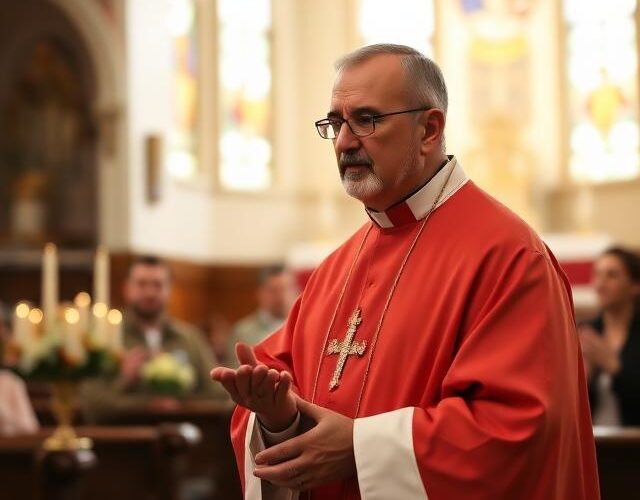
Catholic Homily on the Priesthood
“You are a priest for ever, in the order of Melchizedek.” — Psalm 110:4 | “The harvest is plentiful but the workers are few. Ask the Lord of the harvest, therefore, to send out workers into his harvest field.” — Matthew 9:37–38
The priest stands at the most extraordinary intersection in human experience: the place where heaven and earth meet, where the eternal touches time, where the sacred enters the ordinary. He is an ordinary man chosen, configured, and sent to do what no human being could do by natural power alone — to offer the Sacrifice of Calvary on an altar, to absolve sins in the name of Christ, to speak the Word of God to souls who are hungry, wounded, and seeking. A Homily on the Priesthood is not only for seminarians and priests — it is for every Catholic who has ever benefited from the ministry of a faithful priest, who prays for vocations, who has been baptised, forgiven, anointed, or fed at the altar. This page offers a complete, Scripture-rooted, theologically rich, and pastorally warm guide for preaching on the beauty, the cost, the grace, and the irreplaceable gift of the Catholic priesthood.
The Priesthood of Christ — The Foundation of All
Before any discussion of the Catholic ministerial priesthood can begin, one foundational truth must be established: there is only one priest in the full and eternal sense — Jesus Christ himself. The Letter to the Hebrews, which is the New Testament’s most sustained theology of priesthood, makes this emphatically clear. The entire sacrificial system of the Old Testament — the Levitical priesthood, the temple, the daily offerings and the great annual sacrifice of Yom Kippur — was a shadow, a type, a preparation pointing toward the reality that was to come. And that reality is Christ: “The High Priest who sat down at the right hand of the throne of the Majesty in heaven.” (Hebrews 8:1).
What makes Christ’s priesthood unique and unrepeatable is that he is simultaneously priest, victim, and altar. He offers himself. He is offered. And he is the sacred ground on which the offering takes place. “He sacrificed for their sins once for all when he offered himself.” (Hebrews 7:27). The Catholic ministerial priesthood does not add to this. It makes it present — drawing the one sacrifice of Calvary into the present moment of every Mass, in every church, across every century. The priest at the altar is not performing a new sacrifice. He is acting in persona Christi — in the person of Christ — making the one eternal sacrifice sacramentally real for the people gathered before him.
This is the first and most important word of a Priest Homily: before we speak of the men who are priests, we must speak of the One who is Priest. The beauty, the mystery, and the power of the ministerial priesthood is entirely derivative — it flows from and participates in the priesthood of Jesus Christ, and makes no sense apart from him.
Two Participations in Christ’s Priesthood — Common and Ministerial
The Second Vatican Council’s teaching on priesthood introduced a clarity that had sometimes been obscured in popular understanding: there are two distinct but related ways in which the faithful share in the one priesthood of Christ. The Council declared: “The common priesthood of the faithful and the ministerial or hierarchical priesthood are nonetheless interrelated: each of them in its own special way is a participation in the one priesthood of Christ.” (Lumen Gentium §10).
| The Common Priesthood | The Ministerial Priesthood |
|---|---|
| Received by all the faithful at Baptism — the royal priesthood of 1 Peter 2:9. | Received through the Sacrament of Holy Orders — a specific, sacramental configuration to Christ the Head. |
| Exercised by offering one’s life, work, prayer, and suffering in union with Christ’s sacrifice. | Exercised by offering the Eucharistic Sacrifice, administering sacraments, and proclaiming the Gospel with authority. |
| Directed primarily toward the sanctification of the world through Christian living. | Directed primarily toward the service of the common priesthood — building it up, feeding it, and leading it toward God. |
| Permanent and indelible — the baptismal character cannot be removed. | Also permanent and indelible — the priestly character remains even if a priest is laicised or suspended. |
| Shared by every baptised person without exception — lay, religious, ordained. | Shared only by those who have received Holy Orders — deacons, priests, and bishops. |
This distinction matters enormously for a Priest Homily — because it locates the ministerial priesthood not above the laity but at their service. The priest is ordained for the people, not above them. His unique sacramental powers exist to build up, nourish, and sanctify the common priesthood of the baptised. Without the laity’s priesthood, the ministerial priesthood has no one to serve. Without the ministerial priesthood, the laity’s priesthood lacks the sacramental nourishment it needs to thrive. The two are inseparable and mutually dependent.
In Persona Christi — The Most Extraordinary Claim
Of all the theological concepts surrounding the Catholic priesthood, none is more important or more astonishing than in persona Christi Capitis — “in the person of Christ the Head.” This phrase, developed through centuries of theological tradition and given definitive expression in the documents of the Second Vatican Council and the Catechism, describes what happens when a priest celebrates the sacraments — particularly the Eucharist and Reconciliation.
When the priest says “This is my Body” at the consecration, he does not say it in his own name. He speaks in the name and in the person of Christ. The words are Christ’s words, spoken through the priest’s voice, by the power of the Holy Spirit, making present what they signify. Similarly, when the priest says “I absolve you” in the confessional, the absolution is Christ’s — the priest is the instrument, the voice, the human channel through which the mercy of the Risen Lord reaches the penitent soul. This is why the priestly character is indelible: the configuration to Christ given in Holy Orders is not a function that can be switched off. It is a permanent transformation of the man who receives it.
St. John Vianney — the Curé of Ars — is said to have told his parishioners: “If you met a priest and an angel at the same time, you should greet the priest before the angel. The angel is a friend of God, but the priest stands in God’s place. The angel could not give you Holy Communion; the priest can.”
This is not a claim about the holiness of the individual man — some priests are sinners, as the Church has painfully acknowledged. It is a claim about the sacramental reality given in Holy Orders: that God, in his wisdom and humility, has chosen to act through human instruments, however imperfect, so that grace might reach human beings in a fully human way.
The Three Munera — Priest, Prophet, and King
The ordained ministry of the priest is traditionally understood through three offices — or munera — which mirror the three-fold office of Jesus Christ himself: priest, prophet, and king. Together, they describe the full scope of what an ordained minister is called to be and do.
The priest’s most distinctive function: offering the Eucharistic Sacrifice, administering the sacraments, presiding at liturgy. Through these acts, he channels the grace of Christ to the faithful — most fully in the Eucharist, where he makes present the one sacrifice of Calvary, and in Reconciliation, where he pronounces Christ’s absolution over penitent souls.
The priest is called to proclaim the Word of God — in the homily, in catechesis, in personal counsel, in the example of his life. He does not speak his own wisdom but the wisdom of the Gospel, interpreting Scripture and Tradition for the people of his time. The homily is his primary prophetic act, Sunday by Sunday.
The priest exercises a form of governance — not as a lord but as a servant. “Whoever wants to become great among you must be your servant.” (Matthew 20:26). He leads the community entrusted to him, makes decisions for its welfare, and is accountable to God and to the Church for the souls in his care. His governing is always service.
These are not three separate jobs but three dimensions of one calling — as inseparable as the three Persons of the Trinity, whose image the priest is called to reflect in his ministry. A priest who teaches but does not sanctify has words without bread. A priest who sanctifies but does not govern leaves his flock without direction. All three must be lived together.
The Call — How God Chooses His Priests
“No one takes this honour on himself, but he receives it when called by God, just as Aaron was.” (Hebrews 5:4). The Catholic theology of priestly vocation is clear: a man does not decide to become a priest the way he decides to become a doctor or a lawyer. He is called — by God, through the Church — and his task is to discern that call and respond to it with freedom and generosity. The call may come through many channels: a word from a trusted priest, a moment of grace in prayer, a growing interior conviction, the encouragement of a parent or teacher, the witness of a holy life.
Jesus’s call of the first disciples is the model for every priestly vocation: “Come, follow me” (Matthew 4:19) — personal, urgent, requiring the leaving of nets and boats and father. The seminarian’s years of formation are the extended process of discerning whether the call is genuine, deepening the response, and receiving the theological, spiritual, and human formation that priestly ministry requires. The Church’s role in vocation is not to manufacture priests but to recognise, test, and form those whom God has already called. Every vocation is ultimately God’s initiative — the Church responds to it, she does not create it.
The prayer for vocations — which Jesus himself commanded — is not a passive exercise. It is an active participation in God’s work of calling men to the priesthood. Every family that prays for vocations, every young person who takes the question of a priestly calling seriously, every parish community that creates an environment where holiness is visible and the priesthood is honoured — is cooperating with God’s work of raising up the workers the harvest needs. The Confirmation Homily addresses every young person’s call to mission. This homily asks a more specific question: could God be calling you to serve him as a priest?
Celibacy — The Sign of Total Gift
Of all the aspects of priestly life that the world finds most difficult to understand, celibacy is foremost. In a culture that regards the capacity for romantic and sexual partnership as essential to full human flourishing, the choice to forego marriage for the sake of the Kingdom seems at best eccentric and at worst psychologically dangerous. The Church’s theology of priestly celibacy offers a different account — one that must be preached clearly and compassionately, especially to congregations where this is a source of confusion or criticism.
Jesus himself gave the foundational teaching on celibacy for the Kingdom: “There are those who have renounced marriage because of the kingdom of heaven. The one who can accept this should accept it.” (Matthew 19:12). Celibacy is not a rejection of human love or an assertion that marriage is inferior. It is a sign — a particular, visible, embodied sign — of the Kingdom of God. The celibate priest points to a love that is not limited to one person but offered to all; a life not divided between family and ministry but given entirely to both; a relationship with God that is lived as the primary, most intimate relationship of a human life. He is, as Pope St. John Paul II described, “a living sign of the future Kingdom of God.”
Celibacy is not a guarantee of holiness, and its abuse has caused real harm — as the Church has painfully acknowledged. But lived with integrity, it is one of the most powerful signs available in the modern world: that there is a love beyond the human, a Kingdom beyond the present age, and a God whose claim on a human life is total enough that a man would give everything else up for it.
The Priest at Prayer — The Interior Life as Foundation
A priest who does not pray is a contradiction in terms. His entire ministry — the Mass, the sacraments, the homily, the pastoral care — flows from and depends upon his personal relationship with the God he serves. Without an interior life, the external ministry becomes hollow: beautiful in form, empty in power. The great tradition of priestly spirituality is unanimous on this point: the priest must be, first and foremost, a man of prayer. Not because prayer is one duty among many but because it is the source from which all the others draw their life.
The Liturgy of the Hours — the Divine Office — is the Church’s daily prayer, prayed by priests and religious across the world in rhythmic waves through every hour of every day. By praying the Hours, the priest joins his voice to the prayer of the whole Church — sunrise, morning, midday, evening, night — sanctifying time itself and maintaining the unbroken conversation with God that his vocation demands. The Homily on Prayer explores the depths of Christian prayer. For the priest, this is not merely a spiritual practice — it is a professional obligation and a personal lifeline.
The Curé of Ars regularly slept only three to four hours a night in order to spend more time in prayer before the Blessed Sacrament and in the confessional. Pilgrims came from across France and beyond to confess to him — at the height of his ministry, he spent up to eighteen hours a day in the confessional. When asked the secret of his extraordinary effectiveness, he said simply: “The priesthood is the love of the heart of Jesus.”
His life demonstrated something the whole Church needs to hear: the effectiveness of a priest’s ministry is not primarily a function of his talent, education, or personality. It is a function of his holiness — and holiness is formed in prayer.
The Wounds of the Priesthood — Honest Pastoral Realities
Any Priest Homily that presents only the beauty and glory of the priesthood without engaging its wounds and difficulties will ring false to most of its listeners — and to most priests themselves. The last decades have been among the most painful in the Church’s history, as the full extent of clerical sexual abuse and its institutional mishandling has come to light. A homily that does not acknowledge this reality, even briefly and honestly, will lose credibility before it gains it.
The abuse crisis has caused enormous harm — to the survivors, whose suffering must be named and whose dignity must be restored; to the faithful, whose trust in the institution was betrayed; and to the many faithful priests whose honourable lives have been shadowed by the sins of others. The Church’s response must be — and increasingly is — accountability, transparency, genuine reform, and unwavering commitment to the protection of the vulnerable. These are not merely administrative responses. They are Gospel imperatives: “Whoever causes one of these little ones who believe in me to stumble, it would be better for them to have a large millstone hung around their neck and to be drowned in the depths of the sea.” (Matthew 18:6).
Beyond the crisis, priests face many other challenges — loneliness, the weight of pastoral responsibility, the demands of a vocation that has no off-duty hours, the struggle to maintain an interior life amid constant external demands, the difficulty of exercising authority in a culture that is suspicious of all authority. These wounds are real, and they call for the prayer, the support, and the genuine care of the whole community. A priest who knows his people are praying for him is a different man from one who feels alone.
The Good Shepherd — Jesus’s Own Image of Priesthood
When Jesus chose an image to describe his own priestly ministry, he did not choose a king on a throne, a judge on a bench, or a professor at a lectern. He chose a shepherd. “I am the good shepherd. The good shepherd lays down his life for the sheep.” (John 10:11). This image of shepherd — with all its implications of intimate knowledge, patient care, courageous defence, and willingness to suffer for the flock — is the primary image of priestly ministry in the Gospel tradition.
The shepherd of John 10 knows his sheep by name. He calls them and they recognise his voice. He goes ahead of them into danger. He searches for the lost one — leaving the ninety-nine — until he finds it. And when the wolf comes, unlike the hired hand who runs, the good shepherd stands his ground and lays down his life. This is the model of priestly ministry that Jesus himself proclaimed and embodied — and it is radically different from the model of institutional management or professional service that the world might offer. The priest is not a service provider. He is a shepherd — called to know his flock, to love them at personal cost, and to give his life for their welfare.
Holy Orders — The Sacrament That Configures
The Sacrament of Holy Orders — received through the laying on of hands by a bishop, accompanied by the consecratory prayer — is the moment at which a man is not merely given a new role but undergoes a new ontological reality. The Catechism teaches: “Holy Orders is the sacrament through which the mission entrusted by Christ to his apostles continues to be exercised in the Church until the end of time.” (§1536). And: “The ordained minister is, as it were, an ‘icon’ of Christ the Priest.” (§1142).
The laying on of hands — the essential gesture of Holy Orders — connects the ordained priest to an unbroken chain of ordinations stretching back through every generation of the Church to the Apostles themselves, who received their commission from the Risen Christ on Easter Sunday. When a bishop lays hands on a man today, he is transmitting something given to the Apostles, handed on by their successors, guarded and transmitted across two thousand years and every culture on earth. The continuity of apostolic succession is not merely historical — it is sacramental, and it is the guarantee that the Church’s ministry today is the ministry that Christ established and entrusted to his Apostles.
Great Priest-Saints — Lives That Illuminate the Vocation
The most compelling Priest Homily draws its power from the lives of priests who have lived the vocation with extraordinary faithfulness — showing that it is genuinely possible, genuinely beautiful, and genuinely transformative of the lives they touch.
Failed his seminary exams repeatedly, was barely literate in Latin, and was given the most obscure parish in France. He transformed the village of Ars through prayer, penance, and an extraordinary gift for the confessional. People travelled for days to have him hear their confession. He spent up to eighteen hours a day in the confessional for thirty years. Patron of all parish priests. Feast: August 4.
The Franciscan friar from San Giovanni Rotondo who bore the stigmata for fifty years, exercised the gifts of bilocation and reading of souls, and drew millions to Confession. His confessional queues stretched for weeks. He founded a hospital for the sick and suffering. He told his spiritual children: “Pray, hope, and don’t worry.” Canonised 2002.
A Polish Franciscan priest who volunteered to die in place of a stranger — Francis Gajowniczek, a married man with children — in the starvation bunker of Auschwitz in 1941. He led his fellow prisoners in prayer and singing until his death. His sacrifice is one of the most perfectly priestly acts in modern history: laying down his life for another, freely and completely. Canonised 1982.
A Mexican Jesuit who ministered underground during the Cristero persecution when priests were hunted by the government. Disguised as a mechanic, a street vendor, a businessman, he continued to celebrate Mass, hear confessions, and bring communion to Catholics. Executed by firing squad in 1927. His last words: “Viva Cristo Rey!” — “Long live Christ the King.” Beatified 1988.
Praying for Priests — The Congregation’s Sacred Duty
One of the most immediately practical and most urgently needed dimensions of a Priest Homily is the call to prayer for priests. Jesus himself commanded it: “The harvest is plentiful but the workers are few. Ask the Lord of the harvest, therefore, to send out workers into his harvest field.” (Matthew 9:37–38). The prayer for vocations is not an optional pious exercise — it is a direct command of the Lord, addressed to every baptised Christian.
But beyond praying for new vocations, the congregation is called to pray for the priests they already have — for their holiness, their perseverance, their joy, their protection from temptation, their fidelity to their calling. A priest who is prayed for is different from one who is not. The prayers of his people surround and support him in the invisible but real economy of grace that underlies all pastoral ministry. St. John Vianney said that the devil was more afraid of a holy priest than of anything else — and that the devil’s primary target was always the priest, because if he could corrupt the shepherd, the flock would scatter. The prayer of the faithful for their priests is not a gesture of sentiment. It is an act of spiritual warfare on behalf of the whole Church.
A practical suggestion for any Priest Homily: invite the congregation to commit to praying for one priest by name — their pastor, a priest who influenced their life, a missionary, a prison chaplain — every day for one month. This simple practice, multiplied across a congregation, creates a network of intercession that quietly sustains the ministry of the Church in ways that will only be fully visible in eternity.
The Joy of the Priesthood — A Vocation Worth Living
A Priest Homily that speaks only of the cost and the wounds of the priesthood without speaking of its joy is incomplete — and unfair to the thousands of priests who live their vocation with profound fulfilment, deep happiness, and a sense of privilege that no external difficulty can extinguish. Pope St. John Paul II, in his 1992 apostolic exhortation Pastores Dabo Vobis (I Will Give You Shepherds), wrote with passion about the “joy of the priesthood” — not a naive joy that ignores difficulty but a deep, theological joy grounded in the privilege of participating in the ministry of Christ himself.
A priest who celebrates Mass daily — who holds in his hands the Body and Blood of Christ, who speaks the words of consecration, who distributes communion to the faithful — is doing something that angels cannot do. A priest who pronounces absolution over a weeping penitent is channelling the mercy of God directly into a human soul. A priest who anoints the dying is accompanying a soul through the most important threshold of its existence. A priest who baptises a child is welcoming a new member into the eternal family of God. These are not merely duties. They are astonishing privileges — and no priest of genuine faith can perform them without being, at some level, overwhelmed by the grace of what he has been given.
How the Faithful Can Support Their Priests — A Practical Guide
A Priest Homily is not complete without a practical call to action for the congregation. Here is a guide for how the faithful can actively support, pray for, and encourage the priests in their lives.
-
1
Pray for your priest by name — daily. The single most important thing a parishioner can do for their priest is pray for him. By name. Every day. For his holiness, his health, his joy, his faithfulness, and his protection from every temptation and discouragement that seeks to diminish his ministry.
-
2
Thank your priest — specifically and sincerely. Priests are rarely thanked. A brief, genuine word of thanks after Mass, a note of appreciation for a homily that moved you, a card on the anniversary of his ordination — these small acts of recognition carry more weight than most lay people realise. They remind a priest why he does what he does.
-
3
Pray for vocations — as Jesus commanded. Pray by name for young men in your family and parish who might be called. Create a parish culture where the priesthood is honoured, where vocations are expected, and where young people can see that the life of a priest is a life worth living.
-
4
Support your priest’s humanity. Invite him occasionally to a family meal. Remember that he is a human being who gets tired, lonely, and discouraged. Practical support — help with parish tasks, bringing a meal during a difficult season, offering to assist with projects — is one of the most concrete expressions of lay solidarity with the ordained ministry.
-
5
Be a good parishioner. Attend Mass faithfully. Go to Confession. Participate actively in the liturgy. Give financially, generously, and proportionately. Volunteer. Engage with the parish community. A priest whose parishioners are actively, faithfully engaged is a priest who is energised rather than drained by his ministry.
-
6
Defend priests who are unjustly accused. In the current climate, priests are sometimes subjected to unfair suspicion or public criticism. While genuine abuse must always be reported and addressed through proper channels, the faithful can play a role in creating a culture of fair witness — neither naively defensive nor reflexively suspicious.
-
7
Support seminarians and priestly formation. If your diocese has a seminary, consider contributing financially to the education and formation of future priests. Consider hosting a seminarian for a meal or a day of pastoral experience. The priests of the next generation are being formed now — and the faithful’s support for that formation is a direct investment in the future of the Church.
The Eternal Priesthood — Until He Comes Again
Every time a priest celebrates Mass, he proclaims the death of the Lord until he comes again (1 Corinthians 11:26). The priesthood is not a permanent feature of eternal life — in heaven, there will be no need for sacraments, because we will see God face to face. The ministerial priesthood is a provision for the age of pilgrimage — given by Christ to his Church to sustain her on the road, to feed her with his Body and Blood, to forgive her sins, to anoint her dying, to bless her unions and her children, to preach the Word that lights the path through the dark.
Until that day when the Lord returns and faith is replaced by vision, the priest stands at the altar of the world — imperfect, human, sometimes struggling, sometimes soaring — and does what no other human being can do: he makes Christ present. In bread and wine. In words of absolution. In the blessing of a child’s head, the anointing of a dying man’s forehead, the gentle counsel of a confessor who has sat and listened through ten thousand hours of human frailty and never ceased to believe that grace is greater than sin. The priesthood is not a career. It is a vocation. It is not a profession. It is a participation in the eternal priesthood of the Son of God. And the Church — wounded, beautiful, imperfect, beloved — cannot live without it.
Pray for your priests. Thank them. Support them. And if you feel, in some deep and quiet corner of your heart, a stirring — an inexplicable draw toward the altar, toward the confessional, toward the life of a man given entirely to God and his people — do not dismiss it. That stirring may be the voice of the Lord of the harvest, calling one more worker into his field. ✝ 🕯️
“Lord, Give Us Holy Priests”
Lord Jesus Christ, eternal High Priest — you who chose twelve ordinary men and sent them to the ends of the earth, you who breathed the Holy Spirit upon them and said “Receive the Holy Spirit; whose sins you forgive are forgiven” — look upon your Church today with the same mercy, the same generosity, the same inexhaustible desire to give yourself to your people.
Give us holy priests. Give us men who pray before they speak and love before they lead. Give us shepherds who know their sheep by name, who enter the dark valleys with them, who stand their ground when the wolf comes. Give us confessors who are patient with human weakness because they know their own. Give us preachers who have spent time with you before they climb the steps to the ambo. Give us priests who live their celibacy as a sign of the Kingdom and their obedience as an act of love.
And grant that the faithful people you have given to these priests might love them well — praying for them daily, forgiving their failures, honouring their vocation, and raising up among their own children the next generation of workers for your harvest. Until the day when the harvest is complete, the workers are home, and the eternal Priest reigns in the joy of his Kingdom without end.
Amen. ✝ 🕯️
Trusted External Resources for a Priest Homily
- Pastores Dabo Vobis — John Paul II on Priestly Formation and Identity (Vatican.va)
- Catechism of the Catholic Church — On Holy Orders §1536–1600 (Vatican.va)
- USCCB Online Bible — All Scripture passages referenced
- USCCB — Vocations Resources: Praying and Fostering Priestly Vocations
- Letter Proclaiming the Year for Priests — Pope Benedict XVI, 2009 (Vatican.va)
- Directory on the Ministry and Life of Priests — Congregation for the Clergy (Vatican.va)
More Homilies on HomilySunday.com
- Discipleship Homily
- Faith Homily
- Homily on Prayer
- Humility Homily
- Homily on God’s Mercy
- Divine Mercy Homily
- Homily on Forgiveness
- Homily on the Holy Spirit
- Family Homily
- Children’s Homily
- Confirmation Homily
- Baptism Homily
- Healing Homily
- Wedding Homily
- Funeral Homily
- Youth Homily
- Marian Homily
- Sunday Homilies Year A
- Sunday Homilies Year B
- 100 Homily Stories
