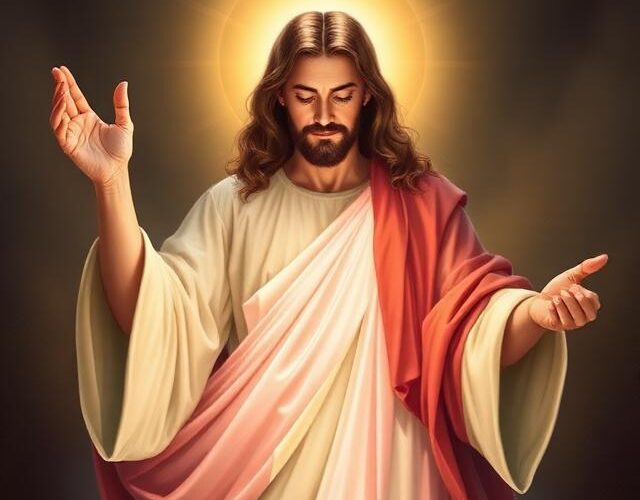
Catholic Divine Mercy Homily
“Jesus, I Trust in You.”
“Blessed are the merciful, for they will be shown mercy.” — Matthew 5:7 | “His mercy endures forever.” — Psalm 136:1
Divine Mercy is not merely a devotion — it is the heart of the Gospel itself. In the 1930s, through a humble Polish nun, Jesus chose to remind a suffering world of the truth that has always been at the centre of the Christian faith: that no sin is greater than God’s mercy, that no soul is beyond the reach of his love, and that the ocean of grace flowing from his pierced Heart is available to every human being who turns toward him with even the smallest flicker of trust. A Divine Mercy Homily speaks to the deepest longing of every human heart — the longing to be truly, completely, permanently forgiven and loved. This page offers a complete, Scripture-rooted, theologically rich, and pastorally warm guide for preaching on Divine Mercy: its origins, its message, its practices, and its inexhaustible relevance for our time.
What Is Divine Mercy? — The Ancient Gospel, Newly Proclaimed
Before we speak of devotion, images, chaplets, or feast days, we must begin with the theological foundation: Divine Mercy is not a new doctrine. It is the oldest truth in the Gospel — the truth that God’s love for humanity is not earned, not conditional, and not exhausted by any human failure. What the Divine Mercy revelation given to St. Faustina Kowalska in the 1930s accomplished was not the introduction of something new but the vivid, urgent, personalised re-proclamation of the most ancient Christian truth to a world drowning in war, suffering, and despair.
The word Jesus used most frequently in his revelations to Faustina — mercy — is the New Testament rendering of the Old Testament hesed: God’s covenantal, loyal, inexhaustible love. It is the attribute God chose to name first when he revealed himself to Moses: “The LORD, the LORD, the compassionate and gracious God, slow to anger, abounding in love and faithfulness.” (Exodus 34:6). It is the refrain of Psalm 136, repeated in every single verse: “His mercy endures forever.” It is the word on the lips of the blind, the sick, the outcast, and the dying throughout the Gospels: “Lord, have mercy.” Divine Mercy is not a Polish devotion. It is the heartbeat of the entire Christian faith.
A Divine Mercy Homily sits at the very centre of what the Homily on God’s Mercy explores theologically. This page goes deeper into the specific revelation, devotion, and practical life of Divine Mercy as the Church has received and celebrated it — and invites every listener to open their heart to an ocean of grace that has no bottom.
St. Faustina Kowalska — The Apostle of Divine Mercy
Helena Kowalska was born on August 25, 1905, the third of ten children in a poor farming family near Łódź, Poland. She received only three years of formal education. At the age of twenty, she entered the Congregation of the Sisters of Our Lady of Mercy in Warsaw — taking the name Sister Maria Faustina. She spent the remaining thirteen years of her life in quiet, hidden service: as cook, gardener, and doorkeeper at various convents. She died of tuberculosis on October 5, 1938, at the age of thirty-three.
By every outward measure, she was unremarkable. By the measure of what God chose to do through her, she became one of the most significant spiritual figures of the twentieth century. Between 1931 and 1938, Sister Faustina received a series of visions of Jesus Christ, in which he revealed to her his desire to make his mercy known to the whole world in a new and urgent way — calling her to be the secretary and apostle of this message. She recorded everything in her spiritual diary, known as Divine Mercy in My Soul — a work that runs to nearly 700 pages and has been translated into more than twenty languages.
On the evening of February 22, 1931, in her cell in Płock, Poland, Sister Faustina received a vision of Jesus dressed in a white garment. From his Heart flowed two rays of light — one red, one pale. He spoke to her: “Paint an image according to the pattern you see, with the signature: Jesus, I trust in you. I desire that this image be venerated, first in your chapel, and then throughout the world.”
She later asked Jesus what the two rays meant. He replied: “The two rays denote Blood and Water. The pale ray stands for the Water which makes souls righteous. The red ray stands for the Blood which is the life of souls. These two rays issued forth from the very depths of my tender mercy when my agonised Heart was opened by a lance on the Cross.” (Diary §299)
The Divine Mercy Image — Every Detail Is Theology
At Jesus’s request, Sister Faustina worked with painters (first Adolf Hyła, then others) to produce the image he had shown her. She found it difficult — no earthly image could capture what she had seen — and is said to have wept, saying: “Who will paint you as beautiful as you are?” Jesus consoled her: “Not in the beauty of the colour, nor of the brush, lies the greatness of this image, but in my grace.” The image that emerged, and is now venerated across the world, is one of the most theologically rich visual objects in the history of Christian art.
| Element of the Image | Theological Meaning | Scriptural Root |
|---|---|---|
| White garment | The Risen Christ — resurrected, glorious, living. Not the suffering Christ of the Passion but the victorious Christ who has passed through death. | Matthew 17:2 — Transfiguration; Revelation 1:13 |
| Red ray | The Blood of Christ — his sacrifice on the Cross, the source of the sacramental life of the Church, the life of souls. | John 19:34 — blood from his pierced side |
| Pale (white/blue) ray | The Water that flowed from his side — Baptism, grace, the Holy Spirit, the righteousness given to souls. | John 19:34; John 7:38 — rivers of living water |
| Right hand raised in blessing | Christ bestowing grace on all who come to him in trust. The gesture of priestly blessing and divine gift. | Luke 24:50 — Jesus blessing as he ascended |
| Gaze directed at the viewer | Jesus looks at each person individually — this mercy is personal, not generic. He sees you, specifically. | John 1:42 — “Jesus looked at him”; Luke 22:61 |
| Inscription: “Jesus, I Trust in You” | The condition for receiving mercy — not worthiness but trust. The entire spiritual posture required: open hands, open heart, trust. | Psalm 56:3 — “When I am afraid, I put my trust in you” |
Jesus promised extraordinary graces to those who venerate this image with trust: “I promise that the soul that will venerate this image will not perish. I also promise victory over its enemies already here on earth, especially at the hour of death. I myself will defend it as my own glory.” (Diary §48).
The Chaplet of Divine Mercy — Praying with the Church
On September 13, 1935, Sister Faustina received the Chaplet of Divine Mercy from Jesus himself — a prayer to be said on ordinary rosary beads, interceding for the world and for the dying. Jesus attached extraordinary promises to this prayer, particularly for those at the hour of death. The Chaplet is now one of the most widely prayed devotional prayers in the Catholic Church, prayed daily by millions across the world.
How to Pray the Chaplet of Divine Mercy
-
Begin with an optional opening prayer:
“You expired, Jesus, but the source of life gushed forth for souls, and the ocean of mercy opened up for the whole world. O Fount of Life, unfathomable Divine Mercy, envelop the whole world and empty yourself out upon us.” (×3) “O Blood and Water, which gushed forth from the Heart of Jesus as a fount of mercy for us, I trust in you!”
-
Our Father, Hail Mary, The Apostles’ Creed
One each, on the large bead before the decades.
-
On each large (Our Father) bead:
“Eternal Father, I offer you the Body and Blood, Soul and Divinity of your dearly beloved Son, our Lord, Jesus Christ, in atonement for our sins and those of the whole world.”
-
On each of the 10 small (Hail Mary) beads:
“For the sake of his sorrowful Passion, have mercy on us and on the whole world.”
- Repeat for five decades.
-
Conclude with (×3):
“Holy God, Holy Mighty One, Holy Immortal One, have mercy on us and on the whole world.”
-
Optional closing prayer:
“Eternal God, in whom mercy is endless and the treasury of compassion inexhaustible, look kindly upon us and increase your mercy in us, that in difficult moments we might not despair nor become despondent, but with great confidence submit ourselves to your holy will, which is Love and Mercy itself.”
Jesus told Faustina: “Whoever will recite it will receive great mercy at the hour of death. When they say this chaplet in the presence of the dying, I will stand between my Father and the dying person, not as the just Judge but as the merciful Saviour.” (Diary §811).
The Hour of Mercy — Three O’Clock
One of the most distinctive elements of the Divine Mercy devotion is the Hour of Mercy — three o’clock in the afternoon, the traditional hour of Jesus’s death on the Cross. Jesus asked Faustina to immerse herself in his Passion at this hour, particularly in his abandonment at the moment of agony, and promised extraordinary grace to any soul who turned to him at this hour.
“I remind you, my daughter, that as often as you hear the clock strike the third hour, immerse yourself completely in my mercy, adoring and glorifying it; invoke its omnipotence for the sinners, especially for those who are dying on this day. In this hour, you can obtain everything for yourself and for others for the asking; it was the hour of grace for the whole world — mercy triumphed over justice.”
The suggested prayer for this hour is simple: “You expired, Jesus, but the source of life gushed forth for souls, and the ocean of mercy opened up for the whole world… O Fount of Life, unfathomable Divine Mercy, envelop the whole world and empty yourself out upon us.” It is a moment to pause — in the middle of an ordinary afternoon — and remember that at this same hour, on a Friday outside Jerusalem, God was dying for love of the world. Preaching this hour to a congregation connects the devotion to the rhythm of daily life in a powerful and practical way.
Divine Mercy Sunday — The Feast of All Feasts
One of Jesus’s central requests to Faustina was the establishment of a Feast of Divine Mercy on the Sunday after Easter — what the Church calls the Second Sunday of Easter. He promised extraordinary graces for this day — graces so extraordinary that Faustina recorded Jesus’s own words about it with awe: “I desire that the Feast of Mercy be a refuge and shelter for all souls, and especially for poor sinners. On that day the very depths of my tender mercy are open. I pour out a whole ocean of graces upon those souls who approach the fount of my mercy.” (Diary §699).
After decades of ecclesiastical caution — the devotion was initially suppressed by the Vatican in 1959 before being formally rehabilitated in 1978 — Pope St. John Paul II, himself deeply devoted to Divine Mercy, officially established Divine Mercy Sunday as a universal feast of the Catholic Church on April 30, 2000, when he canonised St. Faustina in Rome. In his homily that day, he declared: “It is important that we accept the whole message that comes to us from the word of God on this Second Sunday of Easter, which from now on throughout the Church will be called ‘Divine Mercy Sunday’.”
The Gospel for Divine Mercy Sunday — John 20:19–31 — is the account of the Risen Christ appearing to the disciples and breathing the Holy Spirit upon them: “Receive the Holy Spirit. If you forgive anyone’s sins, their sins are forgiven.” (John 20:22–23). This is the institution of the Sacrament of Reconciliation — mercy made personal, audible, certain. Divine Mercy Sunday and the Confessional are inseparable.
The Message of Divine Mercy — What Jesus Wanted the World to Know
At the heart of all the visions, images, prayers, and devotional practices lies a message of breathtaking simplicity and infinite depth. Jesus expressed it to Faustina in many ways, across many years of visions. The core can be summarised in three inseparable movements — what theologians of the devotion have called the three aspects of the Divine Mercy message:
God’s mercy is the greatest attribute of his nature. It is available to every soul, without exception, no matter how grave the sin. The only condition is genuine trust. “The greater the sinner, the greater the right he has to my mercy.” (Diary §723). No sin outweighs the ocean of mercy Christ offers.
Jesus asks us to approach the throne of grace with confidence — for ourselves and as intercessors for the whole world. The Chaplet, the Hour of Mercy, and the Novena are all forms of this intercession. We are invited to bring every soul — the dying, the despairing, the lukewarm, the greatest sinners — to the font of mercy.
“I am giving you three ways of exercising mercy toward your neighbour: the first — by deed, the second — by word, the third — by prayer. In these three degrees is contained the fullness of mercy, and it is an unquestionable proof of love for me.” (Diary §742). Divine Mercy received must become Divine Mercy given.
Trust is the key that unlocks the treasury of Divine Mercy. Not confidence in our own merit — which we do not have. Not certainty that we deserve mercy — which we do not. But trust in him — in his promise, his love, his power to save. These four words are the whole spiritual life in miniature.
Divine Mercy and the Cross — The Fountain That Never Runs Dry
The theological foundation of Divine Mercy is the Cross of Jesus Christ. The two rays in the image — red and pale — flow from the wound in his side: “One of the soldiers pierced Jesus’s side with a spear, bringing a sudden flow of blood and water.” (John 19:34). The Church Fathers saw in this wound the birth of the Church and the source of the sacraments — Baptism (water) and the Eucharist (blood). Faustina’s revelation makes this ancient insight vivid and personal: from the pierced Heart of Christ flows an ocean of mercy that has no bottom and no end.
St. John Paul II, in his encyclical Dives in Misericordia (Rich in Mercy, 1980), wrote that the Cross is “the most profound condescension of God to man and to what man — especially in difficult and painful moments — looks on as his unhappy destiny.” On the Cross, divine mercy and divine justice were not in tension — they were reconciled, in the one body of the Son of God, forever. The Cross is not a display of God’s anger toward sinners. It is the most extreme act of love in human history — God absorbing the consequence of human sin so that humanity could be freed from it.
A Divine Mercy Homily rooted in the Cross connects naturally with the Homily on Forgiveness — because the forgiveness that God offers is not cheap, not casual, not indifferent to the reality of sin. It cost everything. And because it cost everything, it is offered freely, to everyone, without remainder.
St. John Paul II and Divine Mercy — A Personal Bond
No figure in the twentieth century was more responsible for the worldwide spread of the Divine Mercy devotion than Pope St. John Paul II — and his relationship with it was not merely administrative but deeply, personally felt. He grew up in Kraków, Poland, in the same spiritual environment that produced Faustina. He knew of her and her diary from his youth, and when the devotion was suppressed in 1959, he was among those who continued to study it with an open mind. As Archbishop of Kraków, he formally initiated the investigation that led to its rehabilitation.
On May 13, 1981 — the feast of Our Lady of Fátima — John Paul II was shot in St. Peter’s Square. He later said he was convinced that Our Lady had guided the bullet away from his vital organs. He was taken to the Gemelli Hospital, where surgeons operated for nearly six hours. When he recovered, he read Faustina’s Diary during his convalescence — and emerged with a deeper conviction than ever that the message of Divine Mercy was the message most urgently needed in the modern world. He beatified Faustina in 1993 and canonised her on April 30, 2000 — establishing Divine Mercy Sunday the same day. He died on the vigil of Divine Mercy Sunday, April 2, 2005.
“It is important that we accept the whole message that comes to us from the word of God on this Second Sunday of Easter… The Church accepts this message with the same faith and the same spirit of joy and hope as the Apostle Thomas, who after his experience of the Risen Christ exclaimed: ‘My Lord and my God!'”
Divine Mercy and the Sacrament of Reconciliation — Mercy Made Certain
Of all the ways Jesus has provided for his mercy to reach human beings, the Sacrament of Reconciliation is the most personal, the most certain, and the most complete. In the confessional, the abstract theological truth that “God forgives” becomes a concrete, audible, personal reality: “I absolve you from your sins, in the name of the Father and of the Son and of the Holy Spirit.” These are not the priest’s words. They are Christ’s words — spoken through the priest, in the authority Christ gave to the Apostles on Easter Sunday: “Receive the Holy Spirit. If you forgive anyone’s sins, their sins are forgiven.” (John 20:22–23).
Faustina called the confessional “the tribunal of mercy” — a phrase so striking and so true that it has entered the language of the Church’s pastoral preaching. In a tribunal of law, the judge pronounces sentence. In the tribunal of mercy, the judge is also the advocate, the one who has already paid the penalty himself, and the sentence is always the same for those who come with genuine contrition: absolved, forgiven, clean, restored. Jesus told Faustina: “When you go to confession, to this fountain of my mercy, the Blood and Water which came forth from my Heart always flows down upon your soul and ennobles it.” (Diary §1602).
A Divine Mercy Homily is one of the most natural and urgent invitations to return to Confession. The invitation of Divine Mercy Sunday — with its promise of the complete remission of sin and punishment for those who receive Communion and go to Confession — makes this connection explicit and pastorally powerful.
For the Greatest Sinners — Nobody Is Beyond the Reach of Mercy
One of the most radical and most pastorally important aspects of the Divine Mercy message is its explicit, repeated, emphatic insistence that it is directed especially toward the greatest sinners — those who feel most certainly beyond the reach of God’s love. Jesus said to Faustina: “The greater the sinner, the greater the right he has to my mercy.” (Diary §723). And again: “Let no soul fear to draw near to me, even though its sins be as scarlet.” (Diary §699). And again: “I cannot punish even the greatest sinner if he makes an appeal to my compassion.” (Diary §1146).
“Write this: Everything that exists is enclosed in the bowels of my mercy, more deeply than an infant in its mother’s womb. How painfully distrust of my goodness wounds me! Sins of distrust wound me most painfully.”
This passage is extraordinary — Jesus says that the sin that wounds him most is not any particular moral failure but the refusal to trust in his mercy. Despair — the belief that one is beyond forgiveness — is the one posture that, by definition, closes the door to the very mercy that is being offered. The Divine Mercy message addresses this directly and urgently: no one is too far gone. No sin is too great. No wound is too deep. The only condition is turning — even feebly, even with a whisper of trust — toward the One who ran down the road to meet the Prodigal while he was still a long way off. This connects powerfully with the Homily on God’s Mercy and the Homily on Forgiveness.
The Divine Mercy Novena — Nine Days of Grace
Jesus asked Faustina to pray a novena beginning on Good Friday and ending on the eve of Divine Mercy Sunday. Each day of the novena, Jesus asked her to bring a different group of souls to his mercy — as if placing them in the wound of his Heart to be bathed in his blood. The nine groups form a comprehensive portrait of the whole Church and the whole world — from consecrated souls to the most lukewarm Catholics, from sinners to the dying, from the faithful departed to those who do not yet know him.
| Day | Souls to Bring to Mercy |
|---|---|
| Day 1 (Good Friday) | All mankind, especially sinners |
| Day 2 | The souls of priests and religious |
| Day 3 | All devout and faithful souls |
| Day 4 | Those who do not yet believe and those who do not yet know Jesus |
| Day 5 | The souls of heretics and schismatics |
| Day 6 | The meek and humble souls, and the souls of little children |
| Day 7 | The souls who especially venerate and glorify God’s mercy |
| Day 8 | The souls in purgatory |
| Day 9 (Holy Saturday) | Souls who have become lukewarm |
The novena prayer for each day follows the same pattern: an invocation of God’s mercy for the named group, prayed with the Chaplet. Jesus’s promise was striking: “By this novena, I will grant every possible grace to souls.” (Diary §796). The breadth of the groups — encompassing every category of human being — reflects the universality of Divine Mercy: there is no one outside its reach.
Living Divine Mercy — From Devotion to Life
Jesus was explicit with Faustina that Divine Mercy is not only to be received — it is to be lived. The devotion without the life is incomplete. “I demand from you deeds of mercy, which are to arise out of love for me. You are to show mercy to your neighbours always and everywhere. You must not shrink from this or try to excuse or absolve yourself from it.” (Diary §742). The mercy that flows from the Heart of Christ into our souls must flow from our hearts into the world.
This is the connection between the Divine Mercy devotion and the whole moral and social life of the Christian — a connection that Pope Francis has consistently emphasised. The corporal and spiritual works of mercy, the care for the poor and the vulnerable, the willingness to forgive enemies and welcome the stranger — all of these are the lived expression of a soul that has genuinely received Divine Mercy and allowed it to transform the heart. A heart truly touched by Divine Mercy cannot remain indifferent to the suffering of others, because it recognises in every suffering face the face of the One who suffered for all.
How to Enter the Divine Mercy Devotion — A Complete Pastoral Guide
A Divine Mercy Homily is most powerful when it gives people practical, concrete ways to enter more deeply into this extraordinary gift. Here is a complete pastoral guide for living the Divine Mercy devotion.
-
1
Venerate the Divine Mercy Image. Place the image in your home — not as decoration but as a window. Each time you pass it, say the inscription: “Jesus, I trust in you.” Let it become the most frequent prayer of your day. Jesus promised: “I promise that the soul that will venerate this image will not perish.” (Diary §48).
-
2
Pray the Chaplet daily. On ordinary rosary beads, fifteen minutes, available to every person at any moment. Prayed especially for the dying, for sinners, and for the whole world. At 3 p.m. if possible — the Hour of Mercy.
-
3
Observe the 3 o’clock Hour of Mercy. Even for just a moment — a pause, a breath, a “Jesus, I trust in you.” Remember what happened at this hour on Good Friday. Let the memory of the Cross be the anchor of your afternoon.
-
4
Receive the Sacrament of Reconciliation. Especially before Divine Mercy Sunday. The complete remission of sin and punishment promised on that day requires sacramental Confession and worthy reception of Holy Communion. Come to the “tribunal of mercy” — and leave clean.
-
5
Pray the Divine Mercy Novena. Begin on Good Friday, pray one decade each day through Holy Saturday, and arrive at Divine Mercy Sunday having spent nine days immersed in intercession for the whole world.
-
6
Read the Diary of St. Faustina. Even a few pages at a time. It is one of the most accessible and most moving spiritual documents of the twentieth century. Begin with entries §47–50 (the Image), §699 (Divine Mercy Sunday), and §1146–1148 (mercy for the greatest sinners).
-
7
Extend mercy to others. Find one concrete act of mercy this week — a word of kindness, a deed of service, a prayer for someone who has hurt you. The mercy you receive from God must become the mercy you give to the world. “Blessed are the merciful, for they will be shown mercy.” (Matthew 5:7).
“His Mercy Endures Forever” — The Eternal Song
The last words of Pope St. John Paul II, whispered in Polish in the early hours of Divine Mercy Sunday, April 3, 2005, were: “Let me go to the house of the Father.” He died as the Church around the world was preparing to celebrate the feast he had given it — the Feast of Divine Mercy. It was as if his whole pontificate — from the encyclical Dives in Misericordia to the canonisation of Faustina, from the Jubilee of Mercy to his final breath — was itself a homily on Divine Mercy: “This is the most urgent message of our time. Open your hearts. Trust. The ocean of grace is real, and it has no bottom.”
A Divine Mercy Homily ends where it began: with the most ancient truth in the Gospel, proclaimed now with fresh urgency for those who are tired, wounded, ashamed, or despairing. You are not too far gone. Your sin is not too great. Your distance from God is not too wide. There is an ocean of mercy waiting — and it is asking only one thing of you. Not perfection. Not achievement. Not the resolution of every wound and habit and failure. Just four words, offered with whatever trust you can manage today: “Jesus, I trust in you.”
His mercy endures forever. Begin there. Stay there. And let the ocean do what oceans do — let it carry you home. ✝
“O Blood and Water, I Trust in You”
Lord Jesus Christ, from whose pierced Heart flowed blood and water — the fountainhead of mercy for the whole world — pour that ocean of grace upon us now. Upon the proud and the despairing alike. Upon those who think they do not need your mercy and those who think they are beyond it. Upon the dying and the lukewarm. Upon the doubting and the grieving. Upon all who carry wounds too deep and sins too heavy to bring to anyone else.
We come to you not with our merits but with our need. Not with our righteousness but with our thirst. Not with anything we have earned but with the four words you asked of us: Jesus, I trust in you. Let those words be enough. Let your promise be enough. Let your Heart, opened on the Cross for our sake, be the only credential we bring.
And having received your mercy without measure, make us vessels of it for the world — merciful in word, in deed, and in prayer — until the day when we see you face to face and understand at last the depth of the ocean into which you have been inviting us all along.
“Jesus, I Trust in You.” ❤️🔥
Trusted External Resources for a Divine Mercy Homily
- Dives in Misericordia — Pope St. John Paul II’s Encyclical on Divine Mercy (Vatican.va)
- Official Site of the Congregation of Sisters of Our Lady of Mercy — St. Faustina’s Congregation
- The Divine Mercy — Marians of the Immaculate Conception (Official English-language resource)
- USCCB Online Bible — All Scripture passages referenced
- Canonisation Homily of St. Faustina — Pope St. John Paul II, April 30, 2000 (Vatican.va)
- USCCB — Divine Mercy Sunday Resources and Pastoral Guidance
More Homilies on HomilySunday.com
- Homily on God’s Mercy
- Homily on Forgiveness
- Humility Homily
- Discipleship Homily
- Homily on Prayer
- Homily on the Holy Spirit
- Children’s Homily
- Confirmation Homily
- Baptism Homily
- Healing Homily
- Wedding Homily
- Funeral Homily
- Youth Homily
- Marian Homily
- Sunday Homilies Year A
- Sunday Homilies Year B
- Sunday Homilies Year C
- 100 Homily Stories
