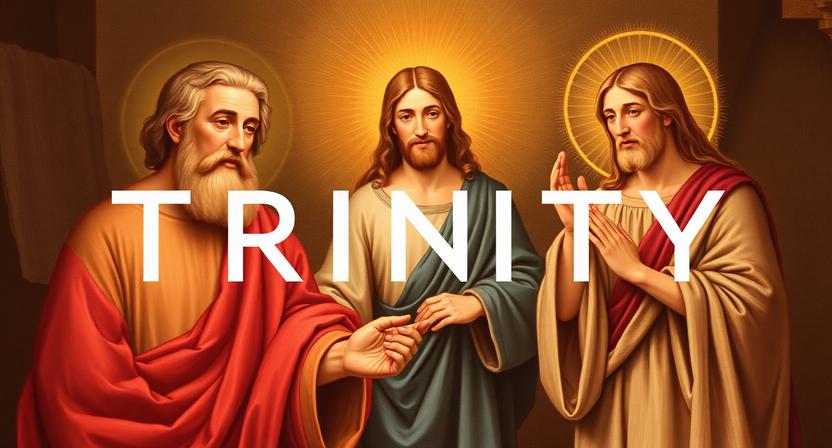
Catholic Homily on the Holy Trinity
“Go and make disciples of all nations, baptising them in the name of the Father and of the Son and of the Holy Spirit.” — Matthew 28:19 | “God is love.” — 1 John 4:8
The doctrine of the Holy Trinity is the most distinctive and most mysterious claim in all of Christian theology. No other religion confesses a God who is simultaneously one and three — one in being, three in person; a unity that is not solitary but relational; a God who is not a monad existing in eternal self-sufficiency, but a communion of love from all eternity. This is not a puzzle to be solved or a formula to be memorised. It is a truth to be entered — a way of understanding everything: who God is, who we are, why love matters, what the Church is for, and what eternal life looks like. A Homily on the Trinity is, at its deepest, a homily about love — because the God who is Father, Son, and Holy Spirit is, in his very being, the eternal self-giving of love.
The Most Daring Claim — God Is a Communion of Persons
The doctrine of the Holy Trinity — that the one God exists eternally as Father, Son, and Holy Spirit, three distinct Persons sharing one divine nature — is the most distinctive and most audacious claim in the history of human thought about God. It does not emerge from philosophical speculation. It emerges from the experience of the first disciples: men and women who had known Jesus of Nazareth, who had witnessed his death and encountered him risen, who had received the Holy Spirit at Pentecost — and who, in trying to make sense of what had happened to them, arrived at the astonishing conclusion that the God they had always worshipped as one had revealed himself to be, in some profound and irreducible sense, three.
The doctrine of the Trinity took centuries to formulate with precision — the Council of Nicaea (325 AD), the Council of Constantinople (381 AD), and subsequent councils refined the language until the Church found terms adequate to the mystery: one substance (homoousios), three persons (hypostases). But the mystery itself is not a product of philosophical ingenuity. It is a description of what the disciples experienced: a God who was Father, who became incarnate as Son, who poured out the Spirit — and who was, in all three modes of self-giving, the same God, the same love, the same holiness.
The Baptism of Jesus is one of the earliest and most luminous Trinitarian moments in the Gospels: the Son is baptised in the Jordan; the Spirit descends in visible form; the Father speaks from heaven. All three are present, distinct, and yet utterly united in the one action of divine love. This is not a formula imposed from outside — it is the lived experience of God breaking open into the world and revealing, in the fullness of time, who he has always been.
“God Is Love” — The Trinity as the Ground of All Love
The most compact and most explosive Trinitarian statement in the New Testament is also one of the shortest sentences in the Bible: “God is love.” (1 John 4:8). Three words. And their implications are staggering. If God is love — not merely loving as an attribute or activity, but love as his very being — then love must be possible within God prior to creation. A God who existed before anything else existed could not be love in isolation. Love requires an object. Love requires relationship. Love requires another.
The doctrine of the Trinity is, among other things, the theological explanation of how “God is love” can be eternally true: because God has always been, within his own life, a relationship of love. The Father loves the Son from all eternity with a love so complete and so living that it is itself a Person — the Holy Spirit. The Son returns that love to the Father. The Spirit is the bond of that love, its overflow, its gift. God does not need creation to be loving — he is love before the first atom exists. Creation is not God’s solution to loneliness. It is the overflow of a love that was already infinitely full.
This has profound implications for human life. If God is love in his very being, and human beings are made in God’s image, then the most God-like thing a human being can do is to love. Not to achieve, not to accumulate, not to dominate — but to love: generously, self-givingly, permanently, in the image of the eternal love that is the inner life of the Trinity. Every act of genuine human love is, in a sense, a participation in the very life of God.
The Father — Source, Origin, and Fountain of the Godhead
In the theology of the Trinity, the Father is understood as the source and origin — not in time, but in the eternal order of the divine life. The Father begets the Son from all eternity; the Father breathes forth the Spirit. This is not a sequence in time but a relationship of eternal origin: the Father is the fountain of the Godhead, from whom the Son and Spirit flow without beginning and without end.
Jesus’s relationship with the Father is the most intimate and most defining feature of his identity. He addresses God as Abba — a word that carries the intimacy of “Dad,” the trusted, familiar, loving parent — a form of address that was unprecedented in Jewish prayer and that shocked his contemporaries. He speaks of the Father with an ease and confidence that is entirely absent from the religious culture around him: “The Father and I are one.” (John 10:30). “Anyone who has seen me has seen the Father.” (John 14:9). “I am in the Father and the Father is in me.” (John 14:10). This mutual indwelling — the perichoresis or “circumincession” of the divine Persons — is the deepest word the tradition has for the inner life of God: three Persons, each completely present in the other, in a dance of mutual self-giving love.
The legend tells that St Augustine, while writing his great work On the Trinity, was walking on the beach wrestling with the mystery of how three Persons could be one God. He saw a child digging a hole in the sand and carrying water from the sea to fill it. Augustine asked what the child was doing. “I am emptying the ocean into this hole,” said the child. “That is impossible,” said Augustine. The child looked up and said: “It is no more impossible than what you are trying to do — contain the Trinity in your small human mind.” Then the child vanished. Augustine returned to his writing — not to explain the mystery, but to point to it with greater humility and greater wonder.
The Son — The Word Made Flesh, God’s Self-Expression
The Second Person of the Trinity — the Son, the eternal Word — is the perfect self-expression of the Father. Just as a human word expresses the inner thought of the one who speaks it, the eternal Word expresses the inner life of the Father completely, perfectly, and personally. “In the beginning was the Word, and the Word was with God, and the Word was God.” (John 1:1). The Son is not a lesser divinity or a divine messenger — he is God himself, in the mode of the one who is eternally spoken, eternally given, eternally received.
The Incarnation — the Word becoming flesh — is the most astonishing event in the history of the universe: the eternal Son of God taking on a fully human nature in the womb of Mary. Not ceasing to be divine, but becoming human; not abandoning his divine nature, but adding to it a human nature — born of a woman, growing up in a family, eating, sleeping, laughing, weeping, suffering, dying. The Council of Chalcedon (451 AD) formulated the Church’s understanding: Jesus Christ is one Person with two natures, divine and human, united without confusion, without change, without division, without separation.
The Son’s eternal relationship to the Father is one of complete receptivity and complete self-giving. He receives everything from the Father — his being, his life, his love — and returns it all in perfect love and obedience. This eternal pattern of receiving and returning is expressed in time in the life of Jesus: “I do nothing on my own but speak just what the Father has taught me… I always do what pleases him.” (John 8:28–29). The life of Jesus is the lived-out expression in human history of the eternal relationship between Father and Son — and therefore a window into the very life of God.
The Holy Spirit — The Breath of God, the Bond of Love
The Third Person of the Trinity is the Holy Spirit — the most mysterious of the three, the one who is, as the Nicene Creed says, “the Lord and Giver of Life, who proceeds from the Father and the Son, who with the Father and the Son is adored and glorified.” The Spirit is not the least of the three Persons — but he is the most self-effacing. Jesus says the Spirit “will not speak on his own” but “will glorify me.” (John 16:13–14). The Spirit’s particular mode of being is self-giving without self-assertion — the love between Father and Son expressed as a living, personal gift.
The Greek word for Spirit is pneuma — breath, wind. The Hebrew ruah carries the same double meaning. The Spirit is the breath of God — the creative power that hovered over the waters at the beginning (Genesis 1:2), that breathed life into the first human (Genesis 2:7), that filled the prophets with the divine word, that overshadowed Mary at the Annunciation (Luke 1:35), that descended on Jesus at his Baptism (Matthew 3:16), and that was poured out on the Church at Pentecost (Acts 2). The Spirit is always the power of divine life — entering, renewing, transforming, making alive.
St Augustine described the Holy Spirit as the “bond of love” between Father and Son — the love they share, expressed as a Person. This means that when the Spirit is poured into our hearts (Romans 5:5), it is the very love of God — the love that unites Father and Son — that is being poured in. We are not merely receiving a gift from God. We are being drawn into the inner life of God. This is what Paul means when he speaks of being “in Christ” and having “the Spirit of God” dwelling within us — we have been incorporated into the Trinitarian communion of love.
Baptism — The Door Into Trinitarian Life
The Great Commission specifies the form of Baptism with a precision that is theologically momentous: “baptising them in the name of the Father and of the Son and of the Holy Spirit.” (Matthew 28:19). Not “in the names” (plural) of three separate deities, but “in the name” (singular) of the one God who is Father, Son, and Holy Spirit. Baptism is not merely a rite of initiation into a human community — it is an act of divine adoption into the family of God, an immersion into the Trinitarian life.
When a person is baptised, Paul says, they are “baptised into Christ Jesus” and “baptised into his death” (Romans 6:3) — and therefore also into his resurrection. The Spirit is given (Acts 2:38). The Father’s voice that spoke at Jesus’s own Baptism — “This is my beloved Son” — now speaks, by participation, over every newly baptised person. They have been drawn into the Son’s relationship with the Father, by the power of the Spirit. This is what the tradition means by “adoption” or theosis — divinisation: not that we become God, but that we are drawn into the very life of God, participating in the eternal exchange of love between Father, Son, and Spirit.
This means that Christian prayer — especially the Lord’s Prayer — is not the prayer of a creature addressing a distant deity. It is the prayer of an adopted child addressing “Our Father” in the same Spirit with which Jesus himself addressed his Father. When the Christian prays, the Spirit prays within them (Romans 8:26); they pray in the Son’s own relationship with the Father; and the Father hears in them the voice of his beloved Son. Christian prayer is, at its deepest, a participation in the eternal conversation of the Trinity.
Perichoresis — The Divine Dance of Mutual Indwelling
One of the most beautiful words in Christian theology is the Greek perichoresis — sometimes translated “circumincession” in Latin, sometimes rendered in English as “mutual indwelling” or, more poetically, “the divine dance.” It describes the way in which the three Persons of the Trinity are not three separate centres of consciousness alongside each other, but three Persons each of whom is completely present in and to the others. The Father is in the Son; the Son is in the Father; the Spirit dwells in both and flows between them. There is no separation, no distance, no self-containment in the Trinity — only an eternal, joyful, mutual self-giving.
Some theologians have used the image of a dance to capture this: three dancers so completely coordinated, so attuned to each other’s movement, that they appear as one — yet each remains distinct, each contributing their own movement to the whole. The beauty of the dance comes precisely from the distinctiveness of the dancers and the perfection of their unity. C.S. Lewis wrote that the divine life is “so dynamic, so dramatic, pulsating with vitality that our abstract notion of it is more like a still life than like the real thing.”
The implications of perichoresis for human life are profound. If the inner life of God is a perfect communion of mutual self-giving, then human beings — made in God’s image — are made for exactly this kind of life: not for isolation or self-sufficiency, but for communion; not for self-assertion, but for self-giving; not for competition, but for the kind of love in which the joy of the other is one’s own joy. The Trinity is not only the ground of Christian theology — it is the model of Christian community.
The Trinity and Prayer — Drawn Into the Divine Conversation
Christian prayer is Trinitarian in its structure — whether or not the person praying is aware of it. The classic form of Christian prayer is addressed to the Father, through the Son, in the Holy Spirit. This is not a liturgical convention — it is a description of what is actually happening in every genuine act of Christian prayer. The Spirit, given at Baptism, stirs within the believer and draws them toward God. The Son, in whom the believer has been incorporated through Baptism, presents their prayer to the Father. The Father, hearing the voice of his Son in the believer, receives the prayer with the same love with which he receives the Son.
Paul makes this explicit in Romans 8: “The Spirit helps us in our weakness. We do not know what we ought to pray for, but the Spirit himself intercedes for us through wordless groans.” (Romans 8:26). The Spirit is not merely helping us pray — the Spirit is praying in us, with the very love of God, toward God. This is why Christian prayer is never merely a human activity directed at a distant deity. It is a participation in the eternal conversation of the Trinity — the believer drawn, by the Spirit, into the Son’s relationship with the Father.
The Lord’s Prayer is the most perfectly Trinitarian prayer in existence. “Our Father” — we address the First Person in the intimacy that belongs to adopted children. “Your kingdom come” — we pray for the completion of the Son’s redeeming work in the world. “Your will be done” — we surrender to the Spirit’s movement in our lives, conforming us to Christ. Every phrase of the prayer is Trinitarian; every act of genuine Christian prayer is an entry into the divine life that the Trinity shares.
Heresies Ancient and Modern — Getting the Trinity Wrong
The history of Trinitarian theology is in part a history of the errors the Church has had to reject in order to clarify what it actually believes. Each of the great heresies of the early centuries got something wrong about the relationship of the Persons — and the Church’s response to each error deepened its positive understanding of the mystery. Three ancient heresies still echo in contemporary misunderstandings, and a Trinity Homily does well to name them clearly.
The Son is not truly God but the greatest of creatures — “there was a time when he was not.” Rejected at Nicaea (325): the Son is homoousios — of the same substance as the Father, not a lesser divinity.
Father, Son, and Spirit are not three distinct Persons but three “modes” or “masks” of one God — like an actor playing three roles. Rejected: the three are genuinely distinct; the Father did not die on the cross.
Father, Son, and Spirit are three separate Gods. Rejected: there is one divine nature shared by three Persons — not three deities cooperating but one God in three modes of personal existence.
“God in three roles” (modalism), “Jesus is just a great teacher” (implicit Arianism), “three aspects of my experience of God” (psychological modalism) — all miss the mystery the Church has always defended.
Rublev’s Icon — A Window Into the Life of the Trinity
Among the most profound meditations on the Trinity in the history of Christian art is Andrei Rublev’s icon of the Holy Trinity, painted around 1411 for the Trinity Monastery of St Sergius in Russia. It depicts three angelic figures seated around a table — a scene drawn from the visit of three strangers to Abraham at the Oak of Mamre (Genesis 18:1–15), which the tradition has long read as a theophany: an appearance of the Trinity in human form. The three figures are identical in dignity but distinct in posture and gesture; they lean toward each other in a conversation of infinite tenderness; a cup on the table between them prefigures the Eucharist.
What makes Rublev’s icon so theologically powerful is the space at the front of the table — an opening that seems deliberately to invite the viewer in. The three Persons are not a closed circle, self-contained in their divine intimacy. They are an open community, reaching outward toward the one who stands before them. Pope Benedict XVI wrote that this icon seems to say: “Become part of this communion of love.” The Trinity is not a remote theological abstraction — it is an invitation. The divine life is not locked away in heaven — it is opening itself toward every human being, drawing them in, making room at the table.
The Eucharistic table of every Mass is, in the theology of the Church, a participation in this same Trinitarian hospitality — the Father’s welcome, the Son’s self-giving, the Spirit’s sanctifying presence, all present in the one act of Eucharistic communion. When the congregation gathers around the altar, they are being drawn into the same life that Rublev’s icon depicts: the eternal, open, welcoming communion of the Trinity.
The Trinity in the Liturgy — From Sign of the Cross to Doxology
The Trinitarian faith of the Church is embedded in its worship from the first gesture to the last word. Here is how the Trinity shapes the entire structure of Catholic liturgical life:
| Liturgical Moment | Trinitarian Dimension | What It Expresses |
|---|---|---|
| Sign of the Cross | “In the name of the Father, and of the Son, and of the Holy Spirit” | Every prayer begins with a Trinitarian declaration — we enter prayer under the name of God who is three |
| Gloria | “Glory to God in the highest… Lord Jesus Christ… Holy Spirit” | The opening hymn of praise addresses all three Persons in sequence — worship of the one triune God |
| Creed | Three articles: Father (Creator), Son (Redeemer), Spirit (Sanctifier) | The structure of the Nicene Creed is explicitly Trinitarian — faith professed in three Persons |
| Eucharistic Prayer | Addressed to the Father, through the Son, invoking the Spirit (epiclesis) | The Great Prayer of the Mass is a Trinitarian act — offered by the Church in Christ to the Father through the Spirit |
| Doxology | “Through him, and with him, and in him… all glory and honour is yours, Father Almighty, in the unity of the Holy Spirit” | The culminating act of the Mass — the ultimate Trinitarian doxology, the Church’s highest act of praise |
| Blessing and Dismissal | “May almighty God bless you, the Father, and the Son, and the Holy Spirit” | The people are sent into the world under the Trinitarian blessing — carrying the name of the Trinity into daily life |
| Glory Be / Doxology | “Glory be to the Father, and to the Son, and to the Holy Spirit” | The simplest and most repeated Trinitarian prayer — praise returning to its source in the eternal communion of love |
The Trinity and Human Relationships — Made for Communion
One of the most far-reaching implications of the doctrine of the Trinity is anthropological — it tells us something definitive about what human beings are and what they are made for. If the inner life of God is a communion of Persons in mutual self-giving love, and if human beings are made in God’s image, then human beings are not made for isolation. They are made for communion — for the kind of relationship in which the self is given rather than hoarded, in which the other’s flourishing is inseparable from one’s own, in which love flows freely rather than conditionally.
Pope St John Paul II developed this insight extensively in his “theology of the body” — the observation that the human body, created male and female, is designed for a self-giving love that mirrors the self-giving of the Trinitarian Persons. Marriage, in this theology, is not merely a social institution — it is a sacramental sign of the Trinity’s own inner life: two persons becoming one flesh in a love that is total, faithful, fruitful, and free. The family — father, mother, child — is a human icon of the Trinity; the Church — a community of persons united in love — is the social form that the Trinity takes in history.
The unity Jesus prays for in John 17 is explicitly modelled on the unity of Father and Son — not a uniformity that erases difference, but a communion that preserves distinction while creating deep union. The Church’s unity is a Trinitarian unity: diverse persons, diverse gifts, diverse vocations, held together not by institutional power but by the same Spirit of love who holds the Trinity together. Every genuinely loving human community — every marriage, family, friendship, religious community, parish — is a participation in and a witness to the communion of the Holy Trinity.
St Patrick and the Shamrock — Analogies for the Mystery
Every teacher of the faith, from the earliest Fathers to the present day, has reached for analogies to help make the mystery of the Trinity more accessible — while also insisting that every analogy eventually breaks down. The tradition is full of them: St Patrick’s famous shamrock (three leaves, one plant); Augustine’s three dimensions of the human mind (memory, understanding, and will — one mind, three faculties); the sun (the sun itself, its light, and its warmth); a spring, a river, and the water they share. Each illuminates one aspect of the mystery and fails at another.
The shamrock — whether or not the story of Patrick teaching Irish chieftains with a three-leafed clover is historically accurate — captures something important: that the three are genuinely distinct (three leaves) and genuinely one (one plant). What it fails to capture is the full personhood of each of the three — a shamrock leaf is not a person, and the three leaves are not in relationship with each other. Augustine’s psychological analogy — memory, understanding, will — captures the unity and the relatedness of the three, but fails to account for their genuine distinctness as Persons. Every analogy gifts and limits; the mystery always exceeds the model.
A catechist was explaining the Trinity to a class of seven-year-olds with a shamrock. A girl in the front raised her hand and said: “But if the three leaves are Father, Son, and Spirit — which one loves the other ones?” The catechist was stopped in her tracks. After a long pause, she said: “That is the best question anyone has ever asked in this class. The answer is: all three love each other. That’s why they’re one.” She later said it was the moment she understood the Trinity for the first time. Children, she wrote, often ask better theological questions than adults because they haven’t yet been taught to pretend to understand.
How to Live a Trinitarian Life — A Complete Pastoral Guide
The Trinity is not merely a doctrine to be believed but a life to be lived. Here is a complete pastoral guide for growing into the Trinitarian communion that is the heart of Christian existence.
-
1
Make the Sign of the Cross slowly and consciously — every time. The Sign of the Cross is the most frequently made Trinitarian prayer in most Catholics’ lives — and the most frequently made unconsciously. From today, make it slowly: “In the name of the Father” — the source of all love and life. “And of the Son” — the Word who became flesh and redeemed us. “And of the Holy Spirit” — the breath of God living within us. Let every crossing be an act of faith in the God who is three, and a renewed awareness that you live within the Trinitarian life.
-
2
Pray to each Person — and attend to how each responds. The tradition encourages direct address to each of the three Persons in prayer. The Father, as Abba — with the confident intimacy of an adopted child. The Son, as Lord and Friend and Saviour — with the gratitude of one who has been redeemed. The Spirit, as the breath within — with the attentiveness of one who knows that God is praying in them. Notice how each mode of address opens something different in the heart. This is a practical school of Trinitarian contemplation.
-
3
Let your community life be shaped by Trinitarian love. The Trinity shows us that the divine life is a community of persons in mutual self-giving. Ask: does my family, my friendship group, my parish community reflect this? Is it a place where each person is genuinely received, where difference is honoured, where the good of each is the concern of all? The quality of our human relationships is the most visible testimony to what we believe about God. A Trinitarian community is one where self-giving love — not power, not performance — is the currency.
-
4
Meditate on Rublev’s icon — spend time before it. Find a print or image of Andrei Rublev’s Trinity icon and spend ten minutes before it in silence. Notice the posture of each figure — the Father sending, the Son offering, the Spirit receiving. Notice the open space at the front of the table. Hear the invitation: “Come in. There is a place for you here.” Let the icon be an entry point into contemplation of the divine life — a window, as the Orthodox tradition says, not a picture to be admired but a presence to be encountered.
-
5
Attend to the Trinitarian structure of the Mass. Next time you are at Mass, notice how the entire liturgy is addressed to the Father, through the Son, in the Spirit. The Eucharistic Prayer especially — hear it as a Trinitarian act: the Church, in Christ, addressing the Father and invoking the Spirit. Let this awareness deepen your participation: you are not a spectator of a religious rite. You are a participant in the eternal worship that the Son offers the Father, in the unity of the Spirit. Every Mass is a Trinitarian event.
-
6
Live the perichoresis — practise mutual self-giving in your closest relationships. The divine life is one of complete mutual indwelling — each Person “at home” in the others, each delighting in the others’ existence. The closest human approximation is the relationship in which I am genuinely present to the other: not performing, not calculating, not protecting myself, but truly given — my attention, my time, my care, my honesty, freely given. Choose one relationship this week in which to practise this kind of presence. The Trinitarian life does not stay in theology — it comes home.
-
7
End each day with the doxology — return the day to the Trinity. “Glory be to the Father, and to the Son, and to the Holy Spirit; as it was in the beginning, is now, and ever shall be, world without end. Amen.” This ancient prayer — the Gloria Patri — is the simplest and most complete act of Trinitarian praise. Prayed at the end of each day, it returns the whole day — its joys and failures, its graces and struggles — to the God from whom it came. It is the Christian equivalent of closing the hands in offering: everything given back to the One who gave it all.
“That They May Be One” — The Trinity as Humanity’s Destiny
The High Priestly Prayer of Jesus in John 17 contains what may be the most extraordinary sentence in the entire Gospel: “I pray… that all of them may be one, Father, just as you are in me and I am in you. May they also be in us so that the world may believe that you have sent me… I have given them the glory that you gave me, that they may be one as we are one — I in them and you in me — so that they may be brought to complete unity.” (John 17:20–23). The unity Jesus prays for his followers is modelled on the unity of the Trinity — and more than modelled: believers are to be “in” the Father and the Son, drawn into the very communion that the Trinity is.
This is the ultimate vision of Christian life: not merely an improved morality or a richer religious experience, but a genuine participation in the life of God. The Greek theological tradition calls this theosis — deification — not the obliteration of the human person into God, but the transformation of the human person by participation in the divine nature (2 Peter 1:4). This is what eternal life is: not a comfortable afterlife, but an endless, joyful, ever-deepening entry into the love that the Father and the Son and the Spirit have shared from all eternity. The God who is communion invites every human being into that communion — now, in prayer and sacrament and community; and at the last, in the fullness of the Kingdom. This is the whole of Christianity. This is the Trinity. 🙏 ✝
“Glory Be to the Father, and to the Son, and to the Holy Spirit”
Holy Trinity — Father, Son, and Holy Spirit — one God, three Persons, eternal communion of love — we stand before you today not as those who understand, but as those who have been drawn in. Drawn in by Baptism, drawn in by prayer, drawn in by the Eucharist where your Son gives himself to us and we are gathered into the body of your love. We did not find you. You found us.
Father — thank you for being the source, the origin, the “Abba” who runs toward us before we have finished our speech. Son — thank you for being the face of God turned toward us in human flesh, for the cross where the eternal self-giving of the Trinity became our salvation, for the resurrection that tells us love is stronger than death. Holy Spirit — thank you for the fire that falls, the breath that renews, the prayer that prays within us when we have no words.
Make us what you made us to be: a community of persons in mutual self-giving love — a small, imperfect, earthly image of the eternal communion you are. Let our unity be your witness to a fragmented world. Let our love be your argument against despair. And at the last, draw us fully into what we have glimpsed and tasted and believed: the eternal dance of love that is your life, and our destiny, and the joy that will never end.
Glory be to the Father, and to the Son, and to the Holy Spirit. Amen. 🙏 ✝
Trusted External Resources for a Trinity Homily
- Catechism of the Catholic Church §232–267 — The Holy Trinity (Vatican.va)
- USCCB Online Bible — All Scripture passages referenced
- Dominum et Vivificantem — St John Paul II on the Holy Spirit (Vatican.va)
- St Augustine — On the Trinity (De Trinitate), New Advent
- USCCB — Prayers to the Holy Trinity
- Pope Benedict XVI — Catechesis on the Holy Trinity (Vatican.va)
More Homilies on HomilySunday.com
- Gratitude Homily
- Stewardship Homily
- Word of God Homily
- Suffering Homily
- Evangelization Homily
- Justice Homily
- Eucharist Homily
- Saints Homily
- Hope Homily
- Faith Homily
- Love Homily
- Easter Homily
- Homily on Forgiveness
- Homily on God’s Mercy
- Healing Homily
- Homily on Prayer
- Homily on the Holy Spirit
- Discipleship Homily
- Peace Homily
- 100 Homily Stories
