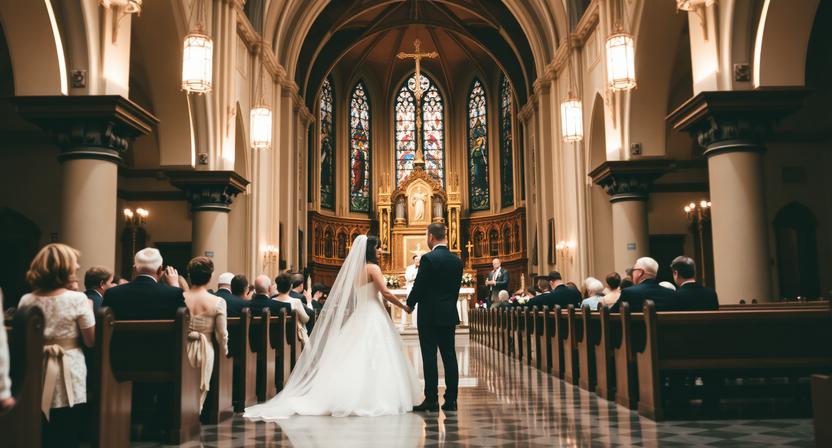
Wedding Homily
“What God has joined together, let no one separate.” — Mark 10:9
A wedding homily is one of the most joyful and sacred moments in a priest or deacon’s ministry. Two people stand before God and the Church, offering themselves to each other in love — and the homily is the Church’s opportunity to illuminate what that love truly means, where it comes from, and where it is destined to go.
This page offers a complete pastoral and theological guide for writing or delivering a beautiful, Scripture-rooted, and deeply personal wedding homily. Whether you are preparing for a Nuptial Mass or a simple marriage ceremony, you will find here everything you need: rich content, key Scripture passages, pastoral wisdom, and a clear structure from opening to blessing.
1 Opening Words of Joy and Welcome
Every wedding homily begins with celebration. Before theology, before instruction, before exhortation — there is joy. The priest or deacon steps into the midst of a gathering of family and friends, of laughter and tears of happiness, and names what is happening: something holy is taking place here today.
The opening of a wedding homily should feel like a warm embrace. Welcome the couple by name. Welcome the families. Acknowledge the emotion in the room — the pride of parents, the excitement of friends, the deep happiness of those who love the couple. Let everyone feel that the Church is genuinely glad to be here, not merely officiating a ceremony but celebrating a sacrament.
- Welcome the couple warmly and personally by name
- Acknowledge the families and loved ones gathered
- Name the joy and the beauty of the moment honestly
- Set the tone: this is a celebration of God’s love made visible
2 Love Is From God
The most fundamental truth a wedding homily must proclaim is this: the love between this man and this woman did not originate with them. It originated with God. Before they ever met, before they ever spoke, before the first glance across a room — God was already at work, drawing two souls toward each other.
St. John says it plainly and powerfully: “God is love.” (1 John 4:8). This means that every genuine act of love in the universe is, in some mysterious way, a participation in the very life of God. When these two people love each other — truly, selflessly, faithfully — they are not merely exchanging feelings. They are participating in the divine nature itself.
3 Marriage as a Sacrament
In the Catholic understanding, marriage is not merely a social contract or a legal arrangement — it is a sacrament. This means it is an outward sign, instituted by Christ, that confers the grace it signifies. The couple themselves are the ministers of the sacrament; the priest or deacon is the Church’s witness.
What does this mean practically? It means that God is not a guest at this wedding — he is the host. The grace of this sacrament will accompany this couple through every season of their life together: the joy of new beginnings, the challenge of difficult years, the beauty of children and grandchildren, and the faithfulness of old age. They do not walk their marriage alone — Christ walks with them.
4 What Love Truly Requires
The most quoted passage at Christian weddings is 1 Corinthians 13 — the great hymn to love. And yet it is worth pausing over these words rather than rushing past them. Paul is not describing romantic feeling. He is describing a moral commitment, a daily choice, a discipline of the heart that must be renewed every morning.
Love is patient — even when your spouse is frustrating. Love is kind — even when you are tired. Love is not irritable — even when you have every human reason to be. This is not poetry about emotions; it is a programme for daily living. The wedding homily does the couple a great service by naming this honestly: love is not something that simply happens to you. It is something you choose, every single day, with God’s grace.
| Quality of Love | What It Looks Like in Marriage |
|---|---|
| Patient | Bearing with each other’s weaknesses without resentment |
| Kind | Choosing gentleness even after a long and difficult day |
| Not self-seeking | Putting the other’s needs genuinely before your own |
| Rejoices in truth | Building a home where honesty and trust are the foundation |
| Bears all things | Standing together in suffering, illness, and loss |
| Never fails | Remaining faithful through every season of life |
Replace this div with your Mediavine ad code
5 Marriage in the Beginning — The Book of Genesis
To understand Christian marriage, we must go back to the very beginning. In the Book of Genesis, before sin entered the world, before suffering and death — God created man and woman for each other. The very first gift God gave to the human family was not food or shelter or knowledge — it was companionship. “It is not good for man to be alone.” (Genesis 2:18)
When Adam sees Eve for the first time, he breaks into the first poem in human history: “This at last is bone of my bones and flesh of my flesh.” (Genesis 2:23). There is recognition, delight, joy, and belonging. This is what a wedding celebrates — the restoration, in each particular couple, of that original divine design for human love.
6 The Wedding at Cana — Jesus and Marriage
Jesus’ first miracle was performed not at a synagogue, not at the Temple, but at a wedding. At Cana in Galilee, when the wine ran out and the celebration was in danger of ending in embarrassment, Jesus intervened. He transformed water into wine — the finest wine — and the party continued.
This is profoundly symbolic. Jesus’ presence at a wedding does not merely bless the institution — it transforms it. What was ordinary becomes extraordinary. What was running dry is renewed. This is what Christ promises to every Christian marriage: his presence, his grace, and his ability to transform the ordinary moments of daily life into something beautiful and holy.
7 Covenant Love — More Than a Contract
Modern culture often speaks of marriage as a contract between two consenting parties — an agreement that can be renegotiated or dissolved when circumstances change. The Christian vision is entirely different. Marriage is a covenant — and the difference between a contract and a covenant is everything.
A contract is conditional: I give you this, provided you give me that. A covenant is unconditional: I give you myself, entirely, permanently, regardless. It mirrors the covenant God made with his people — not dependent on their performance, but rooted in his faithful, enduring love. When the couple exchange vows today, they are not signing a contract. They are entering a covenant — a permanent, exclusive, life-giving bond, blessed and sustained by God himself.
- Permanent: “Until death do us part” — not a feeling, but a promise
- Exclusive: Given wholly to this one person, held back from none
- Life-giving: Open to the gift of children, the fruit of their love
- Faithful: Sustained by grace through every season and storm
8 The Holy Trinity and the Family
There is a profound theological insight that deepens our understanding of Christian marriage: the family is an image of the Holy Trinity. God himself is a communion of persons — Father, Son, and Holy Spirit — united in perfect love, each giving completely to the other. Christian marriage is called to reflect that divine communion.
When husband and wife love each other with total self-giving, and when that love is so real and so fruitful that it takes on a name and a face in their children — they become a living icon of the Trinity. The home becomes a “domestic Church,” a place where the love of God is made visible, tangible, and daily.
9 The Wedding Vows — A Word About the Promises
The vows are the heart of the wedding. Everything else — the flowers, the music, the gathering of loved ones — is the setting for this single moment when two people look at each other and say, before God and the Church: I give you myself. The homily should honour this moment by reflecting on the extraordinary weight and beauty of what is about to be promised.
The wedding vows are perhaps the most radical words a human being can ever speak. To love and to cherish. To have and to hold. In sickness and in health. For richer, for poorer. Until death do us part. Invite the couple — and the congregation — to hear these words as if for the first time, because today they are being spoken anew, by these two people, before this God.
10 Building a Christian Home
A wedding is a beginning, not an arrival. The homily should look forward — with realism and with hope — to the life the couple is now beginning together. Building a Christian home is one of the most important and most beautiful vocations in the Church. It requires daily prayer, daily forgiveness, daily generosity, and daily trust in God.
Offer the couple practical pastoral wisdom: pray together every day, even briefly. Go to Mass together. Make your home a place of welcome and hospitality. Read Scripture together. Forgive quickly and generously. Seek the sacrament of Reconciliation regularly — for individual sins, and to restore what daily life inevitably wears down.
- Pray together daily — even a brief prayer before bed transforms a marriage
- Celebrate Sunday Mass together as the anchor of the week
- Make your home a place of welcome, peace, and hospitality
- Forgive each other quickly — do not let the sun go down on your anger (Ephesians 4:26)
- Seek the sacraments regularly — Reconciliation and Eucharist sustain the marriage
- Invite Mary into your home — she is the model of faithful, generous love
11 Love That Bears All Things
A wedding homily that only speaks of joy is incomplete. The homily should also prepare the couple — honestly and pastorally — for the reality that love will be tested. Every marriage passes through storms. There will be misunderstandings, disappointments, times of illness, financial pressure, grief, and the ordinary friction of two imperfect people living at close quarters every day.
But this is precisely where the grace of the sacrament comes in. The couple does not face these challenges in their own strength. The same Christ who was present at the Wedding of Cana is present in this marriage. He can transform not only water into wine but hardship into growth, conflict into understanding, and weakness into deeper love. The cross is not the end of love — it is the sign of love at its greatest.
12 Marriage as Witness to the World
Christian marriage is not merely a private arrangement between two people. It is a public witness. In a world that increasingly doubts the possibility of permanent, faithful, self-giving love — every Christian marriage stands as a living sign of contradiction, saying: this kind of love is possible, because God makes it possible.
The couple is being sent out today as missionaries of love — not to foreign lands necessarily, but to their neighbourhood, their workplace, their family circle, their community. The way they love each other will speak louder than any sermon. Let their marriage be a light.
13 A Word to the Families and Friends
A wedding homily that speaks only to the couple misses a pastoral opportunity. The families and friends gathered are also part of this moment — they are not merely an audience but a community of support. The homily can gently address them too.
To the parents: you have loved and raised these two people to the point where they are ready to give themselves in marriage. Today you do not lose a son or a daughter — you gain a son or a daughter. Your role now shifts: to support, to encourage, to pray, and to trust. To the friends: you are the community in which this marriage will grow. Surround them with prayer, with loyalty, and with the kind of friendship that strengthens rather than tempts.
- Parents: your gift today is to entrust them joyfully to each other and to God
- Friends: be the kind of companions who strengthen their marriage, not weaken it
- All: commit to praying for this couple — today and in the years ahead
- Community: celebrate with them, and be a safe haven in difficult times
14 Marian Blessing for the Couple
In Catholic wedding homilies, it is beautiful and appropriate to entrust the new couple to the care of Our Lady. Mary is the perfect model of faithful, generous, obedient love — the love that says “let it be done to me according to your word” (Luke 1:38). She is the Mother of the Church and the Mother of every Christian family.
Invite the couple to place their marriage under Mary’s protection. Many couples choose to process to a Marian shrine during the wedding Mass, laying flowers at her feet — a gesture of trust and consecration. What a beautiful way to begin: by entrusting your love to the one who loved most perfectly of all.
Replace this div with your Mediavine ad code
15 Closing Blessing and Words of Hope
Every wedding homily should end as it began — in joy, in hope, and in the love of God. But the closing is also the moment to send the couple forward. They leave this church today not as two individuals who happened to meet — they leave as one: one flesh, one covenant, one family in the making.
Offer them a blessing that is warm, personal, and anchored in faith. Speak of the adventure ahead — not with naivety about its difficulty but with genuine confidence in God’s faithfulness. Close with something the couple will carry in their hearts long after the flowers have faded and the music has ended.
- May your home always be filled with prayer, laughter, and the presence of God
- May you forgive each other as freely as God has forgiven you
- May your love grow stronger with every year, every trial, and every grace
- May God bless you — and may you be a blessing to everyone whose life you touch
“What God Has Joined”
May Almighty God bless you in your love, keep you in his care, and fill your home with his peace. May Christ, who blessed the wedding at Cana with his presence and his gift of wine, bless this marriage with his grace today and through all the years to come. And may Our Lady, who said yes to God’s love perfectly, accompany you always on your journey together. Amen.
