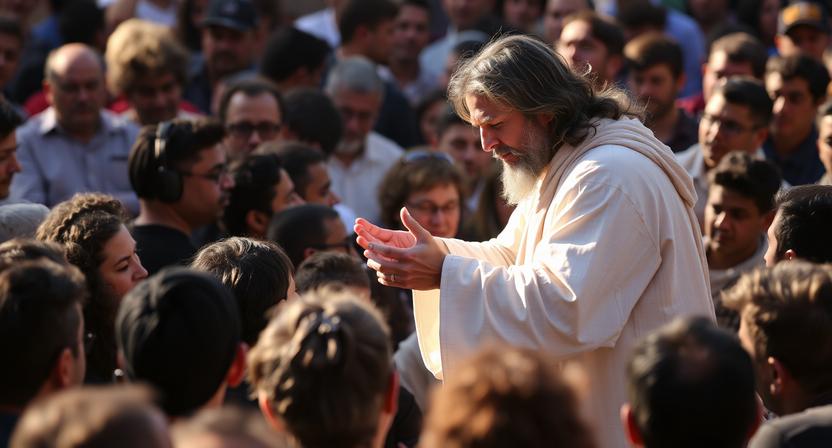
Healing Homily
“He healed all who were sick — that what was spoken through the prophet Isaiah might be fulfilled: ‘He took up our infirmities and bore our diseases.'” — Matthew 8:16–17
Healing is one of the most central and consistent themes of the entire ministry of Jesus. Wherever he went, the sick came to him — and he never turned them away. He healed with a word, with a touch, with mud and water, with the command to rise and walk. The Gospels are filled with these moments, and together they reveal something essential about who God is and what he desires for his people.
A Healing Homily speaks to one of the deepest hungers of the human heart: the longing to be made whole. This page offers a complete pastoral and theological guide for preaching on healing — physical, emotional, spiritual, and relational — drawing from the riches of Scripture, the sacramental life of the Church, and the compassionate witness of Christ himself.
1 God Who Heals — The Heart of the Homily
Before all else, a Healing Homily must proclaim who God is. One of the most beautiful and least preached names of God in the Old Testament is Yahweh Rapha — “the Lord who heals.” After the crossing of the Red Sea, as Israel wandered in the desert and the waters of Marah were too bitter to drink, God sweetened the waters and declared: “I am the Lord who heals you.” (Exodus 15:26). This was not merely a promise about physical water — it was a revelation of God’s character.
God does not observe human suffering from a distance. He enters into it. He bends toward the broken. He is not uncomfortable with illness, with grief, with the messy and painful reality of human fragility. He is drawn to it — as a physician is drawn to the sick, as a shepherd leaves the ninety-nine to search for the one that is lost and wounded.
2 Jesus the Healer — The Gospels’ Testimony
No one in human history has healed as Jesus healed. The Gospels record miracle after miracle — the blind see, the deaf hear, the lame walk, lepers are cleansed, the dead are raised. These are not decorations on the margin of the Gospel story. They are central to it. They are signs of the Kingdom of God breaking into the world.
What is striking about Jesus’ healing ministry is not merely the power behind it but the manner of it. He touched the untouchable leper (Mark 1:41). He stopped mid-crowd to ask who had touched his cloak (Luke 8:45) — because he noticed one anonymous, suffering woman. He wept before raising Lazarus (John 11:35). Every healing is intensely personal. He never healed at a distance from the soul of the person he healed.
| Healing Miracle | Scripture | Key Message |
|---|---|---|
| The Ten Lepers | Luke 17:11–19 | Faith and gratitude are inseparable from healing |
| The Blind Man Bartimaeus | Mark 10:46–52 | Persistent faith moves the heart of Jesus |
| The Paralysed Man at Bethesda | John 5:1–15 | Jesus heals even the long-suffering and hopeless |
| The Woman with a Haemorrhage | Luke 8:43–48 | Even the smallest act of faith reaches Christ |
| The Raising of Lazarus | John 11:1–44 | Christ is Lord even over death itself |
| The Leper Cleansed | Mark 1:40–45 | Jesus touches the outcast — no one is beyond his reach |
3 The Three Dimensions of Healing
A rich Healing Homily distinguishes between the different dimensions of healing that Scripture and the Church hold together. To speak only of physical healing is to miss the fullness of what Christ offers. The Gospel vision of healing is holistic — it touches the body, the soul, and our relationships with one another.
- Physical Healing: The restoration of the body — the miracles of the Gospels, the anointing of the sick, the gift of medicine and medical care as instruments of God’s healing grace.
- Emotional and Psychological Healing: The deep inner wounds of grief, trauma, fear, shame, and anxiety. Jesus healed the heart as well as the body. “Come to me, all who are weary and burdened, and I will give you rest.” (Matthew 11:28)
- Spiritual Healing: The healing of the soul from sin, from alienation from God, from guilt and despair. This is the deepest healing — the forgiveness of sins, offered in the Sacrament of Reconciliation.
- Relational Healing: The restoration of broken relationships — between spouses, between parents and children, between estranged friends, between divided communities. Christ came to reconcile all things (Colossians 1:20).
4 Faith and Healing — The Necessary Connection
Again and again in the healing accounts of the Gospels, Jesus links healing to faith. To the blind man: “Your faith has healed you.” To the woman who touched his cloak: “Daughter, your faith has made you well.” To the centurion whose servant was healed: “I have not found such great faith even in Israel.” Faith does not earn healing — but it opens the door to it.
This does not mean that those who are not healed lack faith. The homily must handle this pastoral tension carefully and honestly. Faith is not a formula or a technique. It is a posture of trust toward a God who is always good, even when his answer is not the one we hoped for. The greatest act of faith is sometimes not to receive the healing we ask for — but to trust the one who chose not to give it, as Paul did with his thorn in the flesh (2 Corinthians 12:7–9).
5 The Anointing of the Sick — The Church’s Healing Sacrament
The Catholic Church has always believed in the healing power of Christ — and has entrusted this healing to the sacramental life of the community. The Anointing of the Sick, one of the seven sacraments, is the Church’s great gift to those who suffer from serious illness, old age, or the approach of death. It is not a sacrament of last resort — it is a sacrament of healing, of strengthening, and of peace.
Grounded in the Letter of James (5:14–15), the Anointing of the Sick brings the healing presence of Christ directly to the bedside of the suffering person. Through the laying on of hands and the anointing with blessed oil, the Church prays for physical healing where it is God’s will, for inner strength and peace, for the forgiveness of sins, and for the courage to face suffering united with Christ’s own passion.
- The sacrament strengthens the whole person — body, mind, and spirit
- It unites the suffering person with the passion and resurrection of Christ
- It may bring physical healing — or the deeper healing of peace and acceptance
- It prepares the soul for the journey home, if that time has come
- It is available to all the seriously ill — not only those near death
6 Healing and Forgiveness — The Deeper Cure
One of the most remarkable features of Jesus’ healing ministry is how often it is connected to forgiveness. When the paralysed man was lowered through the roof by his four friends, Jesus’ first words were not “Rise and walk” — they were “Your sins are forgiven.” (Mark 2:5). The scribes were scandalised. But Jesus was revealing something profound: the deepest wound is not in the body. It is in the soul.
Sin separates us from God, from ourselves, and from one another. That separation is the root sickness of the human condition — and it requires a cure that no medicine can provide. The Sacrament of Reconciliation is, in the truest sense, a healing sacrament. When the priest pronounces absolution, something real happens: the wound of sin is healed, the burden of guilt is lifted, and the soul is restored to right relationship with God.
7 When Healing Does Not Come — Suffering With Christ
Any honest Healing Homily must address the hardest question: what do we say to those who prayed with faith, who received the sacraments, who trusted God — and were not healed? This is not a theoretical question. It is the lived reality of many people sitting in the pews. To ignore it is to be pastorally dishonest. To answer it badly is to cause great harm.
The Christian answer to unremedied suffering is not an explanation — it is a person. It is Jesus on the cross, who himself prayed in Gethsemane for the cup to be taken away — and drank it anyway. It is Paul, who begged three times for his thorn to be removed — and was given grace instead. Suffering united to Christ is not wasted. It is redemptive. It becomes, mysteriously, a sharing in the very work of salvation. “Now I rejoice in what I am suffering for you, and I fill up in my flesh what is still lacking in regard to Christ’s afflictions.” (Colossians 1:24)
8 Healing in Community — We Do Not Suffer Alone
The Christian vision of healing is never merely individual. We are healed in community, through community, and sometimes we are healed as a community. When four friends carried the paralysed man to Jesus — tearing open a roof to lower him down — they were acting in the faith their friend perhaps could not muster alone. Their faith contributed to his healing (Mark 2:5).
The Church is called to be a healing community — a place where the wounded are welcome, where the grieving are supported, where the lonely find belonging, and where the broken find the compassion of Christ made visible in the hands and voices of fellow believers. Encourage the congregation: visit the sick, pray for one another, be the hands of Christ to those who suffer.
9 The Eucharist — Bread of Healing
The Eucharist is the source and summit of the Christian life — and it is also a sacrament of healing. Every time we receive the Body and Blood of Christ, we receive not only spiritual nourishment but the healing power of the Risen Lord himself. The ancient prayer before Communion captures this perfectly: “Lord, I am not worthy that you should enter under my roof, but only say the word and my soul shall be healed.”
These words echo the faith of the centurion in Matthew 8 — a man who believed that a single word from Christ was enough to heal his servant from a distance. We speak the same words at every Mass, before receiving the one who heals body and soul. The Eucharist is not merely a memorial — it is an encounter with the living Christ, who still heals today.
10 Isaiah’s Vision — Healing Foretold
Long before the Gospels, the prophet Isaiah foretold a Servant who would bear the wounds of his people and, through those very wounds, bring about their healing. This is one of the most astonishing prophecies in all of Scripture — written over seven hundred years before the crucifixion of Jesus, and yet describing it with startling precision.
When St. Matthew quotes Isaiah in his account of Jesus’ healing ministry (Matthew 8:17), he is making a deliberate theological point: in the healings of Jesus, the ancient promise is being fulfilled. The one who bore our infirmities is not a mythical figure — he is Jesus of Nazareth, who stretched out his hands on the cross and, by his wounds, healed the deepest sickness of the human race.
11 How to Pray for Healing
A practical and pastoral section of the Healing Homily can guide the faithful in how to pray for healing — both for themselves and for others. Prayer for healing is not a special technique reserved for charismatic ministers. It is the birthright of every baptised Christian. We are all invited to bring our needs and the needs of those we love before the Lord with confidence and trust.
- Pray with faith, not fear: Come before God as a child comes to a loving Father — trusting his goodness, not anxious about the outcome
- Pray specifically: Name the illness, the wound, the broken relationship before God — he knows it already, but naming it is an act of trust
- Pray persistently: The parable of the persistent widow (Luke 18:1–8) encourages us to keep asking, keep knocking, keep seeking
- Pray in community: Ask others to pray with you and for you — the prayer of the community has a particular power
- Surrender the outcome: End every prayer for healing with the words of Christ in Gethsemane: “Not my will, but yours be done” (Luke 22:42)
- Use the sacraments: Receive Anointing of the Sick, go to Confession, receive the Eucharist — these are not optional extras but powerful channels of grace
12 Our Lady of Lourdes — Mary and Healing
The Catholic tradition holds a particular treasure in the Marian shrines of healing — above all, Lourdes in France, where since 1858 millions of sick pilgrims have journeyed to pray, to bathe in the waters, and to entrust themselves to the care of Our Lady. Many healings — some miraculous and medically inexplicable — have been documented there by the Church’s rigorous process of investigation.
But the deeper miracle of Lourdes, as many pilgrims attest, is not always physical healing. It is the inner transformation — the peace found in suffering, the faith deepened through darkness, the encounter with Christ mediated through his Mother. Mary does not heal of herself; she brings us to her Son, who is the one Healer. Her intercession is powerful because she stands at the heart of the Church, always pointing to Christ.
13 Medicine, Science, and the Grace of God
A theologically balanced Healing Homily affirms the gift of medicine without reducing healing to medicine alone. The Catholic tradition has always honoured the healing professions — from the great hospital-founding religious orders to the patron saint of physicians, St. Luke. The Book of Sirach says plainly: “Honour the physician for the service he gives, for the Lord created him.” (Sirach 38:1)
Doctors, nurses, surgeons, pharmacists, therapists, and carers are instruments of God’s healing grace. When we receive medical care, we receive a gift that ultimately comes from the God who made the human body and gave human minds the ingenuity to understand and treat it. Faith and medicine are not rivals — they are partners in the service of human wholeness.
- Seek medical care without guilt — it is a gift of divine providence
- Pray alongside medical treatment, not instead of it
- Give thanks for those who dedicate their lives to healing others
- Remember that the ultimate healer works through many instruments
14 The Healing of Memories
One of the most profound and often neglected dimensions of healing is the healing of memories — the deep inner wounds carried from childhood, from trauma, from abuse, from failure, from loss. These wounds do not disappear with time. They live in the body, in the emotions, in our patterns of relating and responding. They need the healing touch of Christ just as much as any physical illness.
The Church’s prayer ministry, combined with good pastoral accompaniment and where needed professional counselling, can bring remarkable healing to wounded memories. Christ who is Lord of time can enter into our past — not to change what happened, but to be present within it, to redeem it, to bring his peace into the places where fear, shame, or grief have lived. “Jesus Christ is the same yesterday and today and for ever.” (Hebrews 13:8)
15 The Ultimate Healing — The Resurrection
The Healing Homily, like all Christian preaching, must end at the resurrection. Every healing Christ performed during his earthly ministry was a sign — powerful and real, but temporary. Lazarus was raised from the dead, and one day Lazarus died again. The blind man received his sight, and one day those same eyes closed in death. The ultimate healing — the healing that is permanent, total, and eternal — awaits us at the resurrection of the body.
At the last day, God will wipe away every tear (Revelation 21:4). Every sickness, every wound, every disability, every broken memory, every grief — all of it will be healed, transformed, and taken up into the glory of the resurrection. This is the hope that sustains us when healing does not come in this life. It is not a consolation prize. It is the fullness of what God has always promised — the new creation, the restoration of all things, the healing of the world.
“Lord, Only Say the Word”
Lord Jesus Christ, you are the same yesterday, today, and for ever. You who healed the blind, the lame, the broken, and the dead — look upon all who suffer today. Heal what medicine cannot reach. Restore what time has worn away. Bring peace to every wounded heart, and grant that all who suffer in union with you may one day share in the fullness of your resurrection. Amen.
