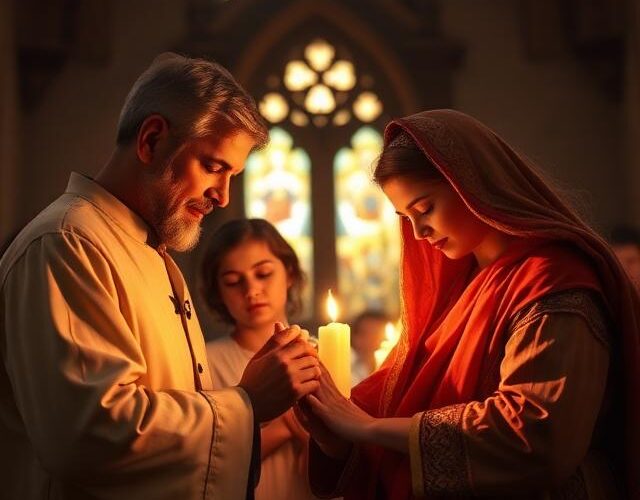
Catholic Family Homily
“As for me and my household, we will serve the LORD.” — Joshua 24:15 | “Where two or three gather in my name, there am I with them.” — Matthew 18:20
The family is not merely the basic unit of society — it is the first school of love, the original church, the place where most human beings first encounter (or fail to encounter) the face of God. In its warmth, its struggle, its daily forgiveness, its shared meals and shared prayers and shared grief, the family is the crucible in which Christian faith is either forged or lost. A Family Homily speaks to every person in the congregation — because every person comes from a family, belongs to a family, longs for a family, or grieves a family. This page offers a complete, Scripture-rooted, theologically rich, and pastorally honest guide for preaching on the family: what God designed it to be, what it faces in our time, and how the grace of God meets every family — whole or broken — with inexhaustible love and practical wisdom.
The Family — God’s First and Most Fundamental Institution
Before there was a temple, before there was a priesthood, before there was a nation of Israel or a Church of Jesus Christ, there was a family. The first chapters of Genesis describe God’s first act of social institution: “It is not good for the man to be alone. I will make a helper suitable for him.” (Genesis 2:18). From the union of man and woman, the family was born — and with it, the possibility of children, community, society, and civilisation itself. The family is not a human invention that God subsequently blessed. It is a divine invention that God gave to humanity as a gift.
The Second Vatican Council, in its Pastoral Constitution Gaudium et Spes, called the family “a kind of school of deeper humanity.” Pope St. John Paul II, who devoted more sustained theological reflection to the family than perhaps any pope in history, described it in Familiaris Consortio as “the primary vital cell of society” and “the domestic church” — the place where the Church is most concretely and intimately present in human life. These are not merely pious sentiments. They are the recognition of something that every generation of human experience has confirmed: the family is where character is formed, where love is learned, where faith is first encountered, and where the wounds that last a lifetime are both inflicted and healed.
A Family Homily begins here — not with problems and solutions, not with statistics about family breakdown, but with the original, beautiful, God-given vision: that the family is a reflection of the inner life of the Trinity itself, a communion of persons bound by love, open to life, and destined for eternity. Everything else in the homily flows from this foundation.
The Holy Family — Our Model and Our Intercessor
At the centre of the Christian vision of family stands the Holy Family of Nazareth: Jesus, Mary, and Joseph. The Church does not hold up the Holy Family as an impossible ideal of domestic perfection — a family so holy that ordinary families cannot recognise themselves in it. It holds them up as a genuinely human family that faced genuine human difficulties and found, in those difficulties, the grace of God.
Joseph discovered that Mary was pregnant before their marriage — a situation of profound confusion, potential public scandal, and what must have been enormous personal anguish. He chose, quietly and generously, to protect her. An angel came to him in a dream and explained what Mary had not been able to. They fled as refugees to Egypt when Herod sought to kill the child. They lost Jesus for three days in Jerusalem when he was twelve — and Mary’s words when they found him (“Son, why have you treated us like this? Your father and I have been anxiously searching for you”) are among the most recognisably human words in the Gospels. The Holy Family knew displacement, poverty, anxiety, incomprehension, and grief. They were a real family — and grace was present in every difficulty.
Of the thirty-three years of Jesus’s life, only three were his public ministry. The other thirty were spent in Nazareth — in the carpenter’s workshop, around the family table, in the synagogue, in the rhythms of village life. We know almost nothing about those years. But they happened. The Son of God spent thirty years in a family home, learning a trade, eating meals, celebrating festivals, growing up. The “hidden years” of Nazareth are themselves a theological statement: ordinary family life is the setting in which God chose to live most of his human life. It is holy ground.
St. John Paul II wrote: “Nazareth is the school where we begin to understand the life of Jesus — the school of the Gospel.” The curriculum of that school was the daily life of a family.
The Domestic Church — Every Home Is a Sanctuary
One of the most beautiful and most practically powerful concepts in Catholic theology of the family is the ecclesia domestica — the domestic church. The phrase appears in the documents of the Second Vatican Council (Lumen Gentium §11) and was developed with great depth by John Paul II in Familiaris Consortio. It means simply this: the family is not merely a unit that supports the parish church from the outside. The family is itself a form of church — a real, living, sacramental expression of the Body of Christ in miniature.
What does this mean practically? It means that when a father reads Scripture to his children at bedtime, that is liturgy. When a mother prays over a sick child, that is intercession. When spouses forgive each other after an argument, that is reconciliation. When a family gathers around the dinner table and gives thanks, that is Eucharist — a thanksgiving, a memorial, a communion. The home is not waiting to become holy by visiting a church. It is already holy — and the task of the family is to recognise, deepen, and live out that holiness in the texture of daily life.
This connects deeply with the Homily on Prayer — because the domestic church is above all a praying community. When families pray together — the rosary, grace before meals, morning offering, night prayer — they are not performing a religious duty. They are being what they are: the Church in miniature, gathered in the name of Jesus, in whose presence his promise is always fulfilled: “Where two or three gather in my name, there am I with them.” (Matthew 18:20).
Marriage — The Covenant at the Heart of the Family
Every family begins somewhere — and for the vast majority, it begins with a marriage. The Church’s understanding of marriage is not merely a social or legal arrangement but a sacrament: a visible sign that effects the grace it signifies. When a man and woman exchange vows at the altar, they do not merely make a promise to each other. They become a sacrament — a living icon of the love between Christ and his Church, as St. Paul describes in Ephesians 5:25–32.
This is a staggering claim — and one that needs to be preached clearly and often, because many Catholics have absorbed the culture’s understanding of marriage (a contract between two people, dissoluble when it no longer meets their needs) without ever fully grasping the Church’s understanding (a covenant between two people and God, imaging the irrevocable love of Christ for his Bride). The difference is not merely theological — it is practical and pastoral. A couple who understands their marriage as a sacrament will approach its difficulties differently from a couple who understands it as a contract. They will look for grace in the hard moments, not just exit strategies.
The Wedding Homily explores marriage at its beginning — the joy, the promise, the vocation. A Family Homily addresses marriage in its continuing life — the daily choosing of the other, the forgiveness that must happen again and again, the love that grows not despite difficulty but through it.
Parents — The First Priests and Prophets of the Home
In the theology of the domestic church, parents occupy a role analogous to that of a priest in the parish — not in the sacramental sense, but in the sense of being the primary mediators of God’s love and truth to their children. The Catechism of the Catholic Church states clearly: “Parents have the first responsibility for the education of their children.” (§2223). Not the school. Not the parish. Not the State. The parents — first in chronological order, first in importance, first in accountability before God.
This is both an honour and a weight. Parents shape the first image of God that their children carry. A child who grows up experiencing their father as demanding and withholding will carry that image of God into adulthood and will find it difficult to pray to a “Father” who feels safe and loving. A child who grows up experiencing unconditional love, consistent forgiveness, and honest faith in the home has received the most important catechesis available — before a single formal lesson is taught. St. John Chrysostom called the Christian home “a little church” and urged parents: “Do you want to honour Christ’s body? Then do not neglect him when he is naked; do not honour him in church with silk vestments while outside you leave him to freeze with cold and nakedness.”
The command not to “exasperate” children is as important as the command to train them. The domestic church is not a training ground where children are drilled into religious compliance — it is a community of love where faith is caught as much as taught, where the Gospel is embodied before it is explained, where grace is more visible than rules.
Children — A Gift and a Trust from God
In a culture that increasingly treats children as consumer choices — something to be planned, optimised, and accommodated when convenient — the Church’s vision of children as a gift is genuinely countercultural. “Children are the supreme gift of marriage and contribute greatly to the good of the parents themselves.” (Gaudium et Spes §50). The Psalmist describes children as “a heritage from the LORD” and “a reward from him” (Psalm 127:3). They are not possessions. They are not projects. They are persons — made in the image of God, entrusted to parents for a season, destined for eternity.
Jesus’s own relationship with children — stopping for them, blessing them, holding them up as the model of Kingdom citizenship — speaks directly to how the family and the Church should regard the youngest among them. The Children’s Homily explores this directly. But a Family Homily must say it to the adults: when you welcome a child — planned or unplanned, easy or difficult — you are welcoming someone Jesus himself said was closest to the Kingdom. The child’s arrival is not an interruption of your life. It is an invitation into a deeper version of it.
Forgiveness in the Family — The Practice That Makes It Possible
No homily on the family is honest without addressing the hardest reality of family life: families hurt each other. Deeply, repeatedly, sometimes permanently. Because we are most ourselves with the people we love most, we are also most unguarded — and most capable of inflicting the wounds that hurt longest. The wounds of family life — a harsh word from a parent that echoes for decades, a sibling rivalry that calcifies into estrangement, a marriage betrayal that shatters trust — are among the most painful and most common of human experiences.
The Gospel’s answer to this reality is not platitude but grace. Forgiveness — the same forgiveness that God extends to us, in the same measure, with the same inexhaustible willingness — is the practice that makes long-term family life possible. Not forgiveness as forgetting, or as pretending the wound did not happen, or as removing all consequences. But forgiveness as the choice, made again and again, to refuse to let the past define the relationship — to keep the door open, to keep trying, to keep believing that grace can do what willpower cannot.
The Homily on Forgiveness explores this in full theological depth. In the context of a Family Homily, the invitation is concrete and immediate: Is there someone in your family from whom you are estranged? Is there a wound you have been carrying for years? Today — not someday — is the invitation to begin the journey back. It may take time. It may require professional help. But the first step is always the same: the decision to forgive, made in the heart, offered to God, even before it can be expressed to the other person.
Praying Together — The Family That Prays Together
The old saying — “The family that prays together stays together” — has more than sentimental truth behind it. Research consistently shows that families who pray together regularly have significantly higher rates of marital stability, lower rates of domestic conflict, and stronger relationships between parents and children. But more importantly than the sociological evidence is the theological reality: a family that prays together is a family that acknowledges, regularly and explicitly, that it is not the source of its own life, love, or strength. It is dependent on God — and that dependence, humbly expressed, becomes the most powerful bond available.
Family prayer need not be elaborate. Grace before meals — even thirty seconds of genuine thanksgiving — is a profound act of domestic liturgy. Night prayer together, even brief. The Rosary on special occasions. A simple Morning Offering said before leaving the house. Scripture read together on Sunday evening. Advent and Lenten practices observed as a household. These practices are not religious add-ons to family life — they are the skeleton that gives family life its shape, its orientation, and its resilience when difficulties come. For deeper reflection on prayer itself, see the Homily on Prayer.
At dinner, before eating, take thirty seconds. Each person names one thing they are grateful for today — no matter how small. Then say together: “Thank you, Lord, for this food and for each other. Bless this family. Amen.” That is it. Do it every night for one month. Watch what happens to the atmosphere of the home.
Gratitude is the opposite of entitlement, and it is one of the most powerful antidotes to the resentment that quietly poisons family life. When we name what we have been given, we remember that we are givers to each other — not merely demanders.
The Family Under Pressure — Honest Pastoral Realities
Any Family Homily that presents only the ideal without engaging the reality will be tuned out by the majority of people in the congregation. The reality of family life in our time includes divorce, addiction, domestic violence, estrangement, infertility, miscarriage, single parenting, blended families, same-sex partnerships, adult children who have left the faith, and elderly parents whose care has become overwhelming. A homily that does not acknowledge these realities — that speaks only of the beautiful ideal — will feel like a sermon delivered to a different congregation than the one sitting in the pews.
| Family Challenge | The Gospel Word | Pastoral Action |
|---|---|---|
| Marital breakdown and divorce | God hates divorce (Malachi 2:16) because he hates what it does to people — but he never stops loving the divorced person. The divorced are not second-class Catholics. | Welcome with compassion. Point to resources: annulment process, support groups, spiritual accompaniment. |
| Addiction in the family | The Healing Christ who healed the blind, the leper, and the paralysed is still healing. Addiction is a wound, not a moral verdict. | Name it without shame. Direct to professional help alongside spiritual support. Remind families: you did not cause this and cannot cure it alone. |
| Adult children leaving the faith | The Prodigal Father waited. He did not pursue, manipulate, or guilt. He kept the door open, watched the horizon, and ran when the son returned. | Encourage continued witness of loving, non-judgmental faith at home. Pray. Trust the long arc of God’s grace. |
| Infertility and miscarriage | Rachel wept for her children (Jeremiah 31:15). Grief for children lost or never conceived is holy grief — God hears it. | Name the grief from the pulpit. Offer specific prayers, pastoral accompaniment, and connection to support communities. |
| Single-parent families | God is “a father to the fatherless, a defender of widows.” (Psalm 68:5). The single parent is not a deficient family. They are a family God specially protects. | Ensure the parish community actively supports single parents — practically, not just verbally. |
Grandparents — The Living Memory of Faith
One of the most underappreciated gifts in any family is the grandparent — and one of the most underpreached dimensions of the family homily is the role of grandparents in transmitting faith across generations. Research consistently shows that grandparents who actively practise and share their faith have a profound and lasting influence on the faith of their grandchildren — often more lasting than that of parents, precisely because the relationship carries less daily conflict and more focused time.
The Bible gives us one of the most touching tributes to grandparental faith in the New Testament: St. Paul writing to his young disciple Timothy says, “I am reminded of your sincere faith, which first lived in your grandmother Lois and in your mother Eunice.” (2 Timothy 1:5). Faith was transmitted through the women of Timothy’s family — grandmother to mother to son. The chain held. It holds today wherever grandparents continue to pray aloud in front of their grandchildren, to speak simply and warmly about their faith, to bring children to Mass and explain what is happening, to share the stories of saints, to model what it looks like to be old and still trusting God.
Witnesses — Families That Showed What Is Possible
The most powerful testimony to the grace available to families comes from families that have lived it — in all their imperfection and God-given beauty.
Louis and Zélie Martin, canonised together in 2015 — the first married couple canonised as a pair in modern times. They raised five daughters, all of whom became nuns. Zélie died of cancer when Thérèse was four. Louis died after years of mental illness. Their sanctity was forged in suffering, in daily fidelity, and in a home saturated with prayer. Their family is the most powerful modern witness that ordinary family life can produce extraordinary holiness.
Not a family without difficulty — refugee, poverty, misunderstanding, loss. But a family in which every difficulty was met with trust, with obedience, and with the presence of the one who called himself “the Way, the Truth, and the Life.” Their home in Nazareth is the model not because it was perfect but because it was faithful.
A young Italian from a wealthy family who spent his life serving the poor of Turin — often bringing them food, medicine, and money without his parents’ knowledge. He died at twenty-four of polio, probably contracted from those he served. His family background was not uniformly devout — his parents were often distant and later divorced. His faith was the fruit of his own encounter with God, sustained by the sacraments, and expressed in radical service of the family of humanity.
The Book of Ruth gives us one of Scripture’s most moving portraits of family life that transcends biology: a widowed Moabite woman who chose loyalty to her widowed mother-in-law over security. “Where you go I will go, and where you stay I will stay.” (Ruth 1:16). Family is not only blood — it is covenant, chosen love, and faithful presence. Ruth became the great-grandmother of King David, and is listed in the genealogy of Jesus.
The Family and the Parish — Two Communities, One Mission
The domestic church and the parish church are not competitors or substitutes for each other — they are complementary expressions of the one Body of Christ, each needing the other to be fully itself. The family needs the parish for the sacraments, for the wider community of faith, for the preaching and teaching that nourishes faith in depth, and for the accountability of belonging to something larger than itself. The parish needs the family — because without strong families, the parish has no living cells, no transmission of faith to the next generation, no roots in the daily life of the world.
The most effective evangelisation in the history of the Church has always been carried out primarily through families — through the witness of a parent, the invitation of a friend, the example of a neighbour whose faith was visible and attractive in the texture of daily life. The parish can never replace this. It can only support it, resource it, and celebrate it. The Discipleship Homily addresses how every baptised person is called to mission. The Family Homily locates that mission: it begins at home, at the kitchen table, in the bedtime prayer, in the way a parent speaks about God when life is hard.
Amoris Laetitia — The Joy of Love
In April 2016, Pope Francis published his apostolic exhortation Amoris Laetitia — “The Joy of Love” — following two synods of bishops dedicated to the family. It is the most extensive magisterial document on the family in the history of the Church: 325 paragraphs, nine chapters, engaging Scripture, tradition, psychology, sociology, and the pastoral experience of families across the world. At its heart is a vision of the family as a community of love, called to joy, sustained by grace, and accompanied by a Church that seeks to understand before it judges.
Chapter Four of Amoris Laetitia is a sustained meditation on 1 Corinthians 13 — Paul’s famous hymn to love — applied paragraph by paragraph to the reality of married and family life. “Love is patient” — meaning the ability to absorb the other’s imperfections without growing bitter. “Love is kind” — meaning the proactive choice to do good for the other, every day, in small concrete ways. “Love does not keep a record of wrongs” — meaning the willingness to let go of the accumulated score-sheet of grievances that slowly suffocates so many marriages. It is a masterclass in the practical theology of family love, and any preacher preparing a Family Homily would be richly rewarded by spending time in those pages.
Strengthening Your Family — A Practical Pastoral Guide
A Family Homily that only describes what the family should be without offering practical steps toward it leaves people inspired but unequipped. Here is a pastoral guide for strengthening family life in the grace of the Gospel.
-
1
Pray together — start small and start tonight. Grace before meals. A brief night prayer with children. One decade of the Rosary on Sunday evenings. The practice matters more than the length. Begin where you are, and let it grow.
-
2
Eat together as often as possible. The family table is the most ancient and most powerful formation space in human society. Turn off screens. Ask each person about their day. Listen. Share. Give thanks. The dinner table is the domestic church’s altar.
-
3
Say sorry — and mean it. Model forgiveness for your children. When you lose your temper, speak harshly, or fail — apologise. Not a performance of humility, but a genuine “I was wrong. I’m sorry.” This is one of the most important things a parent can do for a child’s spiritual formation.
-
4
Celebrate the liturgical year as a family. Advent candles, Christmas crib, Ash Wednesday, Holy Week, Easter eggs that mean something. The rhythms of the Church year, observed in the home, give children a calendar of faith that shapes identity more deeply than any classroom lesson.
-
5
Tell the stories of your faith. Share with your children how God has been present in your own life — in answered prayers, in difficult moments where grace was real, in the people who showed you Jesus by the way they lived. Children need to hear that faith is not only history — it is your story, happening now.
-
6
Reconnect with estranged family members. Is there a sibling, a parent, a child, a cousin from whom you have been distant for years — through pride, through hurt, through accumulated silence? Consider making one small move toward reconciliation. A letter. A phone call. A visit. Not to resolve everything at once — just to signal that the door is not permanently closed.
-
7
Bring your family struggles to God — honestly. Do not pretend your family is what it is not before God. Bring the actual reality — the conflict, the addiction, the broken relationship, the worry about a child — and lay it before him. He is not surprised. He is not disappointed that your family is imperfect. He is waiting to help.
The Family and Eternity — We Are Headed Somewhere Together
The Christian vision of the family is not limited to this life. It is oriented toward eternity. The love that is built in a family — imperfect, forgiven, daily, ordinary, sometimes barely surviving — is not dissolved at death. It is transformed and fulfilled in the resurrection. The saints whom we love and lose are not simply gone. They are ahead of us on the road, interceding, waiting, belonging to us still in the Communion of Saints — that vast family that spans earth and heaven, time and eternity.
St. John Paul II wrote in Familiaris Consortio: “The family is the path of the Church, because the human person is ‘the way of the Church.'” The family is not a stage set for the real drama of individual salvation. It is itself the drama — the place where persons are formed, where love is learned, where God is encountered in the face of the other, and where the journey toward eternity is made together. When we love faithfully in a family — imperfect, broken, beautiful, forgiving, daily, costly family love — we are doing something that will last forever. Not a single act of genuine love is wasted. Not one prayer said over a sleeping child is forgotten. Not one moment of forgiveness between spouses is without eternal weight.
Every family derives its name from the Father. Every family — however broken, however beautiful, however complicated — belongs to the one great Family of God. Go home after this homily and love them. Forgive them. Pray with them. And trust that the God who is himself a Family — Father, Son, and Holy Spirit — knows exactly what he is doing with yours. ✝ 🏠
“Bless This Family, Lord”
Lord God, Father of every family in heaven and on earth — look with love upon the families gathered here today. The whole ones and the broken ones. The joyful ones and the grieving ones. The families full of noise and laughter, and the families sitting in the silence of estrangement. The families with tiny children and the families watching the last parent fade. All of them. Every one. Yours.
Bless the parents who are exhausted. Give them your strength. Bless the children who are confused or frightened. Give them your peace. Bless the marriages that are struggling. Give them your grace — the grace that does not require human willpower alone but brings divine love into the gap between two imperfect people. Bless the single parents carrying more than they were designed to carry alone. Remind them you are Father to the fatherless.
And for all the families represented here today — make our homes sanctuaries. Make our tables altars. Make our daily forgiveness a sacrament. And bring us all, one day, to the great family table of your Kingdom, where every estrangement is healed, every tear is dried, and we are home at last — together, forever, in you.
Amen. 🏠 ✝
Trusted External Resources for a Family Homily
- Familiaris Consortio — John Paul II’s Apostolic Exhortation on the Christian Family (Vatican.va)
- Amoris Laetitia — Pope Francis on the Joy of Love and the Family (Vatican.va)
- USCCB — Marriage and Family Life Ministry Resources
- USCCB Online Bible — All Scripture passages referenced
- Catechism of the Catholic Church — On the Family §2201–2233 (Vatican.va)
- Smart Loving — Catholic Marriage and Family Enrichment Resources
More Homilies on HomilySunday.com
- Wedding Homily
- Children’s Homily
- Homily on Forgiveness
- Homily on God’s Mercy
- Divine Mercy Homily
- Humility Homily
- Discipleship Homily
- Homily on Prayer
- Homily on the Holy Spirit
- Confirmation Homily
- Baptism Homily
- Healing Homily
- Funeral Homily
- Youth Homily
- Marian Homily
- Sunday Homilies Year A
- Sunday Homilies Year B
- Sunday Homilies Year C
- 100 Homily Stories
- How God Speaks
