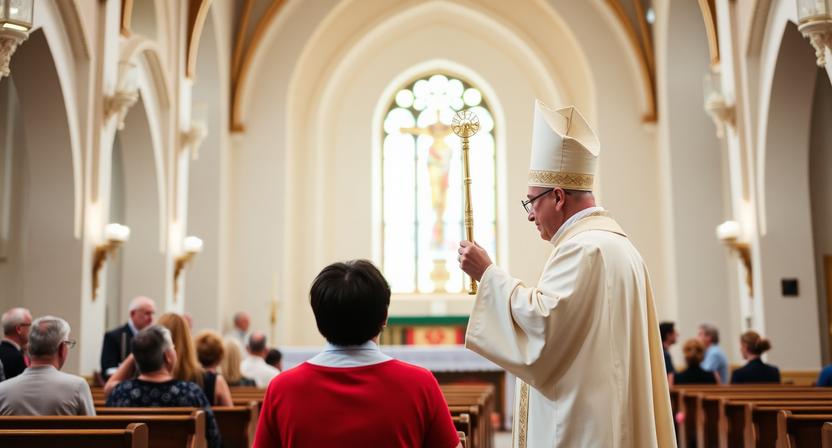
Confirmation Homily
“You will receive power when the Holy Spirit comes on you; and you will be my witnesses.” — Acts 1:8
Confirmation is the sacrament of fire. In the waters of Baptism, we were born into new life. At the table of the Eucharist, we are nourished for the journey. But in Confirmation, the Holy Spirit comes upon us with power — strengthening, deepening, and completing what Baptism began. It is the sacrament of Christian maturity, of personal ownership of faith, of bold witness to the Gospel in the world.
A Confirmation Homily carries a unique pastoral opportunity and responsibility. The candidates being confirmed have, in most cases, reached the age of reason and personal decision. They stand before the Church not simply as recipients of a grace, but as those who are choosing — consciously and freely — to say yes to Christ and to the life of the Spirit. This page offers a complete, rich, and deeply pastoral guide for preaching a Confirmation Homily that will ignite hearts and send young disciples into the world as true witnesses of the faith.
1 What Is Confirmation? — The Sacrament of the Spirit
Confirmation is the second sacrament of Christian initiation, completing what Baptism began and deepening the grace received at the font. The Catechism of the Catholic Church describes it beautifully: Confirmation “perfects Baptismal grace; it is the sacrament which gives the Holy Spirit in order to root us more deeply in the divine filiation, incorporate us more firmly into Christ, strengthen our bond with the Church, associate us more closely with her mission, and help us bear witness to the Christian faith in words accompanied by deeds.” (CCC 1316)
If Baptism is the birth into new life, Confirmation is the coming of age — the moment when the gifts poured out at Baptism are strengthened and stirred up for active mission. The Spirit does not arrive for the first time at Confirmation — the Spirit was already given in Baptism. What happens at Confirmation is a deepening, a strengthening, a sending: the same Spirit who was quietly at work now comes with power, like the wind that fills the sails of a ship and sends it forward into the open sea.
2 Pentecost — The Origin of Confirmation
To understand Confirmation, we must go to its source: the day of Pentecost. Ten days after the Ascension of Jesus, the Apostles were gathered in the Upper Room in Jerusalem — praying, waiting, unsure what would come next. And then it happened. A sound like a rushing mighty wind filled the whole house. Tongues of fire rested on each of them. And they were all filled with the Holy Spirit.
The transformation was immediate and total. The same Apostles who had locked themselves in fear behind closed doors after the crucifixion now burst into the streets of Jerusalem, speaking boldly in languages they had never learned, proclaiming the resurrection of Jesus Christ to thousands of pilgrims from across the known world. Fear became courage. Confusion became clarity. Silence became proclamation. This is what the Holy Spirit does — and this is what Confirmation is meant to continue in the life of every believer.
3 The Seven Gifts of the Holy Spirit
At the heart of the Confirmation Homily is the proclamation of the Seven Gifts of the Holy Spirit — the divine endowments poured into the soul at Confirmation, drawn from the ancient prophecy of Isaiah 11:2–3. These are not merely natural virtues or human qualities. They are supernatural gifts — actual participations in the wisdom and power of God himself, given to equip the confirmed person for Christian living and witness.
| Gift | What It Is | How It Works in Life |
|---|---|---|
| Wisdom | The ability to see life from God’s perspective | Choosing what truly matters; ordering life toward God |
| Understanding | Deep insight into the truths of faith | Grasping what Scripture and the Church truly teach |
| Counsel | Right judgment in difficult situations | Knowing the right thing to do when it is hard |
| Fortitude | Courage to live and proclaim the faith | Standing firm under pressure, ridicule, or persecution |
| Knowledge | Understanding creation in relation to God | Seeing the world as God’s gift; avoiding false values |
| Piety | Loving reverence toward God and holy things | A heart drawn naturally to prayer, worship, and goodness |
| Fear of the Lord | Holy awe and wonder before the greatness of God | A deep reluctance to offend God; wonder at his majesty |
4 Soldiers of Christ — A Tradition Worth Reclaiming
An ancient tradition in catechesis described Confirmation as making the candidate a “soldier of Christ.” This language has fallen out of fashion in recent decades — but the spiritual reality it points to remains as urgent as ever. To be confirmed is to be enlisted in a battle: not a battle of flesh and blood, but the spiritual battle for truth, for goodness, for the Kingdom of God in a world that often resists it.
St. Paul understood this perfectly. His Letter to the Ephesians speaks of the “full armour of God” — the belt of truth, the breastplate of righteousness, the shield of faith, the helmet of salvation, the sword of the Spirit. The confirmed Christian is not called to a life of comfortable religiosity but to active, courageous engagement with the world — bringing the light of the Gospel into every dark corner, defending the weak, proclaiming the truth with love.
5 Freely Choosing Faith — A Personal Yes to God
One of the most beautiful dimensions of Confirmation is that it is — uniquely among the sacraments of initiation — a sacrament of personal, conscious, and deliberate choice. In Baptism, we were carried to the font by our parents and the Church. In Confirmation, we come forward ourselves. We stand before the bishop, we renew our baptismal promises, and we say with our own voice, with our own heart, with our own free will: Yes. I believe. I choose Christ. I accept the Spirit.
This personal dimension is enormously important to emphasise in the Confirmation Homily — especially for the young people being confirmed. Faith is not a heritage to be passively inherited — it is a treasure to be personally claimed. Jesus does not ask us to believe because our parents believed or because our culture expects it. He asks each of us, individually and personally, the question he asked Peter at Caesarea Philippi: “But who do you say that I am?” (Matthew 16:15). Confirmation is the moment of answering that question with the whole of one’s life.
6 The Anointing With Chrism — Sealed With the Spirit
The central gesture of Confirmation is the anointing with Sacred Chrism — a fragrant oil consecrated by the bishop at the Chrism Mass on Holy Thursday. The bishop (or his delegate) lays hands on the candidate and anoints the forehead with the sign of the cross, saying: “Be sealed with the Gift of the Holy Spirit.” The candidate responds: “Amen.” And in that moment, the sacrament is conferred.
The anointing with Chrism is rich with meaning. Oil in Scripture signifies strength, healing, consecration, and joy. The fragrance of Chrism speaks of the “aroma of Christ” that St. Paul says should characterise every Christian life (2 Corinthians 2:15). The word “Christ” itself means “the Anointed One” — and at Confirmation, the candidate is anointed, sharing in the very title and mission of Jesus. They are, in a new and deeper way, anointed as priest, prophet, and king.
7 The Laying On of Hands — An Ancient Gesture of Power
Before the anointing, the bishop extends his hands over all the candidates — a gesture that goes back to the earliest pages of the New Testament. In the Acts of the Apostles, when Philip the deacon had baptised the Samaritans, Peter and John came from Jerusalem and “placed their hands on them, and they received the Holy Spirit.” (Acts 8:17). The laying on of hands is the apostolic gesture of imparting the Spirit — and it has been continuous in the Church from the first Pentecost to this very day.
There is something profoundly moving about this continuity. The bishop who lays hands on the candidates today stands in an unbroken line of succession stretching back through the centuries to the Apostles themselves — who received the Spirit at Pentecost and then passed that same Spirit on to others through this ancient gesture. In Confirmation, the candidates are touched by hands that have been touched by hands, in an unbroken chain of grace reaching back to the Upper Room.
8 The Fruits of the Holy Spirit — The Harvest of a Spirit-Filled Life
While the Seven Gifts describe what the Holy Spirit gives us, the Twelve Fruits describe what grows in a life that is genuinely open to the Spirit. St. Paul lists them in the Letter to the Galatians: “The fruit of the Spirit is love, joy, peace, forbearance, kindness, goodness, faithfulness, gentleness and self-control.” (Galatians 5:22–23). These are not achievements to strive for — they are the natural harvest of a soul that has allowed the Spirit to take root and grow.
A beautiful image for the Confirmation Homily: a tree planted in good soil does not have to work to produce fruit. It simply has to remain rooted — drawing water, receiving sunlight, staying connected to the earth. The confirmed Christian who remains rooted in prayer, in the sacraments, in the community of the Church, in the Word of God — that person will bear the fruit of the Spirit naturally and abundantly. The challenge is not to perform virtues but to remain connected to the Vine.
9 The Role of the Sponsor — A Companion for the Journey
Every Confirmation candidate is accompanied by a sponsor — an older Catholic who stands beside them at the moment of anointing, placing a hand on their shoulder as a sign of support, encouragement, and companionship in faith. This is not a ceremonial role. It is a real spiritual commitment, and the Confirmation Homily is an opportunity to honour and challenge the sponsors present.
The ideal sponsor is someone who lives the faith authentically — who prays, who serves, who has navigated the real difficulties of Christian life and remained faithful. They are not a guide who has arrived but a fellow pilgrim who has walked further down the road. Their role is to accompany the newly confirmed not just on the day but in the years ahead — to be available, to pray for them, to share their experience of faith, and to be a living answer to the question: “What does a confirmed Catholic look like?”
- Pray for your candidate daily — by name, before God
- Share your own faith journey honestly — including its struggles and graces
- Be someone they can call on when faith feels difficult or distant
- Celebrate with them today — and check in with them in the months ahead
- Model what a mature, committed, joyful Catholic life looks like
10 The Confirmation Name — A Patron for Life
At Confirmation, candidates traditionally take a new name — the name of a saint who becomes their patron and companion for the rest of their life. This ancient practice carries a beautiful meaning: in choosing a Confirmation name, the candidate is saying, “I want to be the kind of person this saint was. I want their virtues, their courage, their love for God, to be my model and my aspiration.”
The saint chosen becomes a companion in prayer, an intercessor before God, and a kind of elder brother or sister in faith. The Church’s great roster of saints is extraordinarily diverse — scholars and mystics, martyrs and missionaries, mothers and monks, artists and activists — and every candidate can find a saint whose story resonates with their own gifts and calling. Encourage the candidates to genuinely get to know their patron saint — not merely as a name on a certificate, but as a living member of the Communion of Saints who accompanies them.
11 Called to Be Witnesses — Faith That Goes Public
Jesus’ last words before his Ascension were a commission: “You will receive power when the Holy Spirit comes on you; and you will be my witnesses in Jerusalem, and in all Judea and Samaria, and to the ends of the earth.” (Acts 1:8). These words were not addressed only to the eleven Apostles — they were addressed to everyone who would receive the Holy Spirit, from Pentecost to the end of time. They are addressed today to every person being confirmed.
A witness does not invent their own message. A witness reports what they have seen and heard. The confirmed Christian is called to witness to what they know: that Jesus Christ is risen, that God loves the world, that the Gospel transforms lives, that hope is stronger than despair, that love is stronger than death. This witness happens in a thousand ordinary ways: in how we treat people at work, in what we stand for in school, in the patience we show in our families, in the courage to speak a quiet truth when a lie would be easier.
12 Confirmation and the Eucharist — Initiation Complete
The three sacraments of initiation — Baptism, Confirmation, and the Eucharist — belong together. They are not three separate religious events but three movements of a single divine action: God drawing the human person fully into his own life. Baptism is the birth. Confirmation is the strengthening. The Eucharist is the nourishment for the journey — and the fullest expression of what the Christian life is: the giving and receiving of Christ himself.
After Confirmation, the newly sealed Christians will come forward to receive the Eucharist — as they always do, but now with a deeper understanding of who they are and what they carry. They are anointed ones, sealed with the Spirit, incorporated into Christ, sent into the world. Every Mass they attend from this day forward is a renewal of that commissioning — and the Eucharist is the bread that sustains them for the mission to which the Spirit has sent them.
13 Do Not Grieve the Spirit — Keeping the Flame Alive
St. Paul warns with great pastoral seriousness: “Do not grieve the Holy Spirit of God, with whom you were sealed for the day of redemption.” (Ephesians 4:30). And in his Second Letter to Timothy, he urges: “Fan into flame the gift of God, which is in you through the laying on of my hands.” (2 Timothy 1:6). The gift of the Spirit is real and permanent — but it must be welcomed, cultivated, and not suppressed by sin, by indifference, or by neglect.
This is one of the most important practical messages of the Confirmation Homily: the sacrament opens a door, but the confirmed person must walk through it — and keep walking. The flame lit today will grow or diminish depending on how it is fed. It is fed by prayer, by Scripture, by the sacraments, by service, by the community of the Church, by honest striving for virtue. The Spirit never leaves — but the soul can become deaf to his voice. Keep listening. Keep responding. Fan the flame.
14 A Direct Word to the Candidates
A Confirmation Homily that does not speak directly and personally to the candidates themselves has missed its primary audience. Address them by name if possible — or at least address them as a group, looking them in the eye, speaking to them as the young men and women they are becoming, not as children to be managed but as disciples to be commissioned.
Speak honestly about the world they are being sent into: its beauty and its brokenness, its opportunities and its pressures. Acknowledge that faith will sometimes feel difficult — that there will be moments of doubt, of loneliness, of failure. But speak also of the extraordinary adventure of a life lived in the Spirit — the surprise, the freedom, the joy, the deep purpose of knowing that you are loved by God and called to a mission that matters for eternity. Tell them: you are not ordinary. You are sealed with the Spirit. You are anointed. You are sent. Go.
- You are not alone — the Spirit of God lives within you from this day forward
- Faith will be tested — and that testing is where it grows deepest and strongest
- You do not have to have all the answers — but stay close to the One who is the Answer
- The world needs your faith, your love, your courage — do not keep it hidden
- Come back to the sacraments, to prayer, to the Church — again and again, especially when it is hard
- You are beloved, you are chosen, you are sealed — live like it
15 The Sending Forth — Go, the Spirit Is With You
Every Confirmation Homily must end as Pentecost ended — not with people sitting still but with people going out. The disciples did not linger indefinitely in the Upper Room after the Spirit came. They went out into the streets. They spoke. They proclaimed. They acted. The fire in them could not be contained — and nor should it be. The Spirit is not given to make us comfortable. He is given to make us courageous.
Close the homily with a blessing and a sending. Remind the newly confirmed that the Mass ends — in every language — with a dismissal that is also a commission: “Go and announce the Gospel of the Lord.” The word “Mass” itself comes from the Latin missa — sent. Every Mass is a sending. Today’s Confirmation is a sending in the deepest sense. The Spirit goes with them. Christ walks beside them. The Father watches over them. They are not going alone — they are going filled, anointed, sealed, and sent. Let the world be different because they passed through it.
“Come, Holy Spirit, Fill the Hearts of Your Faithful”
Come, Holy Spirit, fill the hearts of your faithful and kindle in them the fire of your love. Send forth your Spirit and they shall be created — and you shall renew the face of the earth. Lord, grant that these your servants, sealed with the gift of your Spirit today, may go forth as bold witnesses of your love, faithful disciples of your Son, and living flames of your grace in a world that hungers for your light. Amen.
