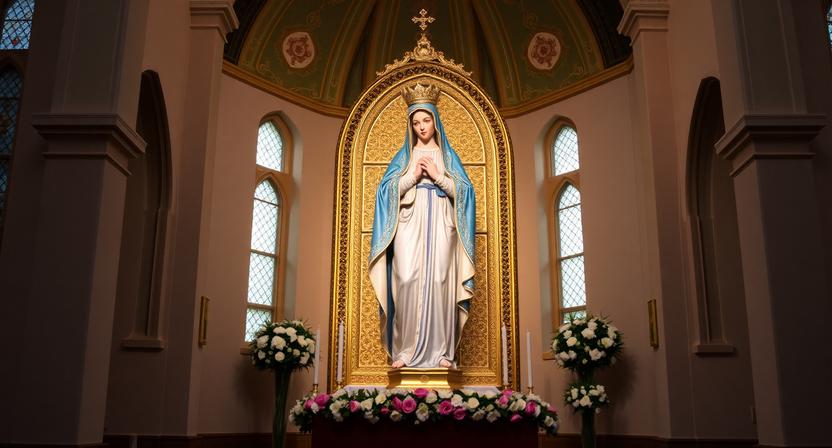
Blessed Virgin Mary
Month of May Devotion
✦ Marian Homily · End of May Devotion ✦
A complete homily celebrating Our Lady at the close of May — her faith, her fiat, her intercession, and her eternal call to bring us to her Son.
For Priests, Deacons & the Faithful. This homily covers all 15 key elements of Marian devotion — Scripture, apparitions, the Rosary, the Magnificat, and a closing prayer of consecration. Suitable for Mass, prayer groups, and May devotion gatherings.
✦ Contents of This Homily
- Mary — Mother of Jesus and Mother of the Church
- Why May Belongs to Mary
- Key Bible Passages About Mary
- Mary’s “Yes” to God — The Fiat
- The Magnificat — Her Song of Praise
- Mary as Model of Faith and Discipleship
- The Rosary and Marian Devotion
- Apparitions and Marian Messages
- Mary’s Role in Difficult Times
- Miracles Through Mary’s Intercession
- Mary in Family Life
- Purity and Holiness
- Mary Leads Us to Jesus
- Practical Marian Commitments
- Closing Prayer and Consecration
Dear brothers and sisters in Christ,
As the beautiful month of May draws to its close, we gather one final time to honour she who is clothed with the sun, crowned with twelve stars, and given to us by Christ himself as our Mother. We have spent these weeks of May adorning her altars with flowers, praying her Rosary, and lifting our hearts to heaven. Today, let us sit at her feet and reflect on who she truly is — and what she is calling each of us to become.
Mary — given to us by Christ himself from the Cross as Mother of all the faithful.
Mary — Mother of Jesus and Mother of the Church
There is no more tender title in all of Christianity than this: Mother. When Jesus hung on the Cross in his final agony, he looked down and saw two people he loved most — his mother Mary, and the beloved disciple John. And in that moment of supreme sacrifice, he did not speak of his pain. He spoke of relationship. He said to Mary: “Woman, behold your son.” And to John: “Behold your mother.” (John 19:26–27)
In that sacred exchange, Jesus gave us one of his greatest gifts — a Mother. Not just a historical figure to admire from a distance, but a living, interceding, ever-present Mother who walks with the Church through every century, every suffering, and every moment of joy.
As Pope Saint Paul VI declared in 1964, Mary is the Mother of the Church — not merely a symbol, but a real spiritual mother who loves each one of us by name. She who nurtured the Saviour of the world in her womb, who fed him, taught him to walk, and stood at his cross without fleeing — that same woman is ours. She is your mother. She is mine.
Why May Belongs to Mary
Have you ever wondered why the Church chose May — of all the months of the year — to honour Our Lady? The answer is as beautiful as the month itself. May is the month of spring in the northern hemisphere — the season of blossoming flowers, of new life, of the earth’s awakening after winter. And what better image for Mary than a flower in full bloom?
This tradition dates back to the 13th century, when devotion to Mary in May flourished in Europe. The flowers that bloomed in spring were offered to her as natural garlands of praise. Over the centuries, this grew into the formal practice of May devotions — the May altars in homes and churches, the crowning of Mary’s statue, the daily Rosary, and the litanies and hymns that fill the month.
Mary is the Rosa Mystica — the Mystical Rose — beautiful in her purity, fragrant in her holiness, and radiant in her closeness to God. Just as the rose is the queen of flowers, Mary is the Queen of all the saints. As May ends today, let us carry the fragrance of this month into the rest of the year.
The month of May — blooming flowers, renewed faith, and tender devotion to Our Lady, the Mystical Rose.
Key Bible Passages About Mary
Mary is not a creation of Catholic tradition alone — she is woven into the very fabric of Sacred Scripture. From the first promise in Genesis to the vision of Revelation, the presence of the woman chosen by God shines through the Bible. Let us walk briefly through four of the most luminous scenes.
✦ Four Great Marian Moments in Scripture
- Luke 1:26–38 The Annunciation — The Angel Gabriel appears to Mary in Nazareth. In humility and trust, she gives her total “Yes” to God. She conceives the Son of God by the Holy Spirit.
- Luke 1:39–56 The Visitation — Mary hastens to serve her elderly cousin Elizabeth. At her arrival, John leaps in the womb, and Elizabeth cries: “Blessed are you among women!” Mary responds with the Magnificat.
- John 2:1–11 Wedding at Cana — Mary notices the couple’s need and intercedes with her Son. At her request, Jesus performs his first miracle. Her last recorded words in Scripture: “Do whatever he tells you.”
- John 19:25–27 Mary at the Cross — Mary does not flee. She stands — steadfast in agony and love — at the foot of the Cross as her Son dies to save the world. She is given to us as Mother.
Each of these scenes reveals a different facet of Mary’s soul: her obedience, her charity, her intercession, and her suffering love. She is not a passive figure — she is active, courageous, and deeply engaged in the story of our salvation. When we read Scripture, we find Mary walking always toward the cross, always toward Christ, always drawing others to him.
Mary’s “Yes” to God — The Fiat
Of all the moments in human history, none may be more decisive than this: a young girl in Nazareth, perhaps fourteen or fifteen years of age, alone with an angel, being asked to bear the Son of God — to carry in her womb the one who carries the entire universe. The weight of that moment is impossible to fully grasp.
And yet, without hesitation, without conditions, without knowing all that would follow — the flight to Egypt, the sword that would pierce her soul, the hill of Calvary — she said: “Behold, I am the handmaid of the Lord. May it be done to me according to your word.” (Luke 1:38)
One word in Latin sums up her entire spiritual life: Fiat — “Let it be done.” Where Eve said No to God and brought death into the world, Mary said Yes and brought Life itself into the world. This single act of humble surrender reversed the course of human history.
Brothers and sisters, we too are called to our own fiat — our own daily “yes” to God. It may not come through an angelic visit, but it comes through the daily invitation of grace: to forgive when it is hard, to serve when we are tired, to trust when we cannot see. Each time we choose God’s will over our own, we echo Mary’s great Yes.
The Magnificat — Mary’s Song of Praise
When Mary arrives at the home of Elizabeth, she does not speak of her own greatness. Instead, she breaks into song. The Magnificat is the most beautiful canticle of the New Testament — a song of radical gratitude, deep humility, and prophetic vision. It has been prayed by the Church every single day for two thousand years in Evening Prayer.
✦ The Magnificat (Luke 1:46–55)
“My soul proclaims the greatness of the Lord; my spirit rejoices in God my saviour. For he has looked upon his handmaid’s lowliness; behold, from now on will all ages call me blessed. The Mighty One has done great things for me, and holy is his name. His mercy is from age to age to those who fear him. He has thrown down the rulers from their thrones but lifted up the lowly. The hungry he has filled with good things; the rich he has sent away empty.”
Notice what Mary praises God for: not wealth, not power, not comfort — but for looking upon her lowliness. She is the Queen of heaven, and yet she calls herself the Lord’s humble servant. This is the secret of her greatness. God does not raise the proud. He raises the humble. The Magnificat is not just Mary’s prayer — it is the model for every Christian soul.
Mary as Model of Faith and Discipleship
The Second Vatican Council, in its great document Lumen Gentium, called Mary “a model of the virtues” — the perfect disciple, the first and greatest of all Christians. She did not have the advantage of seeing the Resurrection before she believed. She believed first, and the Resurrection confirmed what her heart already knew.
Consider the four great virtues she models for us:
✦ Mary’s Four Great Virtues for Our Imitation
- Prayer: She is found in prayer at the Annunciation, at the Visitation, at Pentecost, and throughout the early Church. She teaches us that intimacy with God is the foundation of everything.
- Purity: In body, mind, and spirit, Mary was wholly consecrated to God. Her purity was not merely the absence of sin but the radiance of total love.
- Patience: She waited thirty years in Nazareth as her son grew in wisdom and age. She waited at the Cross. She waited in the Upper Room. She teaches us that God’s timing is always perfect.
- Courage: She stood at Calvary when most had fled. She bore suffering without bitterness, without despair, without loss of faith. This is heroic virtue — the kind the world desperately needs today.
The Rosary and Marian Devotion
The four sets of Mysteries of the Rosary — meditating on the life of Christ with Mary as our guide.
Saint John Paul II called the Rosary “my favourite prayer” — and he was a pope who had witnessed war, totalitarianism, assassination attempts, and the suffering of millions. He found in the Rosary not an escape from reality but a way of seeing reality through the eyes of faith.
The Rosary is not mere repetition of words. It is meditation on the life of Christ — his birth, his ministry, his suffering, and his glory — with Mary as our guide, our teacher, and our companion on the journey. With each decade, we hold the mystery in our hearts the way Mary held all things in her heart, pondering them (Luke 2:19).
Saint Louis de Montfort wrote that “the Rosary is the weapon for our time.” The great Marian apparitions of the modern era — Fatima, Lourdes, and others — all centred on the same urgent invitation: Pray the Rosary. Pray the Rosary. Pray the Rosary. As we close this Month of May, let us resolve to make this prayer not merely a habit of May, but the anchor of our daily life.
Apparitions and Marian Messages
Throughout the centuries, and especially in times of great spiritual danger, heaven has opened and Our Lady has appeared — not to command empires or to announce new doctrines, but to call her children back to the basics of the faith: prayer, penance, and trust in God.
In a small grotto in southern France, Mary appeared eighteen times to fourteen-year-old Bernadette Soubirous. She identified herself as the Immaculate Conception and asked for prayer, penance, and the building of a chapel. Millions have visited Lourdes and received healing — physical and spiritual. The Church recognises 70 miraculous cures that defy medical explanation.
In Portugal, in the shadow of World War I, Mary appeared to three shepherd children — Lucia, Francisco, and Jacinta — and gave an urgent message for the world: pray the Rosary daily, do penance, make reparation for sin, and consecrate Russia to her Immaculate Heart. On October 13, 1917, over 70,000 witnesses saw the sun dance in the sky — a miracle that was reported in secular newspapers across Europe.
Both messages share the same heart: God loves the world, the world is in danger, and Mary — as a mother — is weeping and interceding. The messages of Fatima in particular speak urgently to our own time. The call to pray, repent, and consecrate our lives to God is not less relevant today — it is more urgent than ever.
Mary’s Role in Difficult Times
There is a reason why, throughout history, people have turned to Mary in times of war, plague, persecution, and personal sorrow. She is not distant. She is not cold. She is a mother who has known suffering in a way that few human beings have — she watched her innocent Son die in agony, and she did not turn away.
When you are sick and afraid — she has been there. When you have buried a child — she has been there. When your family is broken and you cannot see any way forward — she has been there. The sword that Simeon prophesied (Luke 2:35) pierced her soul not once but many times. She understands the weight of your cross because she has carried one of her own.
Across the world, in hospital rooms, in prisons, in refugee camps, and in the silent suffering of ordinary homes, people have called on Mary and found not an answer to every question, but the grace to endure, the peace that surpasses understanding, and the quiet certainty that they are not alone. This is her gift to those who suffer: her presence.
✦ “She Is With You”
“If you fear death, think of Mary. If you are tempted, look to Mary. If you wander lost in the darkness, call upon Mary. In danger, difficulty, and doubt — think of Mary, call on Mary, do not leave her, do not lose her. Following her, you will not go astray. Trusting in her, you will not despair. With her interceding, you will reach the harbour.” — St. Bernard of Clairvaux
Miracles Through Mary’s Intercession
✦ A Mother’s Prayer at Lourdes
A young mother from Italy named Vittorio Micheli had a cancerous tumour that had almost completely destroyed his left hip joint. In 1963, he was brought to Lourdes on a stretcher, unable to walk. After bathing in the waters, he returned home. Within months, his medical team was astounded: the hip joint had completely and inexplicably regenerated. He walked again. The Church recognised this as one of the official Lourdes miracles. When asked to explain it, Vittorio said simply: “I prayed, and Our Lady heard me.”
✦ The Rosary and a Family’s Healing
In the early years of the Fatima apparitions, Sister Lucia reported that families who prayed the Rosary together experienced a renewal of love, peace, and forgiveness in their homes — even in the most fractured relationships. “There is no problem,” she wrote, “no matter how difficult — whether temporal or above all spiritual, in the personal life of each one of us, of our families, of the families of the world, or of the religious communities, or even of the life of peoples and nations, that cannot be resolved by the Rosary.”
These are not fairy tales. They are the testimony of millions of ordinary people who called upon a mother’s love and were heard. Mary does not replace Christ — she leads us to him. And Christ, who honoured his mother in life, honours her intercession still.
Mary in Family Life
The home of Nazareth was the first domestic church. In that small, poor, hidden house in Galilee, the holy family lived the ordinary life — work and prayer, meals and silence, laughter and growth. And Mary was the heart of that home. She created an atmosphere where God could be at home in the world.
Mothers: look to Mary. She raises her child in poverty and uncertainty, yet never loses trust in God. She does not know all the answers to the questions her son raises — but she pondered them in her heart. This is the secret of Marian motherhood: not having all the answers, but keeping the questions close to God in prayer.
Fathers: the home of Nazareth was also shaped by the silent, faithful presence of Joseph — but it was Mary who held it all together in love. Honour her in your homes. Place her image where the family gathers. Pray the Rosary together. Make her part of your family’s daily life, not just a figure for May altars.
Young people: Mary was a teenager when she said “Yes” to God. She was young, and she changed the world. Your age is not an obstacle to holiness — it is a gift. Give it to God, as she did.
Children: when you pray the Hail Mary, you are speaking directly to a mother in heaven who loves you more than you can imagine. She is real. She hears you. She is yours.
Purity and Holiness — Mary’s Shining Example
The Church teaches that Mary was conceived without original sin — the Immaculate Conception — and that she lived her entire life in a state of perfect union with God’s grace. This is not a doctrine that distances her from us. It is a vision of what the human soul can become when it is fully open to God.
Purity, in the deepest Catholic sense, is not simply a matter of physical chastity — though that is part of it. Purity is the integration of the whole person — body, mind, heart, and will — around the love of God. It is the opposite of a fragmented, divided life. Mary’s purity was her wholeness. She was not torn between God and the world because she had chosen God entirely.
In an age that reduces the human person to appetite and image, Mary stands as a radical counter-sign. She is beautiful — not because of fashion or flattery, but because she is holy. And holiness is the most profound beauty a human being can possess. As we conclude this month, let us ask her to purify our hearts — to help us desire what is good, to love what is true, and to see beauty as God sees it.
Mary Leads Us Always to Jesus
Mary’s every word, every gesture, every intercession points beyond herself — always to Jesus.
Some people worry that devotion to Mary might somehow compete with devotion to Christ. This misunderstands both Mary and the nature of Marian devotion. Mary never pointed to herself. Her last words in the Gospel are: “Do whatever he tells you.” (John 2:5) She did not say: “Come to me.” She said: “Go to him.”
Saint Louis de Montfort, the great apostle of Marian devotion, wrote that the surest, quickest, and easiest road to Jesus is through Mary — ad Jesum per Mariam — to Jesus through Mary. Not because she is equal to Jesus, but because she is the most perfectly aligned human soul with Jesus. She is the fastest road to him precisely because she is already so completely in him.
Saint Pope John Paul II chose as his papal motto: Totus Tuus — “Totally Yours” — addressed to Mary. Yet no one would accuse John Paul II of insufficient devotion to Christ. His love for Mary was inseparable from his love for her Son. This is the proper ordering of Marian devotion.
Practical Marian Commitments
As we close this month of May, let us not simply feel moved for an hour and then return to our usual routines unchanged. Let us make real, practical commitments — small, daily acts of Marian devotion that will deepen our relationship with Our Lady and, through her, with Christ.
✦ Five Commitments to Begin Today
- The Daily Rosary: Even one decade a day is a beginning. Bring your family, your suffering, your intentions to Mary each day in this prayer.
- Family Prayer: Restore or establish a time of prayer in your home. Light a candle before Mary’s image. Pray together before meals and before bed.
- Scripture Reading: Spend five minutes each day with the Bible. Read the passages that feature Mary — let her lead you into the Word of God.
- Acts of Charity: Mary ran to serve Elizabeth without being asked. Follow her example — one unexpected act of service this week for someone who cannot repay you.
- Marian Consecration: Consider making or renewing a formal consecration to Mary — offering your whole life to Jesus through her hands, following the path of St. Louis de Montfort or St. Maximilian Kolbe.
A Strong Conclusion — Inspiration and Prayer
Dear brothers and sisters, as the flowers of May fade and the warmth of spring gives way to summer, let us carry Mary in our hearts throughout the rest of the year. She does not retreat when May ends. She is always with us — at the bedside of the sick, in the silence of a struggling soul, in the ordinary beauty of a family gathered for dinner, in every prayer whispered in the dark.
The world often tells us that we are alone — that suffering has no meaning, that hope is naive, that love ends. Mary tells us something different. She tells us what the angel told her: Do not be afraid. She tells us what she told the wedding servants: Do whatever he tells you. She tells us what she told all of history by her very existence: God keeps his promises.
Go home today carrying her. Pray her Rosary. Bring your children before her image. When you are afraid, call on her. When you are grateful, bring your joy to her. When you are lost, let her lead you back to her Son.
And as we close this beautiful month, let us pray together the prayer of the Church — her oldest and most beloved prayer to the Mother of God:
✦ Closing Marian Prayer & Consecration
Despise not our petitions in our necessities,
but deliver us from all dangers,
O ever-glorious and blessed Virgin.
Holy Mary, Mother of God and Mother of the Church,
as we close this month of May,
we place our lives, our families, and our futures
into your maternal hands.
Lead us always to your Son.
Teach us to say “Yes” as you said “Yes.”
Cover us with your mantle in times of trial,
and bring us at the last to the joy of heaven,
where you reign as Queen of all the Saints.
Our Lady of Fatima, pray for us.
Our Lady of Lourdes, pray for us.
Our Lady, Queen of the Rosary, pray for us.
Our Lady, Mother of the Church, pray for us.
