HomilySunday.com › Marian Homilies › Mother of Sorrows Homily ✦ Marian Homily Series ✦
Mother of Sorrows Homily: Our Lady of Sorrows and the Grace of Suffering
📅 June 2026 · ⏱ 35 min read
“Is it nothing to you, all you who pass by? Look around and see. Is any suffering like my suffering that was inflicted on me, that the Lord brought on me in the day of his fierce anger?” — Lamentations 1:12
“And a sword will pierce your own soul too.” — Luke 2:35
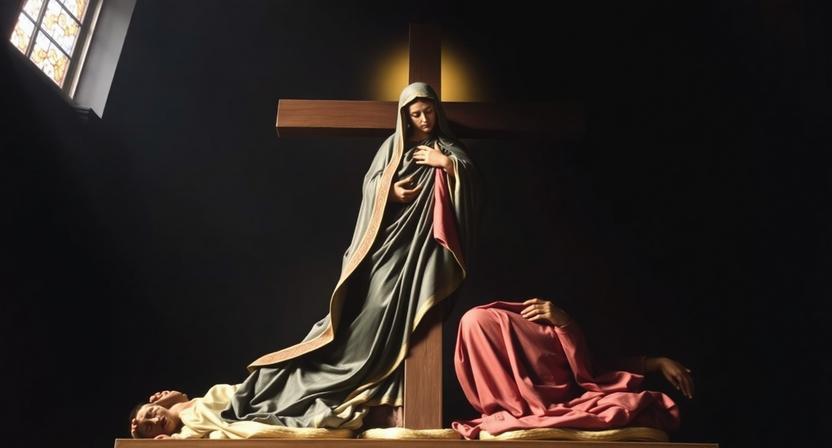
On September 15th — the day after the Feast of the Exaltation of the Holy Cross — the Church celebrates the Feast of Our Lady of Sorrows, Mater Dolorosa. This feast invites the whole Church to contemplate Mary not primarily as queen or intercessor, but as the woman who has suffered most deeply and most faithfully in all of human history — whose seven sorrows have made her the incomparable companion of every human being who has ever known grief, loss, or pain. The Mother of Sorrows Homily does not shy away from the cost of Mary’s vocation. It holds it before the congregation with reverence and honesty — and then shows how her suffering, united with the suffering of her Son, becomes not a wound but a crown, not a tragedy but a path of grace.
📋 Outline — Mother of Sorrows Homily
- Our Lady of Sorrows — History of the Feast
- The Seven Sorrows of Mary — A Complete Guide
- The First Sword — Simeon’s Prophecy
- The Second Sword — Flight into Egypt
- The Third Sword — The Loss of Jesus in the Temple
- The Fourth Sword — Mary Meets Jesus on the Way to Calvary
- The Fifth Sword — The Crucifixion and Death of Jesus
- The Sixth Sword — The Taking Down from the Cross
- The Seventh Sword — The Burial of Jesus
- Mary’s Sorrows and Human Suffering — The Pastoral Meaning
- The Chaplet of the Seven Sorrows — Praying with Mary
- Mary Mediatrix of Grace — Suffering Transformed
- A Complete Mother of Sorrows Homily — Homily Text
- Closing Prayer to Our Lady of Sorrows
Related Marian & Passion Homilies
- Mary at the Foot of the Cross
- Comfort Through Mary Homily
- Marian Homily — Month of May
- Suffering Homily
- Lenten Homily
- Funeral Homily
- Hope Homily
1 Our Lady of Sorrows — History of the Feast
The devotion to Our Lady of Sorrows is one of the oldest and most widespread in the Catholic Church — rooted in Scripture, developed by the Church Fathers, elaborated by medieval mystics and artists, and formally enshrined in the liturgical calendar by the universal Church. Its origins lie in the grief-saturated poetry of the Old Testament (particularly Lamentations and the Psalms of lament), the Passion narratives of the Gospels, and the centuries of reflection by Christians who found in Mary’s suffering a mirror of their own.
The formal title Mater Dolorosa — Sorrowful Mother — developed in the medieval period, particularly through the influence of the Servite Order (Order of Servants of Mary), which was founded in Florence in 1233 and placed the sorrow of Mary at the heart of its spirituality. The Servites propagated the devotion of the Seven Sorrows across Europe, and the Stabat Mater — one of the great medieval liturgical hymns — became the devotion’s defining musical expression.
✦ Timeline of the Feast
1233 — Order of Servants of Mary (Servites) founded; seven founders meditate on Mary’s sorrows. 1413 — Feast of Our Lady of Sorrows approved for the Servite Order. 1727 — Pope Benedict XIII extends the feast to the whole Church (third Sunday of September). 1814 — Pope Pius VII moves the feast to September 15 as a permanent universal feast. 1969 — Post-Vatican II calendar confirms September 15 as a memorial, directly following the Feast of the Exaltation of the Cross (September 14).
2 The Seven Sorrows of Mary — A Complete Guide
The Seven Sorrows of Mary are not an arbitrary collection. They trace the arc of Mary’s participation in the mystery of Christ — from the shadow at his birth to the sealing of his tomb — forming a complete portrait of a life shaped by suffering and sustained by faith. Each sorrow has its own Scripture foundation, its own theological meaning, and its own pastoral resonance for those who pray with it.
| # | Sorrow | Scripture | Pastoral Meaning |
|---|---|---|---|
| I | The Prophecy of Simeon | Luke 2:34–35 | Living with the foreknowledge of suffering; accepting what we cannot change |
| II | The Flight into Egypt | Matthew 2:13–15 | Refugees; the vulnerability of God; trust in a dangerous world |
| III | The Loss of Jesus in the Temple | Luke 2:41–50 | Searching for God; the anguish of not knowing where he is |
| IV | Meeting Jesus on the Way to Calvary | Luke 23:27–31 | Helplessness before suffering we cannot stop; love that cannot turn away |
| V | The Crucifixion and Death of Jesus | John 19:25–30 | Standing at the cross; faith without consolation; love stronger than death |
| VI | The Taking Down from the Cross | Luke 23:53 | Holding what has been broken; the Pietà; grief that has no words |
| VII | The Burial of Jesus | John 19:40–42 | The sealed tomb; Holy Saturday; living without visible hope |
3 The First Sword — Simeon’s Prophecy
Mary’s first sorrow arrives not at the cross but in the Temple — on the day of the Presentation, forty days after the birth of Jesus. The old prophet Simeon, holding the infant in his arms, speaks words of joy and then words of warning: “And a sword will pierce your own soul too” (Luke 2:35). This is the shadow that falls across the whole of Mary’s life from that moment — the knowledge, never quite forgotten, that the mission her son was born to accomplish would cost him — and her — everything.
What is remarkable about this first sorrow is how early it comes — and how Mary responds to it. There is no record of protest, no bargaining with God, no attempt to evade the implications. Luke records simply that “Mary treasured all these things in her heart” (Luke 2:51) — pondering them, carrying them, holding them in faith without yet understanding them. This pondering heart is one of the most important descriptions of Mary in the Gospels: a woman of deep interiority who does not run from what she does not understand, but holds it in the presence of God.
“This child is destined to cause the falling and rising of many in Israel, and to be a sign that will be spoken against… And a sword will pierce your own soul too.” — Luke 2:34–35
4 The Second Sword — Flight into Egypt
The second sorrow comes by night, with urgency and fear. An angel warns Joseph in a dream: “Get up, take the child and his mother and escape to Egypt. Stay there until I tell you, for Herod is going to search for the child to kill him” (Matthew 2:13). The Holy Family become refugees — fleeing with a newborn, leaving everything familiar, travelling to a foreign country where they will be strangers and exiles for an unknown period.
This sorrow speaks with particular power to every displaced family, every refugee, every person who has had to flee their home for reasons of violence or persecution. The God who came to save the world began his life as a displaced person, carried by a mother who had to trust that the same God who sent her on this impossible journey would provide for them in the unknown. Mary’s second sorrow is a sorrow shared by millions in every generation — and her faithfulness in it is a source of hope and solidarity to all who suffer displacement.
5 The Third Sword — The Loss of Jesus in the Temple
The third sorrow is, on the surface, the most domestic of the seven — and yet it probes something very deep about Mary’s relationship with her Son and with the God who gave him to her. When the twelve-year-old Jesus remains behind in the Temple and is lost for three days, Mary and Joseph search in anguish. When they find him, Mary’s response is entirely human: “Son, why have you treated us like this? Your father and I have been anxiously searching for you” (Luke 2:48).
Jesus’ reply — “Did you not know that I must be about my Father’s business?” — is both illuminating and puzzling. Luke records that Mary and Joseph “did not understand what he was saying to them.” Here is one of the most honest moments in all of Marian theology: the Mother of God did not understand her Son. She did not have all the answers. She did not possess some supernatural clarity that placed her above the ordinary human struggle to comprehend the ways of God. She pondered. She held. She trusted without fully understanding.
📖 A Story for the Homily
A woman described losing her teenage daughter to a religious vocation the family had not anticipated. “She left for the convent at eighteen,” she said, “and I grieved for two years. Not because I didn’t respect her choice — but because I didn’t understand it. I couldn’t feel it from the inside. And I kept thinking of Mary, losing Jesus in the Temple, not understanding why he needed to be there. And somehow that helped me. Mary didn’t understand either. And she was still the greatest of the saints. You can trust without understanding. That was what I had to learn.”
6 The Fourth Sword — Mary Meets Jesus on the Way to Calvary
The fourth sorrow is not explicitly recorded in the Gospels, but has been part of Catholic devotional tradition from the earliest centuries, and is the fourth Station of the Cross: the meeting of Mary and Jesus on the Via Dolorosa, as he carries the cross toward Golgotha. The Gospels record that women of Jerusalem wept and mourned for Jesus on the way to Calvary (Luke 23:27–29) — and tradition has always placed Mary among them.
This moment — mother and son, face to face, on the road to his execution — is one of the most humanly devastating in the entire Passion narrative. What do you say? What do you do? There is nothing to say, nothing to do, except to be present to a situation that cannot be changed and must simply be borne. The sword that Simeon prophesied thirty-three years earlier is now fully drawn, and Mary walks toward it rather than away from it.
7 The Fifth Sword — The Crucifixion and Death of Jesus
The fifth and central sorrow is the death of Jesus on the cross — the sorrow that all the others have been preparing, and from which all the Marian tradition of compassion and co-suffering flows. We have treated this sorrow at length in the homily on Mary at the Foot of the Cross. Here we place it in the context of the whole movement of the seven sorrows — seeing it not as an isolated moment of grief, but as the culmination and the centre of a whole life offered in faith.
Mary’s compassio at the cross — her co-suffering with her Son — is the fullest expression of her vocation. She who said “yes” to the Incarnation now says “yes” to the Passion. She who gave him flesh now gives him back to the Father. The theologian Hans Urs von Balthasar describes Mary at the cross as the “handmaid of the Lord” in her most complete expression: having given everything, receiving everything, and standing in the space between gift and gift with nothing held back.
“Near the cross of Jesus stood his mother… When Jesus therefore saw his mother, and the disciple standing by, whom he loved, he said to his mother, ‘Woman, behold your son!'” — John 19:25–26
8 The Sixth Sword — The Taking Down from the Cross
The sixth sorrow is the deposition — the taking down of Jesus’ body from the cross and its placement in Mary’s arms. This is the scene immortalised in the Pietà — the most reproduced image in the history of Christian art. Michelangelo’s marble version in St Peter’s Basilica, created in 1499 when the artist was only twenty-four, shows a young Mary — some have wondered at her youth — holding the adult body of her dead son across her lap. She is composed, but she is holding everything.
The Pietà — Italian for “pity” or “compassion” — is the image of a mother who has outlived her child, holding in her arms the body that she once held as an infant. The sorrow of the Pietà is the sorrow of every parent who has buried a child, every person who has held a dying loved one, every human being who has cradled in their arms the remains of what they loved. Mary in the Pietà does not drop the body, does not turn away, does not rush toward closure. She holds. She stays. She loves, even in the silence of death.
“The Pietà is not the image of defeat. It is the image of a love that will not let go — that holds even what it has lost, trusting that the God who gave will give again.”
9 The Seventh Sword — The Burial of Jesus
The seventh sorrow is the burial of Jesus — the sealing of the tomb, the rolling of the stone, the formal end of what she had given her life to. The Gospels tell us that Mary Magdalene and “the other Mary” (Matthew 27:61) sat opposite the tomb, watching. Joseph of Arimathea wrapped the body and laid it in the tomb. The stone was rolled in place. And that was that.
The seventh sorrow is the sorrow of Holy Saturday — the longest day of the year, spiritually speaking. The day when the disciples (and Mary with them) had to live without knowing the ending. The day when the tomb was sealed and Easter had not yet come. This is the sorrow of everyone who is living in the middle of their story, without the comfort of knowing how it ends — everyone who prays without obvious answer, who waits without visible hope, who trusts a God who seems, at this moment, to be absent.
✦ The Grace of Holy Saturday
Pope John Paul II wrote movingly of Mary on Holy Saturday as the one who, alone among human beings, held the faith of the whole Church between the death and the resurrection of Jesus. While the disciples scattered, while Peter denied, while the Eleven hid in fear — Mary kept faith. She was the Church on Holy Saturday. She carried the flame of faith through its darkest night. And when Easter came, her faith was vindicated beyond anything she had dared to hope.
10 Mary’s Sorrows and Human Suffering — The Pastoral Meaning
Why does the Church give us the Seven Sorrows of Mary? Not for morbid meditation or spiritual self-indulgence. The Seven Sorrows are given to the Church as a pastoral gift — a framework within which every kind of human suffering can be named, held, and offered in union with Mary’s suffering and the suffering of Christ. There is no human sorrow that is not, in some form, reflected in Mary’s seven sorrows. And there is no sorrow that is beyond the reach of her compassion.
- The sorrow of foreknowledge — knowing that something terrible is coming and being unable to prevent it. Every person who watches a loved one’s decline, every parent who sees a child heading toward disaster, knows something of the First Sword.
- The sorrow of displacement — being uprooted from home, family, and everything familiar by circumstances beyond one’s control. The refugee, the immigrant, the bereaved who finds their home unrecognisable without the one they lost — these know the Second Sword.
- The sorrow of incomprehension — the anguish of not understanding why God is doing what he is doing, or allowing what he is allowing. The Third Sword gives Mary’s solidarity to everyone who prays “Why?” into a silence that does not answer.
- The sorrow of helplessness — watching someone you love suffer and being unable to stop it. The Fourth Sword is the sorrow of every carer, every parent at a hospital bedside, every person who has had to watch without being able to intervene.
- The sorrow of loss — the death of the person most central to your existence. The Fifth Sword is the universal human sorrow — amplified in Mary to a degree no one else has known, but shared in some measure by everyone who has loved and lost.
- The sorrow of aftermath — the sorrow of the hours and days after the worst has happened. The Sixth Sword is the sorrow of the long aftermath of loss, when the crisis has passed and the grief settles in.
- The sorrow of waiting — Holy Saturday, the sealed tomb, the God who seems absent. The Seventh Sword is the sorrow of everyone who waits for God in a darkness that does not lift.
11 The Chaplet of the Seven Sorrows — Praying With Mary
The Chaplet of the Seven Sorrows (also called the Rosary of the Seven Sorrows) is a traditional Marian prayer that meditates on each of the seven sorrows of Mary in turn. It is attributed to the Servite Order and has been practised since the medieval period as a means of uniting one’s own sorrows with those of Mary and, through Mary, with the Passion of Christ.
The structure of the chaplet — seven groups of seven beads, each group introduced by an Our Father and a meditation on one of the sorrows, followed by seven Hail Marys — creates a contemplative rhythm that allows the one praying to enter deeply into each sorrow without hurrying. The prayer is particularly recommended as a preparation for the Feast of Our Lady of Sorrows (September 15), as a Lenten devotion, and as a prayer for those who are grieving or accompanying the dying.
St Alphonsus Liguori described the Chaplet of the Seven Sorrows as one of the most effective means of growing in compassion — both for Mary’s sorrows and for the sufferings of those around us: “He who meditates upon the sorrows of Mary will learn to bear his own sorrows with patience and even with joy.”
12 Mary Mediatrix of Grace — Suffering Transformed
The Catholic tradition has always understood Mary’s sorrows not as a dead end but as a source — a wellspring of grace for the whole Church. As Vatican II’s Lumen Gentium teaches: “Taken up to heaven she did not lay aside this salvific duty, but by her constant intercession continued to bring us the gifts of eternal salvation.” The suffering of Mary — united with the suffering of her Son — has been transformed into intercession, into compassion, into the inexhaustible maternal care she exercises for every member of the Body of Christ.
Pope Francis has spoken movingly of Mary under her title Our Lady Undoer of Knots — a title that captures the sense in which her prayers, rooted in her own experience of suffering and of God’s faithfulness, are able to untangle the most complex, painful, apparently hopeless knots of human life. She who carried the knot of Simeon’s prophecy for thirty-three years knows how to hold a knot in prayer. She who survived the sealing of the tomb knows that no situation is beyond the reach of the God who rolls away stones.
“Therefore he is able to save completely those who come to God through him, because he always lives to intercede for them.” — Hebrews 7:25
13 A Complete Mother of Sorrows Homily — Homily Text
Suitable for September 15 (Feast of Our Lady of Sorrows), Lent, the Stations of the Cross, funerals, or any context of deep pastoral grief. Adapt freely.
If you want to understand what the Church means when she calls Mary the Mother of Sorrows, you do not need to consult a theology textbook. You need only to have lost something — or someone — you could not bear to lose.
Then look at her.
She has been where you are. She has carried what you carry. Seven times the tradition counts her sorrows — but anyone who has lived with grief knows that sorrow does not come in countable doses. It comes in waves. It comes at unexpected moments. It comes with a force that takes the breath away even years after the wound was first inflicted. Mary knows this. She carried Simeon’s prophecy for thirty-three years — a shadow she could not escape, a foreknowledge she could not undo, a sword that she knew was coming and could not stop.
“Is it nothing to you, all you who pass by? Look around and see. Is any suffering like my suffering?” — Lamentations 1:12
The Church places this verse from Lamentations alongside the image of Our Lady of Sorrows — not because Mary is speaking it, but because it resonates with what she endured. “Is any suffering like my suffering?” The answer, in the human realm, is no. No mother has ever loved as purely, as completely, as Mary loved. And therefore no mother’s grief at the loss of a child has ever been as pure, as complete, as devastating as hers.
And yet. And yet she was not destroyed by it.
This is the mystery at the heart of the devotion to Our Lady of Sorrows. She is not presented to us as a woman who escaped suffering, or who was given some divine anaesthetic that made the pain less real. She is presented as a woman who suffered fully — more fully than any other human being — and who was not destroyed. Who remained. Who stood. Who went on believing when everything visible contradicted belief.
How? What sustained her?
The tradition gives us a single, simple answer: the same thing that sustained her at the Annunciation — the same thing that has sustained every saint and martyr who came after her. Not certainty. Not consolation. Not the alleviation of the pain. But a trust — radical, irrational, tested to its absolute limit — in the God who had said “Do not be afraid, Mary, for you have found favour with God.”
She trusted that word at the beginning. She trusted it at the end — even when “the end” looked like a sealed tomb and the silence of a God who had nothing more to say.
Brothers and sisters, every person in this congregation is carrying something. Some of you are carrying fresh wounds — griefs so recent that the world has not yet had time to feel normal again. Some of you are carrying old wounds — losses from years or decades ago that never fully healed. Some of you are watching someone you love move toward death, or toward a diminishment that looks like a kind of dying. Some of you are living in the sealed-tomb silence of Holy Saturday, waiting for a God who seems to have gone quiet.
To all of you, the Church holds up this image: the woman who stood. The woman who carried seven swords and was not destroyed. The woman who came through Easter morning having passed through every darkness that precedes it.
She is your mother. She has been given to you by her dying Son for exactly this moment — for the moment when you cannot stand alone. Take her hand. Stand with her. She knows the way through. ✝
✦ Closing Prayer to Our Lady of Sorrows
Most Sorrowful Mother, Mater Dolorosa — you who have passed through every darkness, who have carried every sword, who have stood at the foot of every cross — we come to you with our sorrows. Some of them small, some of them enormous. All of them real. All of them yours, because you have made every human sorrow your own.
Take our grief into your hands. Carry it with us, as you carried yours — not with false comfort, not with easy answers, but with the faithful, quiet, undefeatable love that sustained you from the Temple to the Tomb and on to the Garden of the Resurrection.
Teach us to weep without losing faith. Teach us to wait without losing hope. Teach us to hold, as you held the body of your Son, the broken things in our lives — trusting that the God who gave them is not finished with them yet.
Our Lady of Sorrows, pray for us. Our Lady of Easter joy, pray for us to become what you became: a people who have passed through the sword and found, on the other side, a joy that no one can take away.
Amen. ✦ ✝
More Marian & Homily Resources on HomilySunday.com
- Mary at the Foot of the Cross
- Comfort Through Mary Homily
- Marian Homily — Month of May
- Suffering Homily
- Lenten Homily
- Easter Homily
- Hope Homily
- Funeral Homily
- Healing Homily
- Homily on God’s Mercy
- Forgiveness Homily
- Resurrection Homily
- Eternal Life Homily
- Peace Homily
- Gratitude Homily
- Discipleship Homily
- Saints Homily
- Courage Homily
- Sunday Homilies Year A
- 100 Homily Stories
✦ HomilySunday.com · Catholic Sunday Homily Resources · All rights reserved.
