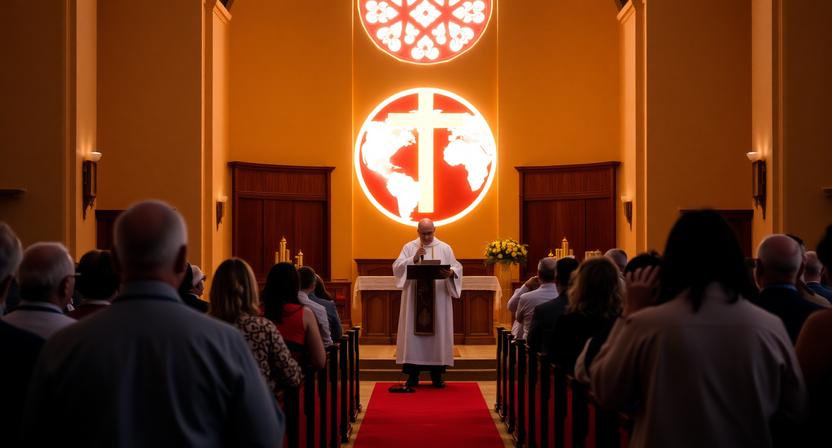
HomilySunday.com › Homilies › Mission Homily
Mission Homily: Go and Make Disciples of All Nations
📅 June 2026 · ⏱ 30 min read
“Therefore go and make disciples of all nations, baptising them in the name of the Father and of the Son and of the Holy Spirit, and teaching them to obey everything I have commanded you.” — Matthew 28:19–20
Mission is not an optional appendix to the Christian faith. It is its heartbeat. The God of the Bible is a sending God — he sent Abraham into the unknown, Moses to Pharaoh, the prophets to a stubborn people, and finally his own Son into the world. The risen Christ’s final words before his ascension are a commissioning: “Go.” The Church does not have a mission. The Church is a mission. A Mission Homily awakens the community to this calling — not as something reserved for religious professionals or foreign missionaries, but as the vocation of every baptised Christian: to carry the Gospel into the world, by word and by life, wherever God has placed them.
📋 Outline — Mission Homily
- The Missionary God — Sent Before We Were Sending
- The Great Commission — Go, Baptise, Teach
- The Mission of the Baptised — Every Christian a Missionary
- Witnesses of the Resurrection — The Heart of the Mission
- The Holy Spirit and Mission — Power from on High
- Mission and Kerygma — The First Proclamation
- Mission to the Peripheries — Where Pope Francis Points
- Obstacles to Mission — Fear, Comfort, and Privatised Faith
- The Missionary Witness of Ordinary Life
- Supporting Missionary Work — Global and Local
- A Complete Mission Homily — Homily Text
- Missionary Prayer of Sending
Related Homilies on HomilySunday.com
- Discipleship Homily
- Evangelization Homily
- Holy Spirit Homily
- Courage Homily
- Parish Homily
- Sunday Homilies Year A
1 The Missionary God — Sent Before We Were Sending
Before we can speak about the Church’s mission, we must speak about God’s mission. The theological concept of missio Dei — the mission of God — insists that mission does not originate with the Church. It originates with God himself. The Father sends the Son. The Father and the Son send the Holy Spirit. And the Spirit sends the Church. Mission is not a human programme. It is a divine movement — an overflow of the love that exists within the Trinity, poured out toward the world.
This is the foundation of Christian mission: not human zeal, not institutional strategy, not religious competition — but the prior, unstoppable, universal love of a God who refuses to remain at a distance from his creation. “For God so loved the world that he gave his one and only Son” (John 3:16). The mission is the love of God in motion.
“As the Father has sent me, I am sending you.” — John 20:21
Jesus links his sending of the disciples directly to his own sending by the Father. The disciples do not go in their own name, with their own message, by their own power. They go as the continued presence of the one who sent them — carrying his Word, his Spirit, his love, his authority. This is what makes Christian mission different from every other form of persuasion or influence: it is not primarily human action. It is God’s action, through human instruments who have been touched by his fire.
2 The Great Commission — Go, Baptise, Teach
The risen Christ’s final words to his disciples in Matthew’s Gospel — the Great Commission — are among the most significant words in all of Scripture for understanding the Church’s identity and purpose. “Go and make disciples of all nations, baptising them in the name of the Father and of the Son and of the Holy Spirit, and teaching them to obey everything I have commanded you” (Matthew 28:19–20).
Three verbs structure the mission. Go — the movement outward, toward those who have not yet heard. The Christian faith is constitutively outward-moving; it cannot remain enclosed within the walls of the church without losing its essential character. Baptise — the incorporation of those who respond into the community of the new creation, the Body of Christ. Mission is not merely sharing ideas; it is drawing people into a community of belonging. Teach — the ongoing formation of disciples in the way of Jesus, the whole of his teaching and practice. Making a disciple is not a moment but a lifetime.
“The Church exists by mission as a fire exists by burning.” — Emil Brunner
And then the promise that surrounds the commission: “And surely I am with you always, to the very end of the age.” The Great Commission is not a burden laid on the disciples but a gift given to them: the assurance that the one who sends them accompanies them. Mission is never lonely when the risen Christ is the one who goes before.
3 The Mission of the Baptised — Every Christian a Missionary
One of the most important recoveries of the Second Vatican Council was the insistence that mission is not the exclusive preserve of ordained ministers or religious sisters. It is the calling of every baptised Christian. The Council’s Apostolicam Actuositatem — the Decree on the Apostolate of the Laity — is explicit: “The apostolate of the laity is a participation in the salvific mission of the Church itself.” By baptism, every Christian is configured to Christ — Priest, Prophet, and King — and sent as his witness into the world.
Pope Francis, in Evangelii Gaudium, uses the striking phrase “missionary disciples” — every disciple is a missionary, and every missionary is a disciple. There is no Christian vocation that is simply passive, simply receptive, simply interior. Every encounter with the living Christ generates a sending: “Come and see” leads inevitably to “Go and tell.”
“But you will receive power when the Holy Spirit comes on you; and you will be my witnesses in Jerusalem, and in all Judea and Samaria, and to the ends of the earth.” — Acts 1:8
📖 A Story for the Homily
A young woman working as a nurse described her experience of mission in the most unlikely setting: the night shift in a hospital ward. “I’m not a missionary,” she said. “I just do my job.” But over time, she began to notice that her colleagues would come to her when they were distressed, that patients asked her questions that were not medical but spiritual, that something in the way she worked — her patience, her attentiveness, her refusal to dehumanise the dying — was communicating something beyond her professional competence. “Eventually I realised,” she said, “that the ward was my mission field. And I had been there all along.”
4 Witnesses of the Resurrection — The Heart of the Mission
At the heart of every missionary proclamation in the Acts of the Apostles is a single, irreducible claim: Jesus rose from the dead. This is the content of the kerygma — the first proclamation — and it is what distinguished the early Christian mission from every other religious movement of its time. The disciples did not primarily preach a moral code, a philosophy, or a set of religious practices. They proclaimed an event: that the one who was crucified had risen, had appeared to them, and was alive.
This resurrection witness is what makes the Christian mission categorically different from religious propaganda or ethical persuasion. The missionaries of the early Church were not arguing for a position. They were testifying to an experience. “We cannot help speaking about what we have seen and heard” (Acts 4:20). The most powerful missionary is not the one with the best arguments but the one whose life testifies to the reality of the risen Christ.
“We are witnesses of these things, and so is the Holy Spirit, whom God has given to those who obey him.” — Acts 5:32
5 The Holy Spirit and Mission — Power from on High
The disciples were told to wait in Jerusalem before beginning their mission. “Do not leave Jerusalem, but wait for the gift my Father promised” (Acts 1:4). This waiting is significant. It establishes that the mission cannot be launched by human initiative alone. It requires the gift of the Holy Spirit — the power from on high that transforms frightened disciples hiding behind locked doors into bold witnesses who speak in every language and fear nothing.
Pentecost is the beginning of the missionary era. The Spirit comes not merely as inner comfort but as outward impulse: the disciples immediately go out, immediately preach, immediately gather the nations — “Parthians, Medes and Elamites; residents of Mesopotamia, Judea and Cappadocia, Pontus and Asia” (Acts 2:9). The Spirit does not simply fill the interior life of the disciples. He sends them out.
Every missionary impulse in the Church is, at its root, the work of the Holy Spirit. The preacher who prays for the Spirit before every homily, the parishioner who finds words to speak about faith in a conversation they did not plan, the young person who goes on a mission trip and is changed by what they encounter — all of these are expressions of the same Pentecost wind still blowing through the Church.
6 Mission and Kerygma — The First Proclamation
The kerygma — from the Greek word for “proclamation” — is the essential core of the Christian message. It is not the whole of Christianity; it is the beginning, the foundation, the irreducible centre from which everything else grows. Pope Francis, drawing on the Catechism and the tradition of evangelisation, has consistently emphasised that the Church must return to this first proclamation as the heart of all its activity.
The kerygma can be summarised in four movements: God loves you. Sin has separated you from God and from one another. Jesus Christ, by his death and resurrection, has overcome that separation and made reconciliation possible. Responding to him in faith and baptism, you enter into the new life of the Holy Spirit and the community of the Church.
| Movement | Content | Key Scripture |
|---|---|---|
| God’s Love | God created us in love and for love; we are his beloved children | John 3:16; 1 John 4:10 |
| Human Condition | Sin has broken the relationship; we are lost and in need of rescue | Romans 3:23; Isaiah 53:6 |
| Christ’s Work | Jesus died for our sins and rose for our justification | Romans 4:25; 1 Corinthians 15:3–4 |
| Response | Repent, believe, be baptised, receive the Spirit, join the community | Acts 2:38; Romans 10:9 |
7 Mission to the Peripheries — Where Pope Francis Points
Pope Francis has returned again and again, throughout his pontificate, to the image of the “peripheries” — the margins of society, the places where the poor, the excluded, the forgotten, and the searching live. He calls the Church to move from the centre to the edges — not because the centre is unimportant, but because Jesus himself consistently moved toward the peripheries: toward lepers, toward Samaritans, toward tax collectors, toward Gentiles, toward the demon-possessed, toward those whom the religious establishment had written off.
“I prefer a Church which is bruised, hurting and dirty because it has been out on the streets,” Francis writes in Evangelii Gaudium, “rather than a Church which is unhealthy from being confined and from clinging to its own security.” This is not an invitation to abandon the parish or the sacraments. It is an invitation to ensure that the parish’s energy flows outward — toward those who are not yet inside its doors, not yet reached by its ministries, not yet touched by its love.
“Go out quickly into the streets and alleys of the town and bring in the poor, the crippled, the blind and the lame.” — Luke 14:21
8 Obstacles to Mission — Fear, Comfort, and Privatised Faith
What holds the baptised back from mission? Three recurring obstacles emerge from reflection on the Christian tradition and honest observation of contemporary parish life.
- Fear. The fear of rejection, of getting it wrong, of seeming weird or imposing — fear is perhaps the most common reason Christians do not speak about their faith. But the risen Christ’s first words to his disciples are consistently: “Do not be afraid.” The antidote to missionary fear is not greater courage in oneself but a deeper trust in the presence of the one who sends.
- Privatised faith. The assumption — deeply embedded in modern Western culture — that religion is a private matter, a personal preference to be kept to oneself. But the Gospel is inherently public. It makes claims about the nature of reality, about the identity of Jesus, about the destiny of every human being — claims that, if true, are of universal significance and cannot be kept private without betraying their very nature.
- Comfort and complacency. The comfortable parish that has everything it needs and has stopped asking whether those outside its walls need what it has. Pope Francis’s diagnosis is sharp: a Church too focused on its own maintenance rather than on its mission loses its energy, its joy, and its reason for existing.
9 The Missionary Witness of Ordinary Life
St Paul VI, in Evangelii Nuntiandi, wrote one of the most quoted sentences in the history of Catholic evangelisation: “Modern man listens more willingly to witnesses than to teachers, and if he does listen to teachers, it is because they are witnesses.” The most powerful missionary instrument is not an argument, a programme, or a campaign. It is a life — a human life visibly marked by the love of Christ, the joy of the Gospel, and the freedom of grace.
This is both encouraging and demanding. Encouraging, because it means that mission is not reserved for those with theological training or public speaking gifts. Every Christian, in the ordinary texture of their daily life — in their marriages, their workplaces, their neighbourhoods, their friendships — is either a witness to the Gospel or a contradiction of it. Demanding, because it means that the quality of our discipleship is itself a missionary act. The way we love our families, serve our communities, care for the vulnerable, and face adversity with hope — all of this preaches.
10 Supporting Missionary Work — Global and Local
While every Christian is called to mission in their own context, the Church also sends missionaries across cultures and continents — men and women who leave their own communities to carry the Gospel to places where it has not yet been heard, or where the Church is young and needs support. Supporting this global missionary work — through prayer, through financial giving, through hospitality to missionaries who visit the parish — is an expression of the whole Church’s shared responsibility for the whole world.
The parish that has a living connection with a missionary — that prays for them by name, that supports them financially, that hosts them when they visit, that hears their stories — is a parish whose missionary imagination is stretched and renewed. Global mission and local mission are not in competition. A parish that is genuinely missionary in its own neighbourhood will naturally extend that concern to the ends of the earth.
“How, then, can they call on the one they have not believed in? And how can they believe in the one of whom they have not heard? And how can they hear without someone preaching to them?” — Romans 10:14
11 A Complete Mission Homily — Homily Text
The following homily text is suitable for Mission Sunday, World Mission Sunday (October), Pentecost, or any occasion when the missionary calling of the Church is the focus. Adapt freely for your congregation.
There is a map in the Acts of the Apostles. You cannot see it with your eyes, but it is there in the structure of the book — a geographical expansion that begins in Jerusalem, moves through Judea, through Samaria, across the Mediterranean world, and ends in Rome, the capital of the known world. From a single upper room to the ends of the earth — in one generation. By a handful of ordinary people, most of them uneducated, none of them powerful, armed with nothing but the news of a resurrection and the fire of a Spirit.
That is the mission. And it is not finished.
The same Spirit that blew through that upper room on Pentecost is still blowing. The same risen Christ who said “Go” to those first disciples is still saying “Go” — to us, to this community, in this city, in this moment of history.
“You will receive power when the Holy Spirit comes on you; and you will be my witnesses.” — Acts 1:8
I want to be honest with you about something. Mission frightens most of us. We imagine a missionary and we picture someone who knocks on doors with a pamphlet, or who stands in a public square with a megaphone. And we think: that is not me. I could never do that. And frankly, I am not sure I want to.
But that is not primarily what Jesus is asking of us. He says: “You will be my witnesses.” A witness is not an argument. A witness is a person who has seen something and is willing to say so. And what have we seen? We have seen — each of us, in our own way, in our own life — something of the goodness of God. A prayer answered in an unexpected way. A moment of forgiveness that seemed impossible. A peace that passed understanding in the middle of a crisis. A love that held when everything else was failing.
That is the testimony. And the world around us — for all its noise and confidence — is desperately hungry for it.
There is a young couple in this neighbourhood who are raising their children without any connection to faith, and who are finding that the world they have built for themselves does not quite hold together the way they hoped. There is an elderly man three streets away who has outlived everyone he loved and is facing death alone. There is a teenager who is being formed by social media into someone her parents no longer recognise, and who, in her most honest moments, is asking questions she has no language for.
These people are not asking you for a theological argument. They are asking — sometimes in words, more often in the texture of their lives — for a witness. For someone who has found something real, and who is willing to say: this is where I found it. Come and see.
You do not have to be eloquent. You do not have to have all the answers. You do not even have to be very brave. You have to be real. The most missionary thing you can do this week is to live your life — your ordinary, Tuesday-morning life — in such a way that the people around you can see that something is different about you. Not weird. Not preachy. Just different. Marked by a joy that the circumstances do not explain. Marked by a generosity that the economics do not explain. Marked by a peace in the face of difficulty that the world cannot account for.
The risen Christ sends us. And he goes before us. And he comes with us. And he will be there, in that conversation you are afraid to have, speaking through your stumbling words, working in the heart of the other person, drawing them home.
Go. Be his witness. The mission is not finished. ✝
🙌 Missionary Prayer of Sending
Lord of the harvest, Sender of all who go — we stand before you as people who have been found, who have been filled, who have been sent. We confess that we have often kept the fire to ourselves, afraid of burning others, afraid of being burned ourselves.
Send us out again. Into our neighbourhoods, our workplaces, our families, our schools — wherever you have placed us. Make us witnesses — not of our own goodness or cleverness, but of yours. Give us words when we need them, and wisdom to know when our lives must speak instead.
Fill us again with your Spirit. Let the same wind that blew through that first upper room blow through us — scattering the timidity, the comfort, and the fear — and leaving in their place the bold, joyful, irresistible love of a God who refuses to stop sending.
We go in your name. Go before us, Lord. We are your witnesses.
Amen. 🙌 ✝
More Homilies on HomilySunday.com
- Parish Homily
- Lenten Homily
- Eternal Life Homily
- Resurrection Homily
- Discipleship Homily
- Evangelization Homily
- Holy Spirit Homily
- Courage Homily
- Easter Homily
- Stewardship Homily
- Hope Homily
- Homily on Prayer
- Peace Homily
- Gratitude Homily
- Saints Homily
- Sunday Homilies Year A
- Sunday Homilies Year B
- Sunday Homilies Year C
- 100 Homily Stories
- Confirmation Homily
✝ HomilySunday.com · Catholic Sunday Homily Resources · All rights reserved.
