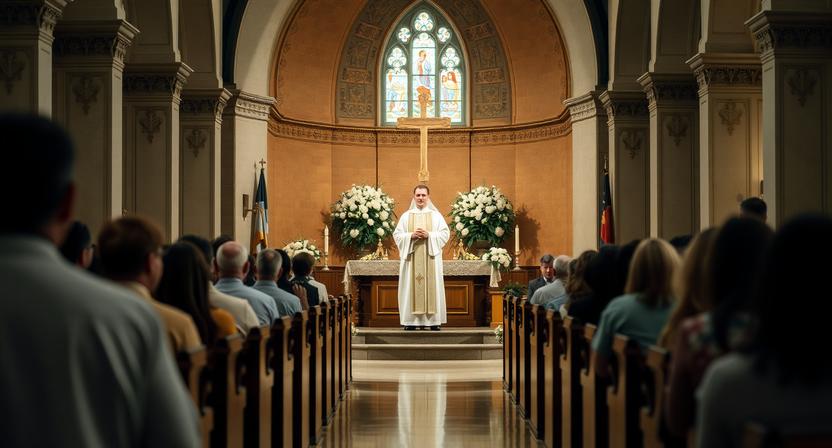
Funeral Homily
“I am the resurrection and the life. Whoever believes in me, though he die, yet shall he live.” — John 11:25
A funeral homily is one of the most sacred responsibilities a priest or deacon receives. It is the moment when the Church gathers to mourn honestly, to remember faithfully, and above all, to proclaim the Easter hope that death does not have the final word. This page offers a complete, structured guide for writing or delivering a profound and comforting funeral homily.
Whether you are preparing for a Mass of Christian Burial or a memorial service, you will find here the theological foundations, scriptural references, pastoral reflections, and structural outlines you need.
1 Opening Words of Consolation
Every funeral homily begins not with theology but with the human heart. Before doctrine, before exegesis, the gathered community needs to feel that the Church sees their pain. The opening words set the entire pastoral tone.
Begin by addressing the family by name if appropriate, acknowledging their grief without minimizing it. Express the solidarity of the whole Church assembled around them. Let the very first sentence signal: you are not alone.
- Extend sympathy warmly and personally to the grieving family
- Name the Christian hope in the resurrection from the very first breath
- Acknowledge openly that sorrow and love walk together
- Invite the assembly to pray together as one Body of Christ
2 The Reality of Human Grief
One of the most powerful moments in all of Scripture is the shortest verse in the Bible: “Jesus wept” (John 11:35). The Son of God stood before the tomb of his friend Lazarus and wept real tears. This tells us something profoundly important: grief is not a failure of faith. Mourning is holy.
A good funeral homily holds space for tears. Do not rush past the pain to arrive at the resurrection. Walk honestly through the valley first. Ecclesiastes reminds us there is a time for mourning — honour that time.
3 Christian Hope in the Resurrection
The heart of every Christian funeral is not remembrance — it is proclamation. We are gathered to announce with boldness what Christ himself declared: “I am the resurrection and the life.” Death does not have the last word. The grave is not the end. Christ walked out of the tomb and that changes everything.
St. Paul in 1 Corinthians 15 builds the entire argument carefully: if Christ is risen, we too shall rise. Our loved one has not ceased to exist — they have passed through the door that Christ opened. This is the anchor of our hope, immovable even in the darkest grief.
4 Reflection on the Life of the Deceased
The funeral homily is not a eulogy — but it must be pastoral. In a few carefully chosen words, the homily should honour the person who has died: their faith, their love, the ways they reflected God’s grace in their ordinary living.
Speak of virtues actually witnessed. Avoid flattery or hagiography — the congregation knows the person. Speak truthfully and warmly: their patience with suffering, their generosity to others, their faithful presence at Mass, their love for family. Let the congregation nod in recognition.
- Faith: How did they practice their faith? What did belief look like in their daily life?
- Love: How did they love their family, neighbours, the poor?
- Service: What did they give of themselves to others?
- Perseverance: How did they bear trials, illness, or hardship with dignity?
- Legacy: What lasting mark did they leave on those they loved?
Entrust them gently to God’s mercy — noting that none of us stands before God on our own merits, but in the mercy of Christ.
5 Jesus’ Compassion Toward the Suffering
The Gospels show us repeatedly that Christ is not distant from suffering — he moves toward it. When the widow of Nain wept for her only son, Jesus did not offer a theological treatise. He stopped, he looked at her with compassion, and he acted. When Mary and Martha grieved Lazarus, he came to them. He still comes.
The Good Shepherd imagery of Psalm 23 — “though I walk through the valley of the shadow of death, I will fear no evil, for you are with me” — is especially powerful at funerals. The Shepherd does not lead us around the dark valley but through it, and he goes before us.
6 The Meaning of Eternal Life
What exactly do we mean when we speak of eternal life? The funeral homily is a precious teaching moment. Heaven is not a vague spiritual realm or a kind of peaceful sleep — it is the eternal communion of the redeemed with the living God, face to face, in the fullness of joy.
Jesus himself spoke plainly: “In my Father’s house are many rooms… I go to prepare a place for you.” (John 14:2). This is a promise spoken personally to each believer. Our loved one has not gone to oblivion — they have gone home.
7 Funeral Homily Based on the Readings
The most theologically rich funeral homilies are built directly from the Liturgy of the Word. The Church assigns specific readings for the Mass of Christian Burial — take them seriously. Let the Word of God carry the homily, not anecdote or sentiment alone.
A reliable structure for building from the readings:
| Step | Question | Example |
|---|---|---|
| 1. Proclaim | What does the reading say? | “Paul tells us death is swallowed up in victory…” |
| 2. Explain | What does it mean? | “He means that Christ’s resurrection changed the nature of death itself…” |
| 3. Apply | How does it comfort us today? | “And so we entrust [Name] not to darkness, but to the Lord of life…” |
Suggested funeral readings to anchor the homily: Job 19:1, 23–27 (I know my Redeemer lives); Romans 8:31–39 (nothing can separate us from the love of God); John 6:37–40 (I will raise him up on the last day); John 14:1–6 (I am the way, the truth, and the life).
8 Mercy and Forgiveness
Many of those seated in the pews carry quiet anxiety: Was my loved one holy enough? Did they confess everything? Will God really receive them? The funeral homily must speak clearly of divine mercy — not to bypass conversion but to offer genuine consolation.
The thief on the cross received paradise with a single act of trust (Luke 23:43). God’s mercy is not earned but received. We entrust our loved one to the One whose mercy endures forever, whose love cannot be overcome by human frailty.
9 Life as a Pilgrimage
One of the most ancient and beautiful images in Christian theology is the idea that this earthly life is a pilgrimage — a journey toward our true homeland. We are pilgrims and strangers on this earth (Hebrews 11:13), and death is not tragedy but arrival. The journey is complete. The pilgrim has reached the destination.
This image liberates the homily from sentimentality. It allows grief while framing it rightly: we grieve not because the journey was ended too soon, but because we miss our fellow traveller. And yet — he or she has arrived safely. We will follow when our own pilgrimage is complete.
10 The Communion of Saints
Catholic funeral homilies have a unique and consoling doctrine to draw upon: the Communion of Saints. Death does not sever the bond between the living and the dead in Christ. We remain one Church — the Church Militant on earth, the Church Suffering in purgatory, the Church Triumphant in heaven. Death changes geography, not relationship.
We may still pray for the deceased. We may still speak to them. They are not gone — they are ahead of us, part of that “great cloud of witnesses” (Hebrews 12:1) who surround and encourage us still.
11 Gratitude and Legacy
A funeral is also an act of thanksgiving. We give thanks to God for the gift of this particular life — for the years we shared, for the love we received, for the faith that was modelled for us. Gratitude transforms grief without denying it.
Invite the assembly to reflect on the legacy the deceased leaves behind — not merely in memory, but in the ongoing life of those they shaped. A mother’s prayers live on in her children. A grandfather’s wisdom echoes in his grandchildren. Faith passed on is a profound inheritance.
- What lesson from this life will you carry forward?
- What example of faith challenged or inspired you?
- How will you honour this legacy in how you live?
12 Call to Conversion and Readiness
Every funeral is a moment of grace for the living. With tact and pastoral charity, a funeral homily can gently invite those present to examine their own readiness. Life is short and uncertain. We do not know the day or the hour. The parable of the ten virgins (Matthew 25) speaks precisely to this: the invitation is extended, but we must be ready when it comes.
This is not a call to fear but to urgency. The message is: Love God now. Reconcile now. Live faithfully now. Because every day is a gift and none of us knows how many remain.
13 The Power of Prayer for the Departed
The Catholic tradition is rich in its understanding of prayer for the dead. We believe the Mass itself is the greatest prayer that can be offered for any soul. We encourage the family to continue offering Masses, to pray the Rosary, to keep the memory of the departed before God in prayer.
This is not superstition — it flows from faith in the Communion of Saints and in God’s mercy. We do not abandon our loved ones at death; we continue to intercede for them, trusting that God hears the prayers of those who love.
- Request Mass intentions for the deceased in the months ahead
- Pray the Rosary as a family — a powerful intercessory prayer
- Remember the deceased on their birthday, anniversary, and All Souls Day
- Light a candle and offer a prayer at moments of remembrance
14 Marian Consolation
In Catholic funerals especially, the figure of Mary, Mother of Sorrows, brings particular consolation. She stood at the foot of the cross and watched her Son die. She knows grief from the inside. She is not an observer of suffering but a participant in it.
Christ gave Mary to us as Mother precisely at the moment of greatest loss: “Behold your mother.” (John 19:27). We receive her as a mother at every moment of sorrow. We pray with her, and through her, to the heart of Christ.
15 Closing Message of Hope
Every funeral homily must end where the Christian faith itself ends — and begins again: in hope. Not vague optimism, but the confident, anchored hope that is founded on an empty tomb. Christ is risen. The grave is conquered. Love is stronger than death.
Close with tenderness and courage in equal measure. Encourage the family to grieve fully, live faithfully, and trust completely. The farewell we give our loved ones at the graveside is not goodbye — it is until we meet again.
- Trust entirely in the mercy and love of God
- Hold fast to the promise of the resurrection
- Continue living as people of faith, hope, and love
- Look forward with joy to the reunion that awaits in God’s eternal home
“Love Never Dies”
Go forth, Christian soul, from this world, in the name of God the almighty Father who created you, in the name of Jesus Christ, Son of the living God, who suffered for you, in the name of the Holy Spirit who was poured out upon you. May you rest this day in peace, and dwell for ever with God in his glory. Amen.
