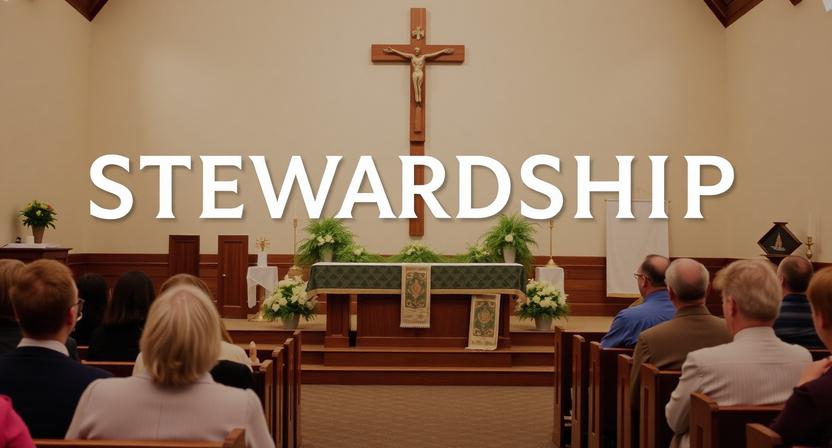
Catholic Homily on Stewardship
“The Lord God took the man and put him in the Garden of Eden to work it and take care of it.” — Genesis 2:15 | “Each of you should use whatever gift you have received to serve others, as faithful stewards of God’s grace in its various forms.” — 1 Peter 4:10
Stewardship is one of the most misunderstood words in the Christian vocabulary. Mention it from the pulpit and some will hear only a funding appeal. But the tradition of stewardship runs far deeper than parish budgets. It is a comprehensive theological vision of the human person’s relationship to everything God has entrusted to us: the created world, the gifts of time and talent, the material resources of treasure, and the community of the Church. To be a steward is not merely to manage resources efficiently. It is to hold everything one has received — life, gifts, the earth itself — with open hands, as a trustee on behalf of the One who owns all things. A Homily on Stewardship invites the congregation not to give more but to see more clearly — to recognise that they are not owners but stewards, and that this recognition is the beginning of a life of extraordinary freedom, generosity, and joy.
The Steward — Not Owner but Trustee of God’s Gifts
The concept of stewardship has its roots in an ancient household reality. In the Graeco-Roman world, the oikonomos — the steward or household manager — was the trusted servant placed in charge of the master’s entire estate. He did not own what he managed. He was accountable for it. His role was to use the master’s resources wisely, to care for the household, and to give a full account when the master returned. This is the image Jesus reaches for again and again when he wants to describe the relationship between God and human beings in relation to everything God has created and given.
The theological claim of stewardship is simple and radical: everything belongs to God. “The earth is the Lord’s, and everything in it, the world, and all who live in it.” (Psalm 24:1). We are not owners. We are trustees. The land, the body, the talent, the time, the money — none of it was ours before we were born, and none of it will be ours after we die. We hold it, for a season, on behalf of the One who made it and to whom it returns. This is not a diminishment of human dignity — it is its proper location. We are called not to possess the world but to care for it; not to consume our gifts but to deploy them; not to hoard our treasure but to invest it in the Kingdom.
A Stewardship Homily begins here: not with the collection envelope but with the character of God and the nature of the human person. We give, we care, we serve — not because the parish needs our money, but because we have grasped something true about reality: that we are creatures, not creators; receivers, not originators; stewards, not masters. And the freedom that comes from this recognition is extraordinary.
Genesis — The Original Commission to Care for Creation
The story of stewardship begins on the first pages of the Bible. In Genesis 1, God creates the world and declares it good — indeed, very good. In Genesis 2:15, he places the human person in the garden with a specific commission: “to work it and take care of it.” The Hebrew words are abad — to serve, to cultivate — and shamar — to keep, to guard, to preserve. The human vocation is not to exploit the earth but to serve it and protect it on God’s behalf.
In Genesis 1:28, God gives humanity “dominion” over creation — a word that has sometimes been misread as a licence for exploitation. But dominion in the biblical sense is not the dominion of a tyrant but of a steward. It is the authority of the responsible caretaker, modelled on the God who himself tends and nurtures and sustains what he has made. The dominion entrusted to humanity is always accountable dominion — answerable to the Creator who made all things for his own glory and for the flourishing of every living creature.
A wise abbot was once asked by a young monk: “Father, what does it mean to care for the earth?” The old man led the young monk to the monastery garden. He showed him the careful composting of kitchen scraps, the rotation of crops, the planting of trees that would not bear fruit for twenty years. “I am planting for those who will come after me,” he said. “I will not taste this fruit. But it will be here — because I was a good steward.” He paused and added: “Every human being is in the same position. We received a garden from those before us. We tend it for those who come after us. We never owned it. We only borrowed it from God.”
This original commission has never been revoked. Whatever the ecological challenges facing the contemporary world — and they are real and urgent — the Christian response is not despair but deepened commitment to the original vocation: to work it and keep it. The steward does not own the garden. But the steward is responsible for it.
The Parable of the Talents — Faithful Use of What Is Entrusted
No parable speaks more directly to the theology of stewardship than the Parable of the Talents (Matthew 25:14–30). A master entrusts his servants with significant sums of money — five talents, two talents, one talent — each “according to his own ability” — and departs. On his return, he calls them to account. The servant given five talents has made five more. The servant given two has made two more. Both receive the same astonishing commendation: “Well done, good and faithful servant! You have been faithful with a few things; I will put you in charge of many things. Come and share your master’s happiness!” The servant given one talent, paralysed by fear, buried it and returned it unchanged. He is rebuked — not for corruption, but for sterility.
The parable is not primarily about money. It is about the whole of what God has entrusted to each person: the specific gifts, graces, opportunities, relationships, and capacities that constitute a unique human life. The question it presses on every believer is not “Are you a good person?” but “What have you done with what you were given?” The master’s commendation — “faithful with a few things” — is achingly humble: it is not heroic achievement he is looking for, but faithful deployment of whatever has been entrusted, however modest. The buried talent represents the life unlived from fear, the gift never shared, the grace hoarded and returned to God unused.
The parable ends with a principle that sounds at first almost unfair: “For whoever has will be given more, and they will have an abundance. Whoever does not have, even what they have will be taken from them.” (Matthew 25:29). In the economy of the Kingdom, gifts that are used grow. Gifts that are hoarded diminish. This is a spiritual law embedded in the nature of gift itself: a gift that is received and shared multiplies; a gift that is grasped and buried dies. Stewardship is not optional — it is the condition of receiving what God wants to give.
Laudato Si’ — Pope Francis and the Cry of the Earth
In 2015, Pope Francis issued one of the most significant and wide-ranging documents of his pontificate: Laudato Si’ — “Praise Be to You” — an encyclical on care for our common home. Taking its opening words from St Francis of Assisi’s Canticle of the Creatures, the encyclical presents an integral vision of ecological stewardship rooted in the Gospel and the Catholic social tradition. It is, at its heart, a sustained Stewardship Homily addressed to every person of goodwill.
Pope Francis argues that ecological care and care for the poor cannot be separated — that the environmental crisis and the social crisis are, at their root, expressions of the same disorder: a culture of consumption that treats both the earth and the human person as resources to be exploited for short-term gain. His response is not despair or ideology but conversion — a change of heart that leads to a change of behaviour. He calls for an “ecological spirituality” rooted in gratitude, wonder, simplicity, and a deep sense of our relatedness to all creation as creatures sharing a common home, gifted to us by a generous Creator.
Laudato Si’ reminds the Church that stewardship of creation is not a political issue but a Gospel issue. It is part of the original human vocation, reaffirmed in the teaching of the Church, and urgently needed in a world where the consequences of poor stewardship — of the earth’s resources, of the poor, of future generations — are increasingly visible. A Stewardship Homily that engages Laudato Si’ is not departing from theology — it is doing theology at its most grounded and prophetic.
Time — The Stewardship of the Hours God Has Given
Among the gifts most taken for granted and least thought of as a stewardship issue is time. Yet time is perhaps the most fundamental gift God gives — because it is the medium in which every other gift is either used or squandered, shared or buried. Each human life is an allotment of hours, irreversible and unrepeatable. The stewardship of time is therefore the stewardship of life itself.
St Paul’s urgency is striking: “Be very careful, then, how you live — not as unwise but as wise, making the most of every opportunity, because the days are evil.” (Ephesians 5:15–16). The phrase “making the most of every opportunity” translates the Greek exagorazomenoi ton kairon — literally “redeeming the time” or “buying back the moment.” Paul understood that time is a non-renewable resource, that the present moment — the kairos — carries within it a weight of divine opportunity that will not return. The wasted hour is not merely inconvenient — in the light of eternity, it is a buried talent.
Sunday worship, daily prayer, annual retreat, the Liturgy of the Hours — these are not subtractions from life but the sanctification of all time. The hour given to God returns multiplied.
Visiting the sick, mentoring the young, being present to family — these are the hours that constitute a life of love. They cannot be recovered once they have passed.
Rest, beauty, friendship, learning — proper self-care is not selfishness but part of stewarding the body and soul entrusted to us. Burnout is not a virtue.
Endless distraction, passive consumption, the hours lost to anxiety about what cannot be changed — these are the buried talents of time. Not sins in themselves, but opportunities forgone.
Talent — Every Gift Is Given for the Common Good
In contemporary culture, “talent” tends to mean spectacular ability — athletic genius, artistic brilliance, extraordinary intelligence. In the Christian tradition, the gifts God gives are far more varied, and often more hidden: the gift of listening, of hospitality, of practical wisdom, of faithfulness in small tasks, of the patience that sustains a family through difficulty, of the encouragement that keeps another person going when they are close to giving up. Every member of the body of Christ has been given something for the building up of the body.
St Paul is emphatic: “Each of you should use whatever gift you have received to serve others, as faithful stewards of God’s grace in its various forms.” (1 Peter 4:10). The gift is given — not earned, not achieved, but given. And it is given for a purpose: not for the glorification of the recipient but for the service of others. The brilliant theologian, the gifted musician, the capable administrator, the woman who makes everyone feel at home — all are stewards of grace that was never theirs to keep.
A concert pianist was once asked by a journalist: “Do you ever feel proud when you play so beautifully?” He paused for a long time before answering. “No,” he said. “I feel — grateful. I did not give myself these hands, this ear, this love of music. I received them. My only task is to play as well as I possibly can, so that what was given to me might be passed on to others. It was never mine to keep.”
This is the theology of stewardship in a single image: the gift received, deployed with all possible care and excellence, and offered back — through service to others — to the God who first gave it.
Treasure — The Spirituality of Generous Giving
Money is the dimension of stewardship that most congregations associate with the word — and the one that most preachers handle most nervously. But Jesus was remarkably candid about money. He spoke about it more than about almost any other subject — more than prayer, more than heaven, more than faith. Sixteen of his thirty-eight parables deal with money and possessions. The reason is simple: Jesus understood that the way a person relates to money reveals the deepest priorities of the heart. “For where your treasure is, there your heart will be also.” (Matthew 6:21).
The biblical vision of treasure-stewardship is shaped by two complementary convictions. First: all material resources are gift, received from a generous God and therefore held accountably. Second: generous giving is not sacrifice — it is the liberation of the heart from the tyranny of possession. The rich young man in Mark 10 went away sad — not because Jesus asked him to give up something good, but because he was not yet free from what he had. The steward who gives generously has discovered a freedom the accumulator never finds: the freedom of the open hand, which can receive far more than the closed fist.
The tradition of the tithe — giving a tenth of one’s income — is an ancient discipline of treasure-stewardship that runs through Scripture from Genesis to the New Testament. It is not a tax but a spiritual practice: a regular, habitual act of returning to God the first fruits of what he has given, acknowledging that all of it belongs to him. Whether or not the congregation practices a tithe, a Stewardship Homily invites them to examine their relationship with money honestly — not with guilt, but with the liberating question: is my treasure pointing toward God or away from him?
The Widow’s Mite — Stewardship Measured by Love, Not Quantity
One of the most arresting moments in the Gospels occurs when Jesus sits opposite the Temple treasury and watches people put in their offerings (Mark 12:41–44). Many rich people throw in large amounts. Then a poor widow comes and puts in two very small copper coins — worth only a fraction of a penny. Jesus calls his disciples and makes a pronouncement that reverses every instinctive judgment about value: “Truly I tell you, this poor widow has put more into the treasury than all the others. They all gave out of their wealth; but she, out of her poverty, put in everything — all she had to live on.”
This is the criterion by which all stewardship is ultimately measured — not quantity, but proportion; not the size of the gift, but the degree of trust it represents. The widow did not give what she could spare. She gave what she could not spare — and in doing so, she made the most radical act of trust in the passage: trusting that the God who noticed her two coins was also capable of caring for her needs. Her gift was, in the deepest sense, an act of faith.
A Stewardship Homily shaped by the Widow’s Mite offers both comfort and challenge. Comfort, to those who feel they have little to give: your gift, given from the heart, is seen by the Lord who measures differently from the world. Challenge, to those who give comfortably from their surplus: the question is not “how much did I give?” but “how much did it cost me?” Stewardship is always a question of the heart before it is a question of the cheque book.
Stewardship of the Body — The Temple of the Holy Spirit
One dimension of stewardship that is often neglected in Catholic preaching is the stewardship of the body. Yet St Paul’s claim is startling in its theological weight: “Do you not know that your bodies are temples of the Holy Spirit, who is in you, whom you have received from God? You are not your own; you were bought at a price. Therefore honour God with your bodies.” (1 Corinthians 6:19–20). The body is not our possession. It is a gift — the particular, irreplaceable, incarnate gift through which we live, love, serve, worship, and encounter God.
The stewardship of the body encompasses far more than sexual ethics (though it includes that). It includes the care of physical health — not from vanity or anxiety, but from the recognition that this body is the instrument through which we serve God and others. It includes the care of mental and emotional health — the willingness to seek help, to rest, to receive the support of community, to acknowledge that the human person is not a machine. It includes the sacramental use of the body: the kneeling in prayer, the fasting that sharpens the spirit, the reception of the sacraments in which God meets us in our bodiliness.
The Incarnation — God becoming flesh in Jesus Christ — is the ultimate affirmation that the body is good, that matter matters, that physical existence is not a problem to be escaped but a gift to be honoured. The steward of the body is the person who inhabits their physicality with the reverence appropriate to a temple — not with pride or obsession, but with gratitude and care for what God has given and what God inhabits.
Stewardship of Relationships — Caring for Those Entrusted to Us
Among the most overlooked dimensions of stewardship is the stewardship of relationships. No relationship we have is merely a private arrangement. The spouse, the child, the parent, the friend, the neighbour, the colleague — each is, in some sense, a gift entrusted to us: someone whose flourishing we have been given a particular responsibility to seek. Cain’s defensive question — “Am I my brother’s keeper?” (Genesis 4:9) — is answered, across the whole of Scripture, with an unambiguous yes.
The stewardship of relationships begins in the family. Parents are stewards of their children’s faith, not merely their education and physical welfare. They are entrusted with the extraordinary responsibility of being the first image of God for a human being — the first embodiment of love, faithfulness, forgiveness, and grace that a child will ever encounter. This is a stewardship with eternal implications. But it extends outward: to the parish community, to the poor neighbour, to the stranger who needs a welcome, to the elderly person who needs a visitor, to the young person who needs a mentor.
The relationship most at risk of poor stewardship is perhaps the one most taken for granted: the relationship with the people closest to us, whose presence has become so familiar that we have stopped noticing it as gift. A Stewardship Homily on relationships invites the congregation to recover the wonder of those they have been given — to see spouse, child, parent, friend, through the eyes of grace: as a gift they did not earn and might not have received.
Faithful Stewardship Across Every Dimension of Life
A complete theology of stewardship touches every dimension of the Christian life. Here is a map of faithful stewardship across the seven domains of what God entrusts to his people:
| Domain | What Is Entrusted | The Faithful Steward’s Response |
|---|---|---|
| Creation | The earth, its resources, and all living creatures | Sustainable living, care for the environment, advocacy for future generations |
| Time | The hours of each day; the seasons of a life | Sabbath rest, daily prayer, generous presence to others, purposeful work |
| Talent | Specific gifts, abilities, and charisms given by the Spirit | Active service in the Church and world; developing gifts; sharing them freely |
| Treasure | Material resources, income, and possessions | Tithing or proportionate giving; simplicity of life; generosity to the poor |
| Body | Physical health, sexuality, emotional wellbeing | Care for health; sacramental reverence for the body; chastity appropriate to one’s state |
| Relationships | Family, community, parish, and neighbours | Faithful presence; forgiveness; hospitality; care for the vulnerable entrusted to us |
| Faith | The gift of faith and the Good News of the Gospel | Deepening one’s own faith; sharing it with others; handing it on to the next generation |
St Francis of Assisi — The Patron of Stewardship
No figure in Christian history embodies the theology of stewardship more completely than Francis of Assisi. He received a vision of Christ from the cross of San Damiano: “Francis, rebuild my Church.” He responded not by organising a theological movement but by rebuilding the ruined chapel stone by stone with his own hands — the most concrete possible expression of stewardship: caring for what has been entrusted with one’s own body and labour.
Francis’s relationship with creation was revolutionary for his time and remains prophetic for ours. He addressed the sun as “Brother Sun,” the moon as “Sister Moon,” the wind, the water, the fire, and the earth as kin — fellow creatures, sharing with him in the great family of the Creator. This was not sentimentality. It was theology: the recognition that every created thing is a gift from the same generous Father, and therefore an object of reverence, care, and wonder. He spoke to birds about the goodness of God. He moved worms off pathways lest they be crushed. He called everything a mirror of the divine generosity.
Pope Francis chose his name deliberately — a signal that the Church’s ecological commitment is not new but ancient; that care for creation is not a political add-on but a Gospel imperative rooted in the tradition of one of the most beloved saints in Christian history. A Stewardship Homily that honours St Francis is a homily that connects the congregation to eight centuries of faithful witness.
The Parable of the Prodigal Son — Stewardship Lost and Restored
The Parable of the Prodigal Son (Luke 15:11–32) can be read as the most vivid biblical account of stewardship lost — and of the grace that restores it. The younger son demands his inheritance early — that is, he treats his father’s gifts as entitlements rather than trust. He takes them, leaves the household, and “wastes his substance with riotous living.” The Greek word for “wasted” — diaskorpizō — means to scatter, to dissipate, to throw away. He was the worst possible steward of what he had been given.
What brings him to his senses is the hard consequence of his own poor stewardship: he ends up feeding pigs, longing to eat their food, “and no one gave him anything.” (Luke 15:16). It is in this extremity — this absolute poverty — that he “comes to himself” and remembers who he is and whose he is. The return home is not merely a moral reformation. It is a theological reorientation: from the posture of the owner who demands to the posture of the steward who returns, with nothing, to the Father who owns all things. And the Father — scandalously, wonderfully — runs to meet him.
The parable is a mercy Homily as much as a Stewardship Homily — and the combination is theologically important. The failure of stewardship is never the last word. The Father who owns all things is also the Father who receives back the failed steward with joy. Every person in the congregation who has squandered what they were given — time, talent, treasure, relationships, faith — is invited not to despair but to return. The Father is already running toward them.
How to Grow as a Faithful Steward — A Complete Pastoral Guide
Stewardship is both a theological conviction and a set of daily practices. Here is a complete guide for growing into the life of the faithful steward that God calls every Christian to be.
-
1
Begin with gratitude — stewardship flows from thanksgiving. The person who has grasped that everything is gift is already most of the way to faithful stewardship. Begin each day by naming, specifically, three things received rather than earned. The Gratitude Homily and the Stewardship Homily are two chapters of the same book: the person who sees with grateful eyes will inevitably begin to hold with open hands.
-
2
Conduct an honest audit of your Time, Talent, and Treasure. Not with guilt, but with honesty: Where does my time actually go in a week? Am I using the gifts I have been given — or are they buried? What proportion of my income am I returning to God and the poor? The purpose of the audit is not self-condemnation but clarity — knowing where you are is the first step to going where God is calling you.
-
3
Practice proportionate giving — and grow toward generosity. Whatever your current level of giving, commit to a specific, intentional proportion of your income directed to God’s work. Begin where you can, and increase — not because of obligation but because generosity is contagious: the more freely you give, the freer you become. Many who have moved toward tithing describe it not as sacrifice but as liberation.
-
4
Discover and deploy your gifts in the service of the Church and world. Every person has been given something — a charism, an ability, a capacity for service. If you are not sure what yours is, ask: What energises me when I do it? What do others say I do well? Where does the world’s need and my gift meet? These questions often lead to the vocation that has been waiting. Offer what you discover to your parish community, and watch it multiply.
-
5
Take Laudato Si’ seriously — in your home and your vote. Read at least one section of Pope Francis’s encyclical on care for creation. Make one concrete change in how you consume energy, food, or goods — not as an ideological statement but as an act of faithful stewardship of the earth God entrusted to humanity. And bring this perspective to how you engage with public questions about the environment, the poor, and future generations.
-
6
Practise Sabbath — the stewardship of rest. God rested on the seventh day — not from exhaustion, but as a theological act: declaring the creation complete and good, and stepping back from the work of production to enjoy what had been made. Sunday is the Christian Sabbath: not merely the day of Mass, but the day of rest, renewal, and grateful enjoyment of what God has given. The culture of overwork and productivity is one of the most powerful obstacles to faithful stewardship of time. Rest is an act of trust: trust that the world will continue without my effort, because it belongs to God.
-
7
Give an account — keep your stewardship visible and accountable. The steward in the parable is called to give an account to the master. We are all accountable — ultimately to God, but also, in healthy community, to each other. Consider sharing your stewardship commitments with a trusted friend, spiritual director, or small group. Accountability to one another in the community of faith is one of the most ancient and effective disciplines for growth in the Christian life. The steward who knows they will be asked “what did you do with what you were given?” tends to live more faithfully.
“Well Done, Good and Faithful Servant” — The Final Account
Every Stewardship Homily ends, ultimately, at the same place: before the Master who returns to call his servants to account. The question he will ask is not “How much did you accumulate?” or “How comfortable was your life?” It is the question posed by the Parable of the Talents, by the Widow’s Mite, by the Prodigal Son, by the whole sweep of biblical teaching about what God entrusts to human hands: “What did you do with what I gave you?”
The commendation we long to hear is achingly humble: “Well done, good and faithful servant. You have been faithful with a few things.” Not “you achieved great things.” Not “you gave more than anyone else.” But faithful — with whatever was entrusted, however modest, in whatever season of life, with whatever measure of gifts. The faithful steward of a small garden receives the same commendation as the faithful steward of a great estate: “Come and share your master’s happiness.” Stewardship is not about the scale of what we manage. It is about the quality of heart with which we hold it: as gift, as trust, as something loved and cared for on behalf of the One who made all things and holds all things and calls us to hold them, for a season, in his name. 🌿 ✝
“Lord, Make Us Faithful Stewards of Your Gifts”
Creator God — who spoke the world into being, who breathed life into dust, who planted a garden and placed us in it to work it and keep it — forgive us for the times we have treated your gifts as our possessions, your earth as our property, your people as our resources, and our own talents as achievements we earned rather than graces we received.
Open our hands. Loosen the grip of possession and entitlement. Teach us to hold everything — time, talent, treasure, the body, the earth, the people we love — with the open hands of the steward who knows that nothing is finally ours, and that this knowledge is not loss but liberation. Let us be found faithful — not in great things, but in the small and daily acts of care that constitute a life of faithful stewardship.
And at the last, when we stand before you to give account of what we have done with what you gave us — may we hear the word every steward longs for: Well done. Come and share your master’s happiness. Come home to the garden, tended and beautiful, that was always yours to give and ours to receive.
Amen. 🌿 ✝
Trusted External Resources for a Stewardship Homily
- Laudato Si’ — Pope Francis on Care for Our Common Home (Vatican.va)
- Caritas in Veritate — Pope Benedict XVI on Integral Human Development (Vatican.va)
- USCCB Online Bible — All Scripture passages referenced
- Stewardship: A Disciple’s Response — USCCB Pastoral Letter on Stewardship
- Catholic Climate Covenant — Care for Creation Resources for Parishes
- Ignatian Spirituality — Resources on Discernment, Time, and Stewardship of Gifts
More Homilies on HomilySunday.com
- Gratitude Homily
- Hope Homily
- Faith Homily
- Love Homily
- Easter Homily
- Advent Homily
- Christmas Homily
- Homily on Forgiveness
- Homily on God’s Mercy
- Healing Homily
- Homily on Prayer
- Homily on the Holy Spirit
- Discipleship Homily
- Family Homily
- Humility Homily
- Divine Mercy Homily
- Peace Homily
- Wedding Homily
- Funeral Homily
- 100 Homily Stories
