17th Sunday in Ordinary Time US Catholic Homily — July 26, 2026
Lectionary Year A · Ordinary Time
First Reading: 1 Kings 3:5, 7–12 | Psalm 119 | Second Reading: Romans 8:28–30 | Gospel: Matthew 13:44–52
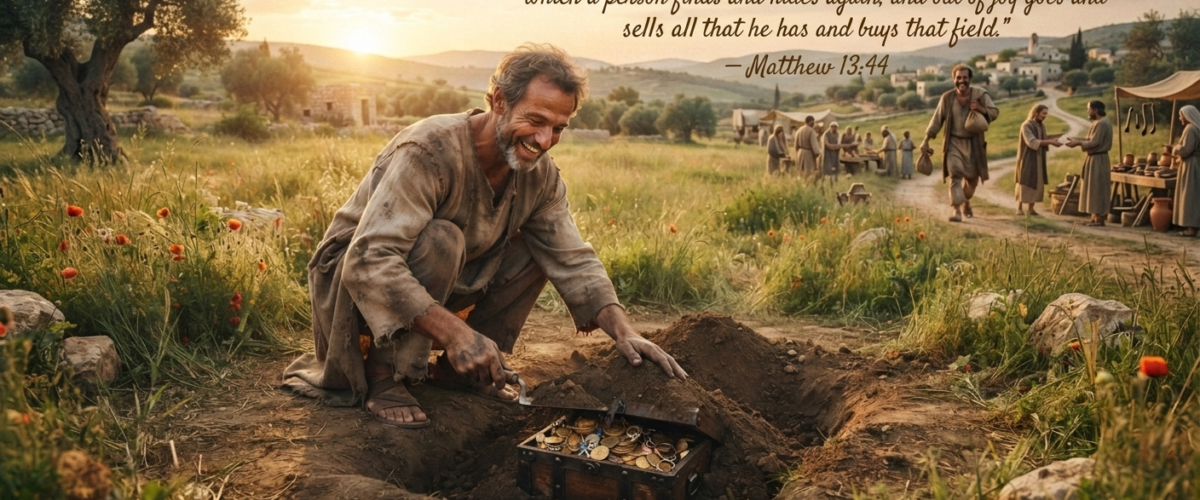
“The kingdom of heaven is like a treasure buried in a field, which a person finds and hides again, and out of joy goes and sells all that he has and buys that field.” — Matthew 13:44
Homilies A Homilies B Homilies C
❖ ✝ ❖
The Pearl of Great Price: What Is Worth Everything?
Good morning, brothers and sisters in Christ. We have been journeying together through the great parable chapter of Matthew 13 — the sermon by the sea. We have scattered seed on four kinds of soil (15th Sunday), watched wheat and weeds grow together in patient hope (16th Sunday), and marveled at the mustard seed and the yeast doing their hidden, transformative work. Today, on this Seventeenth Sunday in Ordinary Time, Matthew 13 reaches its crescendo with three final parables of breathtaking brevity and inexhaustible depth: the Treasure Hidden in the Field, the Pearl of Great Price, and the Net Thrown into the Sea.
These parables ask the most fundamental question any human being can face: what is worth everything? Not what is important among many important things, not what ranks highly on your list of priorities, but what is worth selling everything else to obtain? What is the one thing for which no price is too high?
The answer Jesus gives is not a system, not a set of doctrines, not a moral code — though all of these have their place. The answer is a Kingdom. A reign of God that, when you encounter it in its true nature, reorganizes every other value you hold. A reality so luminous and so real that the person who finds it does not experience the selling-of-everything as sacrifice. The text says he goes “out of joy” to sell all that he has. The merchant does not mourn his other pearls. He has found the one that makes them all irrelevant.
Three readings converge on this question of supreme value. Solomon, offered anything in the world by the God who created everything, chooses wisdom — not because wisdom is a good investment, but because wisdom is the capacity to see what is truly worth having. Paul, in one of the most consoling verses in all of his letters, reveals that all things work together for good for those who love God — including the apparent losses, the detours, the seasons of confusion that feel like everything going wrong. And Jesus gives us two tiny parables, totaling five verses, that have been turning the world’s value system upside down for two thousand years.
❖ ✝ ❖
“Give Your Servant an Understanding Heart”
First Reading — 1 Kings 3:5, 7–12
The Lord appeared to Solomon in a dream at night. God said, “Ask something of me and I will give it to you.” Solomon answered: “O LORD, my God, you have made me, your servant, king to succeed my father David; but I am a mere youth, not knowing at all how to act. I serve you in the midst of the people whom you have chosen, a people so vast that it cannot be numbered or counted. Give your servant, therefore, an understanding heart to judge your people and to distinguish right from wrong. For who is able to govern this vast people of yours?” The LORD was pleased that Solomon made this request. So God said to him: “Because you have asked for this — not for a long life for yourself, nor for riches, nor for the life of your enemies, but for understanding so that you may know what is right — I now do as you requested. I give you a wise and discerning heart.”
Solomon is at Gibeon for a great feast of offerings when God appears to him in a dream and makes an offer that most of us would find almost impossible to navigate wisely: “Ask something of me and I will give it to you.” This is the ancient equivalent of the genie’s three wishes, and history is full of people who would have asked for long life, invincible enemies, or overflowing wealth. Solomon’s list of what he did not ask for — long life, riches, the lives of his enemies — reads like a catalog of what most human ambition reaches for first.
Instead, Solomon asks for a *lev shomea* — a listening heart, a hearing heart. The Hebrew is sometimes translated “understanding heart” or “discerning heart,” but the root is *shama* — to hear, to listen, to attend. Solomon is asking not for knowledge as information but for wisdom as attentiveness: the capacity to truly hear what each situation requires, to listen deeply to the people he governs, to hear the voice of God beneath the noise of political necessity.
God is pleased. Not because wisdom is the theologically correct answer, but because Solomon’s request reveals what he actually values. He asked for the capacity to serve others well rather than for anything that would serve himself. He traded the personal advantage of long life and wealth and victory over enemies for the capacity to do his job as it was meant to be done. And God, who is never outdone in generosity, gives him wisdom — and then gives him the things he did not ask for on top of it (1 Kings 3:13).
Brothers and sisters, if God appeared to you tonight and said “ask something of me,” what would you ask for? The question is not merely hypothetical — it is the question that every prayer answers. What we pray for reveals what we actually value. Solomon’s dream is an invitation to examine our own prayer life and ask: am I asking for the things that would let me serve better, or am I asking for the things that would let me live more comfortably?

❖ ✝ ❖
Responsorial Psalm — Psalm 119:57, 72, 76–77, 127–128, 129–130
R/ Lord, I love your commands.
I have said, O LORD, that my part is to keep your words. The law of your mouth is to me more precious than thousands of gold and silver pieces. Let your kindness comfort me according to your promise to your servants. Let your compassion come to me that I may live, for your law is my delight. For I love your commands more than gold, however fine. For in all your precepts I go forward; every false way I hate. Wonderful are your decrees; therefore I observe them. The revelation of your words sheds light, giving understanding to the simple.
Psalm 119 is the longest psalm in the Psalter — one hundred and seventy-six verses, organized as an extended alphabetic acrostic, every stanza beginning with successive letters of the Hebrew alphabet, every stanza about the same subject: the beauty, the sufficiency, the life-giving power of God’s word. It is an extraordinary monument to the love of Scripture, and today’s excerpt presents the psalmist making the same essential choice Solomon made: the law of God is more precious than thousands of gold and silver pieces.
This is not mere piety. The psalmist is making a claim about comparative value — and the comparison is startling. Gold and silver were not abstract values in the ancient world. They were survival, status, power, and freedom. To say that God’s word is worth more than all of it is to say that the thing that orients you to reality — that gives you the capacity to see what is true and act rightly in it — is more valuable than any resource that might help you succeed within a distorted reality. Wisdom over wealth. The pearl over all the other pearls.
❖ ✝ ❖
“All Things Work Together for Good”
Second Reading — Romans 8:28–30
Brothers and sisters: We know that all things work together for good for those who love God, who are called according to his purpose. For those he foreknew he also predestined to be conformed to the image of his Son, so that he might be the firstborn among many brothers and sisters. And those he predestined he also called; and those he called he also justified; and those he justified he also glorified.
Romans 8:28 is perhaps the most quoted verse in the entire Pauline corpus — and also one of the most misunderstood. “All things work together for good for those who love God” is sometimes read as a promise that everything that happens to Christians will feel good, or will have an obvious happy ending, or will be easily justified as “part of God’s plan.” This is not what Paul is saying, and the misreading leads to enormous pastoral damage — people who feel they must pretend their suffering is good, or who lose their faith when they cannot find the silver lining in a genuine tragedy.
What Paul is actually claiming is more profound and more demanding. He is not saying that every event is good. He is saying that God works all things together — weaving the fabric of a life, including the losses, the detours, the failures, and the grief — toward a good that is larger than any single event. The Greek is *synergei eis agathon* — works together toward the good. It is a claim about the ultimate direction of the narrative, not the goodness of every scene within it.
“Those he predestined he also called; and those he called he also justified; and those he justified he also glorified.” This is the great chain of salvation that Paul describes — and it is stated in the past tense. Glorified. Past tense. Not “will eventually be glorified” but “he glorified.” Paul is speaking from within the divine perspective, where the end is already accomplished. From inside time, we see the weeds and the wheat, the good and the difficult, the progress and the apparent backsliding. From within God’s eternal now, the harvest is complete. The pearl has been purchased. The field has been bought. The good has been achieved.
This is the theological ground of Solomon’s wisdom, of the psalmist’s joy in God’s word, and of the merchant who sells everything with joy. They are all acting from within the conviction that the Kingdom — the pearl of great price — is worth every earthly thing, because the Kingdom is the only thing that participates in the “all things working together for good” in the deepest possible way. It is the end toward which all things are working. It is the treasure that makes the field worth the price.
❖ ✝ ❖
The Treasure, the Pearl, and the Net
Gospel — Matthew 13:44–52
Jesus said to his disciples: “The kingdom of heaven is like a treasure buried in a field, which a person finds and hides again, and out of joy goes and sells all that he has and buys that field. Again, the kingdom of heaven is like a merchant searching for fine pearls. When he finds a pearl of great price, he goes and sells all that he has and buys it. Again, the kingdom of heaven is like a net thrown into the sea, which collects fish of every kind. When it is full they haul it ashore and sit down to put what is good into buckets. What is bad they throw away. Thus it will be at the end of the age. The angels will go out and separate the wicked from the righteous and throw them into the fiery furnace, where there will be wailing and grinding of teeth. Do you understand all these things?” They answered, “Yes.” And he replied, “Then every scribe who has been instructed in the kingdom of heaven is like the head of a household who brings from his storeroom both the new and the old.”
The Parable of the Treasure in the Field and the Parable of the Pearl of Great Price are twins — two versions of the same essential truth, viewed from slightly different angles. In the first, the treasure is found by accident — a day laborer plowing a field stumbles on something buried and hidden, not sought but discovered. In the second, the merchant has been searching specifically for fine pearls — he is a professional, he has been looking for exactly this, and when he finds the pearl he has been seeking, he recognizes it immediately.
Two different experiences of the Kingdom: the unexpected discovery that reorganizes everything, and the long search that finally arrives at its destination. Both are honored. Some people come to faith by stumbling on it when they were not looking — a chance encounter, a funeral that moved them unexpectedly, a book they picked up for reasons they cannot fully explain. Others have been consciously searching for years — trying different traditions, reading theology, attending Mass sporadically — and one day find what they have been seeking all along. The Kingdom makes room for both modes of encounter.
What is identical in both parables is not the path of discovery but the response: joy. “Out of joy goes and sells all that he has.” The selling is not experienced as deprivation. It is experienced as liberation. When you find the thing that is worth everything, everything else is cheerfully released — not because the other things are bad, but because they are simply of a lesser order. The merchant does not mourn his other pearls. He has found the one that puts them all in proportion.
This is the spiritual logic behind every genuine conversion, every decision to enter religious life, every choice to leave a comfortable career for a life of service, every parent who gives up financial advancement to spend more time with their children in the faith. The sacrifice is real. The cost is real. But the joy of the one who has found the treasure makes the cost not merely bearable but, in retrospect, almost irrelevant. “For the joy set before him he endured the cross” (Hebrews 12:2). The cross comes first. The joy enables it.
The Parable of the Net echoes the wheat and weeds: a net thrown into the sea collects everything — fish of every kind — and the sorting happens at the end, not during the catching. The Kingdom is inclusive in its gathering and decisive in its completion. The universal invitation — come, all of you — is genuine. And the final accountability — the separating of the good from the bad — is equally genuine. We are not to do the sorting during the gathering. We are to cast the net wide.
Jesus ends by asking His disciples: “Do you understand all these things?” And they say yes. We do not need to debate whether they fully understood — they almost certainly did not, and would understand more after the resurrection. But their yes is the yes of those who have encountered the Teacher and found in Him something that makes them want to understand more. And Jesus’s final image — the scribe instructed in the Kingdom who brings from his storeroom both the new and the old — is an invitation to exactly that: to be people who can draw on the whole tradition, ancient and fresh, old and new, and offer it to a world that desperately needs the treasure they have found.

❖ ✝ ❖
A Story for the 17th Sunday: The Man Who Sold the Business
There was a man named David who had built a successful manufacturing business over twenty-five years in Cleveland, Ohio. He was Catholic by background, practicing in the minimal sense that he attended Mass at Christmas and Easter, had his children baptized, and wrote a check to the parish every year at the stewardship drive. His faith was real but thin — real enough that he never considered leaving, thin enough that it had no particular claim on his daily decisions.
At fifty-one, his daughter — a junior in college — called him to tell him she had made a retreat with a campus ministry and something had happened that she could not fully explain. She wanted to become a nun. David’s first response was everything you might expect from a successful businessman who had funded four years of college with a particular vision of return on investment. His second response, a week later, surprised him. He went to Mass on a Thursday morning — not a holy day, not a special occasion — because his daughter’s phone call had stirred something he could not name.
He sat in the back of the nearly empty church. The Gospel that morning was from John 6: “The bread that I will give is my flesh for the life of the world.” He had heard those words hundreds of times. On that Thursday morning, for reasons he would later be unable to fully account for, he heard them as if for the first time. And something in him — the careful, managed, performing self he had built over fifty-one years — broke open.
Over the following two years, David made a series of decisions that his business partners found incomprehensible. He sold the company. He and his wife moved to a smaller house. He began volunteering three days a week at a Catholic Worker house. He started Eucharistic adoration on Friday mornings. He became, in the eyes of his former colleagues, a different person.
At sixty, he told his spiritual director: “I don’t know how to explain what happened. I didn’t lose anything I actually needed. I found everything I was actually looking for.” He paused. “I just wish it hadn’t taken me fifty-one years to look in the right field.”
“Out of joy goes and sells all that he has.” David did not experience his choices as sacrifice. He experienced them as the most rational thing he had ever done — the decision of a man who had found the treasure and could not imagine going back to the field without digging it up.
❖ ✝ ❖
An American Saint of Wisdom: Saint John Neumann
For this Sunday of divine wisdom and the pearl of great price, we honor one of the most remarkably wise administrators and pastors in the history of American Catholicism: Saint John Neumann, the fourth Bishop of Philadelphia, canonized in 1977 by Pope Paul VI, whose feast day falls on January 5.
John Neumann was born in Bohemia (present-day Czech Republic) in 1811, the son of a German father and Czech mother. He completed his seminary studies in Prague but was not ordained because the diocese had a surplus of priests. Rather than wait indefinitely, he responded to an advertisement by Bishop John Dubois of New York, who was desperate for priests to serve the rapidly growing German immigrant population of the United States. Neumann arrived in New York in 1836 with no money, speaking German, Czech, Italian, French, Spanish, and enough English to get by. He was ordained four days after his arrival.
He served for four years in rural upstate New York, traveling on horseback in all weather to serve German immigrant communities spread across enormous territories with no roads. In 1840, he entered the Redemptorist order and became the first Redemptorist to profess his vows in the United States. In 1852, Pope Pius IX appointed him Bishop of Philadelphia — the fourth-largest city in the country, with a Catholic population of nearly 170,000, served by an inadequate network of parishes and essentially no Catholic school system.
What Neumann did in eight years as bishop became the template for American Catholic education. He took a diocese that had one Catholic school when he arrived and left it with one hundred. He established the first diocesan Catholic school system in the United States — a network of schools organized, funded, and administered at the diocesan level rather than left entirely to individual parishes. He recognized, with the wisdom of Solomon, that the long-term future of American Catholicism depended on educating its children in the faith. The enrollment in Philadelphia’s Catholic schools grew from five hundred to nine thousand students during his eight years as bishop.
He died suddenly of a stroke in 1860 at the age of forty-eight, collapsing on the street in Philadelphia. He was found to be carrying, at his death, thirty-three cents. He had given everything he had — his time, his health, his comfort, his resources — to build the field that housed the treasure. He had found the pearl. And he had cheerfully sold everything to buy it.
“Do not be disturbed if what you are doing seems small and insignificant. God is honored by small things done faithfully.” — Saint John Neumann

❖ ✝ ❖
What Is Worth Everything? The American Catholic and the Pearl
The Crisis of Value in American Culture
We live in a culture that relentlessly proposes answers to the question “what is worth everything?” — and those answers shift from decade to decade, from platform to platform, from influencer to influencer. Financial security. Physical appearance. Social influence. Career achievement. Political victory. Sexual satisfaction. Experience accumulation. Each of these is presented as the treasure in the field, the pearl of great price — the thing for which everything else should be sold. And each of them, in the end, fails to satisfy the specific hunger they promised to address. The person who has achieved financial security worries about losing it. The person who has achieved social influence fears irrelevance. The person who has devoted their life to experience accumulation finds that experiences do not compound into meaning the way wisdom does.
The Treasure Hidden in Ordinary Life
One of the most important implications of today’s parables for American Catholics is this: the treasure is hidden in the field you are already in. The day laborer did not find the treasure in a famous field, a prestigious location, a specially designated holy site. He was plowing an ordinary field, doing ordinary work, when his plow struck something extraordinary. The Kingdom of God is hidden in the ordinary fabric of your actual life. In your marriage, imperfect and demanding as it is. In your children, exhausting and beautiful as they are. In your work, however unglamorous. In your parish, limited and human as it may be. The treasure is not somewhere else. It is here, in this field, waiting to be uncovered by those who have eyes to see.
Asking for Wisdom
Solomon’s prayer — “Give your servant an understanding heart” — is a prayer available to every one of us every morning. Not a prayer for circumstances to improve, for problems to be resolved, for enemies to be defeated. A prayer for the wisdom to see what is actually happening, to hear what each person and each situation truly needs, to recognize the treasure when your plow strikes it. This is the prayer that recalibrates all other prayers. Ask for wisdom first, and everything else begins to find its proper proportion.
❖ ✝ ❖
Scriptures to Carry Into This Week
- James 1:5 — “If any of you lacks wisdom, you should ask God, who gives generously to all without finding fault, and it will be given to you.” The New Testament echo of Solomon’s prayer — wisdom is available to every person who asks, given generously and without reproach.
- Matthew 6:33 — “But seek first his kingdom and his righteousness, and all these things will be given to you as well.” The summary statement of the treasure and the pearl. Seek the Kingdom first. Trust that God knows what else you need.
- Philippians 3:7–8 — “Whatever were gains to me I now consider loss for the sake of Christ. What is more, I consider everything a loss because of the surpassing worth of knowing Christ Jesus my Lord.” Paul’s personal testimony to the logic of the pearl — not a loss of goods but a discovery of the Good that makes everything else a lesser category.
- Proverbs 4:7 — “The beginning of wisdom is this: Get wisdom. Though it cost all you have, get understanding.” The Hebrew wisdom tradition’s version of the parable of the pearl: wisdom is worth everything. Pay whatever it costs.
- Matthew 7:7–8 — “Ask and it will be given to you; seek and you will find; knock and the door will be opened to you.” The promise that makes Solomon’s dream available to every person: the God who appeared to Solomon in the night answers every petition made in faith.
❖ ✝ ❖
Conclusion: Sell All You Have — Out of Joy
Brothers and sisters, as we conclude five weeks of Matthew’s great parable chapter, I want to leave you with the image that has stayed with me most powerfully from today’s Gospel: the merchant who sells all he has and does so out of joy. Not out of duty. Not out of guilt. Not out of theological correctness. Out of joy. Because he has found the thing that, having found it, makes every other thing seem obviously worth releasing.
The Kingdom of God is not primarily a moral system or a religious institution or a set of doctrines, though it expresses itself in all of these. It is a reality — as real as the treasure in the field, as rare as the pearl of great price — that, when encountered in its true nature, reorganizes everything else. Solomon encountered it in a dream and asked for wisdom. The psalmist encountered it in the beauty of God’s word and found it worth more than silver and gold. Paul encountered it on the road to Damascus and spent his life trying to communicate the joy of the discovery. David, the businessman from Cleveland, encountered it at a weekday Mass when a sentence from the Gospel of John broke him open. John Neumann encountered it in the face of every immigrant child who needed to be taught that they were beloved of God.
You are in a field right now. The treasure is buried somewhere in it. The pearl is perhaps already in your hands, and you have not yet recognized what you are holding. Ask for wisdom — the listening heart, the hearing heart, the *lev shomea* of Solomon — so that you can see what is actually in front of you.
And when you find it — when you see it clearly for what it is — sell everything that needs selling. Out of joy. Because the Kingdom of heaven is worth exactly that, and the merchant who found his pearl did not regret a single thing he gave away.

Glory and praise for ever. Amen.
❖ ✝ ❖
Reflection Questions for Personal Prayer or Group Discussion
1.. If God appeared to you tonight and said “ask something of me and I will give it to you,” what would you ask for? What does your honest first answer reveal about what you actually value right now?
2.. Paul says all things work together for good for those who love God — not that all things are good in themselves, but that God weaves them toward a good larger than any single event. Is there something in your past — a loss, a failure, a detour — that you can now see being woven into something good? Is there something present that you are being asked to trust is being woven, even though you cannot yet see it?
3.. The treasure was found by accident; the pearl was found by long searching. Which of these better describes your own experience of faith? What does that history tell you about how God has been pursuing you?
4.. The merchant sells everything “out of joy” — not reluctantly, but gladly. Is there something in your life you are holding tightly that you sense God is asking you to release? What would it take for the holding-on to become a letting-go out of joy?
5.. Saint John Neumann asked: “Do not be disturbed if what you are doing seems small and insignificant. God is honored by small things done faithfully.” What is the small, faithful thing in your life right now that might be part of the treasure the world cannot yet see?
❖ ✝ ❖
Prayers of the Faithful — 17th Sunday in Ordinary Time
Presider: Brothers and sisters, having found the treasure hidden in the field of God’s word and having tasted the pearl of great price at this Eucharistic table, let us bring before the Father the needs of His Church and His world.
- For the Catholic Church in the United States: that she may be a community of those who have genuinely found the treasure — who can witness to the joy of giving everything for the Kingdom, and who offer that joy to a culture that is searching desperately in the wrong fields. We pray to the Lord.
Lord, hear our prayer.
- For all who are searching for the pearl — who sense that there is something more than what the culture offers, who feel the hunger that consumer society cannot satisfy, who are in the synagogue or the bookstore or the retreat center, looking: that God may lead them to the field where the treasure is buried. We pray to the Lord.
Lord, hear our prayer.
- For wisdom in the leadership of our nation: that those who govern the United States may ask, as Solomon asked, not for personal advantage or victory over enemies, but for the understanding heart that can hear what the people truly need and serve them with justice and mercy. We pray to the Lord.
Lord, hear our prayer.
- For Catholic schools, universities, and religious education programs — the legacy of Saint John Neumann’s vision: that they may form young people not merely in knowledge but in wisdom — in the capacity to see the treasure hidden in the ordinary field of a faithful life. We pray to the Lord.
Lord, hear our prayer.
- For those who are being asked to sell something — to release a relationship, a comfort, a career path, a cherished plan — in order to follow a call they sense but cannot yet fully name: that the joy of the merchant who found his pearl may sustain them through the selling, and that they may arrive at the field knowing it was worth every price. We pray to the Lord.
Lord, hear our prayer.
- For all who are suffering and cannot yet see how their suffering could be part of anything good: that Paul’s promise — “all things work together for good” — may be not a platitude but a lifeline, and that the God who sees the harvest from within eternity may give them a glimpse of what is being woven from their pain. We pray to the Lord.
Lord, hear our prayer.
- For the faithful departed — those who sold everything for the Kingdom and have now received what they purchased: that they may rejoice in the harvest of what they planted, and that we who are still in the field may be encouraged by their witness. We pray to the Lord.
Lord, hear our prayer.
Presider: God of wisdom and abundance, You are the treasure hidden in every field and the pearl beyond all price. You gave Solomon a listening heart, You wove all things toward good for those who love You, and You offered Your Son as the price of the field that contains everything. Grant us the wisdom to see what is truly valuable, the courage to sell what needs selling, and the joy of those who have found what they were made for. We ask this through Christ our Lord.
All: Amen.
❖ ✝ ❖
✝ ✝ ✝
17th Sunday in Ordinary Time · July 26, 2026 · Lectionary Year A · US Catholic Homily
homilysunday.com · Enriching Your Faith with Weekly Catholic Homilies and Reflections

💬 Share Your Reflection