
The Commemoration of All the Faithful Departed (All Souls): US Catholic Homily for November 2, 2026
Lectionary 668 · Monday, November 2, 2026
Readings: Wisdom 3:1–9 | Psalm 23 | Romans 6:3–9 | John 6:37–40
Also this week: the month of the Holy Souls in the US, the All Souls octave (November 1–8), and the feast falls the day after the Solemnity of All Saints.
Sunday Homilies Year A Sunday Homilies Year B Sunday Homilies Year C
They Are in Peace: The Gospel of the Open Hand
Good morning, brothers and sisters. Yesterday we celebrated the saints, those we are sure are with God. Today we pray for everyone else we love and miss. It’s a quieter feast, but it is also one of the most human days of the year.
Nearly everyone here has a name they carry today. A parent, a spouse, a child, a friend, or someone we never got to say goodbye to. Today’s readings do not tell us to stop grieving. They tell us where our dead are, and who is holding them.
The question underneath all four readings is simple: when someone we love dies, into whose hands do they go?
“The Souls of the Just Are in the Hand of God”
First Reading: Wisdom 3:1–9
The author of Wisdom knows how death looks from the outside. “In the view of the foolish they seemed to be dead,” and their passing was thought an affliction. That is how it feels at a hospital bed or a graveside. It feels like destruction.
Then the text turns: “But they are in peace.”
Notice the image. The souls of the just are not floating or lost. They are in a hand, and no torment shall touch them. Whatever happens to us after death, it happens inside the grip of God.
The reading also admits that something is still being worked out. God “tried them like gold in the furnace.” The tradition of the Church has always heard in this a purification: a love still being made whole. That is why we pray for the dead. We do not pray because God is reluctant. We pray because love does not stop at the cemetery gate, and the Church believes our prayers can help.
And the reading ends with a promise: “the faithful shall abide with him in love.”
“Though I Walk in the Valley of Darkness”
Responsorial Psalm: Psalm 23
We have prayed this psalm at more funerals than any other. Look at its pronouns. For the first part, the shepherd is spoken about: “The Lord is my shepherd.” Then, in the valley, the grammar changes and the psalmist speaks to him: “you are with me.”
That shift is what faith sounds like at a graveside. We stop describing God and start addressing him. Grief does not always have words, but it can always say you.
And the psalm does not promise we will avoid the valley. It promises that we will not walk it alone, and that it leads to a table and a house where we will dwell “for years to come.”
“Baptized into His Death”
Second Reading: Romans 6:3–9
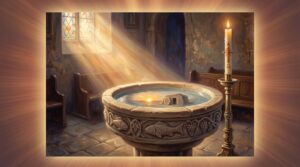
Paul takes us back to the baptismal font. “Are you unaware that we were baptized into his death?” Every one of us who was baptized has already, in a mystery, gone through death with Christ. That is why Paul can say, “If we have died with Christ, we believe that we shall also live with him.”
This is the center of All Souls. The Church does not look at the dead as people who are gone. She looks at them as the baptized, people who carry Christ’s name and have been joined to his Easter. Death has already lost its mastery over them: “Christ, raised from the dead, dies no more.”
Paul’s words are not a poetic comfort. They are a claim about what baptism did.
“I Shall Not Lose Anything of What He Gave Me”
Gospel: John 6:37–40
Jesus says four things in this short passage, and they could be carved over every cemetery gate.
“Whoever comes to me I will not reject.” There is no one who arrives at the end of life and is turned away at the door.
“I came down from heaven not to do my own will but the will of the one who sent me.” Whatever comes next is not improvised. It is the Father’s will.
“That I should not lose anything of what he gave me.” Not one of them. Not the one who left the Church years ago, not the one who died suddenly, not the one whose faith we were never sure about.
“But that I should raise it on the last day.” Not “console.” Not “remember.” Raise.
The grave is not the last word. The Father’s will is not a vague hope. It is a promise to lose no one.
A Story for This Day: The Man with the Coffee Can
(An illustrative story, not a historical account.)
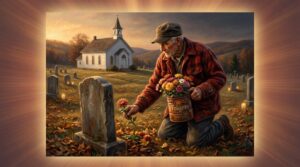
In a small parish cemetery in western Pennsylvania, every year on the first days of November, an old man named Walt would walk the rows carrying a rusty coffee can of fresh mums.
His own wife was buried near the front, and that grave always had flowers. But Walt kept going. He walked to the back, past the stones of families who had moved to Arizona or Texas, past graves where the grass had grown over the markers, and he set one flower at each.
A young deacon once followed him and asked, “Walt, who are these people to you?”
Walt said, “Nobody, really. I just figure everybody ought to have somebody come by.”
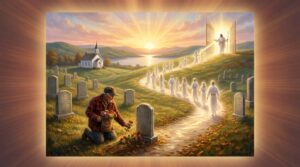
When Walt died, the parish found a small notebook in his coat pocket. It had hundreds of names, copied one at a time from the stones. Beside each name he had written the same words: Lord, remember.
At his funeral the pastor said that the notebook was the best theology of All Souls he had ever seen. The dead are not forgotten by God. But God, as usual, works through people willing to be his hands.
Someone in your family or your parish has no one to pray for them. Today the Church asks us to be that someone.
A Saint for This Feast: St. Odilo of Cluny
Today’s feast has a founder. St. Odilo (c. 962–1049) was the fourth abbot of Cluny, the great Benedictine monastery in France. Around the year 998, he asked all the monasteries under Cluny’s care to remember the faithful departed in prayer on November 2, the day after All Saints.
The practice spread quickly, first through the monasteries and then across the Church, because it answered something every heart already felt. People had always prayed for their dead, but now there was a common day for the whole Church to do it together.
It is a lesson in how the Church works. A single abbot noticed what was missing and acted. Today you can do the same in your family: say the names aloud at dinner, light a candle, put a photograph where you will see it.
All Souls and the American Catholic in 2026
We Don’t Talk About Death, But the Church Does
American culture is skilled at hiding death. We outsource it to hospitals, shorten the mourning period, and say “celebration of life” as though sorrow were bad manners. The Church gently disagrees. She invites us to name the dead, visit their graves, and pray for them aloud. Honest grief is part of faith.
Our Prayers Matter
Many Catholics grow up believing prayers for the dead are a quaint old custom. They are not. Praying for the dead is one of the oldest works of mercy. During the first eight days of November, the Church also offers a plenary indulgence, applicable only to the souls in purgatory, for visiting a cemetery and praying for the dead, under the usual conditions (confession, Communion, and prayer for the Pope’s intentions). If you can, go this week.
The Gift We Can Still Give
One of the hardest parts of grief is feeling there is nothing left to do. All Souls says otherwise. There is something: Mass, rosaries, almsgiving, a visit, a candle. Love still has work to do.
Hope Is Not Optimism
Optimism says things will probably turn out fine. Hope says: Christ is risen, and I belong to him. We do not grieve “as others do who have no hope.” We grieve with tears, and with the Easter promise.
Homily in Five Minutes (Short Version)
For a weekday Mass.
Brothers and sisters, yesterday we celebrated the saints. Today we remember everyone else we love who has died.
The Book of Wisdom says the souls of the just are in the hand of God, and no torment shall touch them. To the foolish they seem to be dead, but they are in peace. The Church believes some are still being purified in love, which is why we pray for them. Our prayers matter.
St. Paul reminds us that we were baptized into Christ’s death. We have already gone through the water with him, so we believe we shall live with him. And in the Gospel Jesus promises the Father’s will in plain words: he will lose nothing of what he was given, and he will raise it on the last day.
So the Church does not ask us to hide our grief. She asks us to bring it here, to say the names, and to hand them back into the hand of God. Today, say one name out loud. Offer one prayer, one candle, or one visit. And if you know someone who has no one to pray for them, be the one who does.
Scriptures to Carry Into This Week
- John 11:25–26: “I am the resurrection and the life; whoever believes in me, even if he dies, will live.” Jesus at the tomb of Lazarus.
- 1 Thessalonians 4:13–14: “We do not want you to be unaware… so that you may not grieve like the rest, who have no hope.”
- 2 Maccabees 12:44–45: Judas Maccabeus prays for the fallen, a root of the Church’s practice.
- Revelation 21:4: “He will wipe every tear from their eyes, and there shall be no more death.”
- Romans 8:38–39: “Neither death nor life… will be able to separate us from the love of God.”
Conclusion: Into Your Hands
Brothers and sisters, the dead are not lost. They are in the hand of God, joined to Christ by baptism, and promised the resurrection by the one who said he would lose nothing the Father gave him.
So this week, do what love does. Say their names. Pray for them. Go to the cemetery, light a candle, or offer a Mass. And let your own death, whenever it comes, be a little less frightening, because you know whose hands are waiting.
Eternal rest grant unto them, O Lord, and let perpetual light shine upon them. May they rest in peace. Amen.
Take-Home for Families
- Talk at dinner: Share one memory of someone who has died, a funny one if possible.
- Do together: Visit a cemetery this week and pray the Eternal Rest prayer at a family grave, or at a grave no one visits.
- Pray together: Light a candle by a photo and say one Our Father and one Hail Mary for the departed.
- For children: Make a “remembrance card” with a name, a drawing, and a short prayer.
Reflection Questions
- Whose name are you carrying into Mass today? What would you like to say to them?
- The Book of Wisdom says the just are “in the hand of God.” What changes in how you grieve if you believe that?
- Paul says we were baptized into Christ’s death. How might remembering your baptism shape the way you face your own death?
- Jesus promises to lose no one. Is there someone you are afraid to entrust to him? Can you do it today?
- Who in your parish or family has no one to pray for them? What is one thing you could do this week?
Prayers of the Faithful: Commemoration of All the Faithful Departed
Presider: Brothers and sisters, confident in the mercy of the God who raised Christ from the dead, let us pray for the living and the dead.
- For Pope Leo XIV, our bishops, priests, and deacons: that they may proclaim the hope of the resurrection with faith and tenderness. We pray to the Lord. Lord, hear our prayer.
- For all who mourn: for widows and widowers, for parents who have lost children, for children who have lost parents: that the God of all consolation may wipe away their tears. We pray to the Lord. Lord, hear our prayer.
- For those who died suddenly, alone, or without the sacraments: that they may know the mercy of Christ, who rejects no one who comes to him. We pray to the Lord. Lord, hear our prayer.
- For the souls in purgatory, especially those who have no one to pray for them: that they may be released from all that holds them back and welcomed into the light of God’s face. We pray to the Lord. Lord, hear our prayer.
- For military veterans and first responders who have died, and for all who died in war, disaster, or violence. We pray to the Lord. Lord, hear our prayer.
- For the sick and the dying, and for those who care for them: that they may know they are in the hand of God. We pray to the Lord. Lord, hear our prayer.
- For ourselves: that remembering our dead may help us live with greater love, and prepare us for a holy death. We pray to the Lord. Lord, hear our prayer.
- For our own beloved dead, whom we name now in silence. (Pause.) We pray to the Lord. Lord, hear our prayer.
Presider: God of the living and the dead, you hold in your hand all whom you have made. Hear our prayers for those who have gone before us, and bring us, with them, to the joy of your kingdom. We ask this through Christ our Lord. All: Amen.
The Commemoration of All the Faithful Departed
(All Souls)
Lectionary: 668
The following are a selection of the readings that may be chosen for this day. The following are a selection of the readings that may be chosen for this day. Please see Lectionary number 668 for the full selection of approved options.
Reading I
Wisdom 3:1-9
The souls of the just are in the hand of God,
and no torment shall touch them.
They seemed, in the view of the foolish, to be dead;
and their passing away was thought an affliction
and their going forth from us, utter destruction.
But they are in peace.
For if before men, indeed, they be punished,
yet is their hope full of immortality;
chastised a little, they shall be greatly blessed,
because God tried them
and found them worthy of himself.
As gold in the furnace, he proved them,
and as sacrificial offerings he took them to himself.
In the time of their visitation they shall shine,
and shall dart about as sparks through stubble;
they shall judge nations and rule over peoples,
and the Lord shall be their King forever.
Those who trust in him shall understand truth,
and the faithful shall abide with him in love:
because grace and mercy are with his holy ones,
and his care is with his elect.
Responsorial Psalm
Psalm 23:1-3a, 3b-4, 5, 6
R. (1) The Lord is my shepherd; there is nothing I shall want.
or:
R. Though I walk in the valley of darkness, I fear no evil, for you are with me.
The LORD is my shepherd; I shall not want.
In verdant pastures he gives me repose;
beside restful waters he leads me;
he refreshes my soul.
R. The Lord is my shepherd; there is nothing I shall want.
or:
R. Though I walk in the valley of darkness, I fear no evil, for you are with me.
He guides me in right paths
for his name’s sake.
Even though I walk in the dark valley
I fear no evil; for you are at my side
with your rod and your staff
that give me courage.
R. The Lord is my shepherd; there is nothing I shall want.
or:
R. Though I walk in the valley of darkness, I fear no evil, for you are with me.
You spread the table before me
in the sight of my foes;
You anoint my head with oil;
my cup overflows.
R. The Lord is my shepherd; there is nothing I shall want.
or:
R. Though I walk in the valley of darkness, I fear no evil, for you are with me.
Only goodness and kindness follow me
all the days of my life;
and I shall dwell in the house of the LORD
for years to come.
R. The Lord is my shepherd; there is nothing I shall want.
or:
R. Though I walk in the valley of darkness, I fear no evil, for you are with me.
Reading II
Romans 5:5-11
Brothers and sisters:
Hope does not disappoint,
because the love of God has been poured out into our hearts
through the Holy Spirit who has been given to us.
For Christ, while we were still helpless,
died at the appointed time for the ungodly.
Indeed, only with difficulty does one die for a just person,
though perhaps for a good person
one might even find courage to die.
But God proves his love for us
in that while we were still sinners Christ died for us.
How much more then, since we are now justified by his Blood,
will we be saved through him from the wrath.
Indeed, if, while we were enemies,
we were reconciled to God through the death of his Son,
how much more, once reconciled,
will we be saved by his life.
Not only that,
but we also boast of God through our Lord Jesus Christ,
through whom we have now received reconciliation.
Or:
Romans 6:3-9
Brothers and sisters:
Are you unaware that we who were baptized into Christ Jesus
were baptized into his death?
We were indeed buried with him through baptism into death,
so that, just as Christ was raised from the dead
by the glory of the Father,
we too might live in newness of life.
For if we have grown into union with him through a death like his,
we shall also be united with him in the resurrection.
We know that our old self was crucified with him,
so that our sinful body might be done away with,
that we might no longer be in slavery to sin.
For a dead person has been absolved from sin.
If, then, we have died with Christ,
we believe that we shall also live with him.
We know that Christ, raised from the dead, dies no more;
death no longer has power over him.
Alleluia
Matthew 25:34
R. Alleluia, alleluia.
Come, you who are blessed by my Father;
inherit the Kingdom prepared for you from the foundation of the world.
R. Alleluia, alleluia.
Gospel
John 6:37-40
Jesus said to the crowds:
“Everything that the Father gives me will come to me,
and I will not reject anyone who comes to me,
because I came down from heaven not to do my own will
but the will of the one who sent me.
And this is the will of the one who sent me,
that I should not lose anything of what he gave me,
but that I should raise it on the last day.
For this is the will of my Father,
that everyone who sees the Son and believes in him
may have eternal life,
and I shall raise him on the last day.”

💬 Share Your Reflection