📅 May 2026 ✍️ SundayHomily ⏱ 20 min read 📂 Catholic Homily Resources
✦ Church Father · Doctor of the Church · c. 347–407 AD ✦
Saint John Chrysostom:
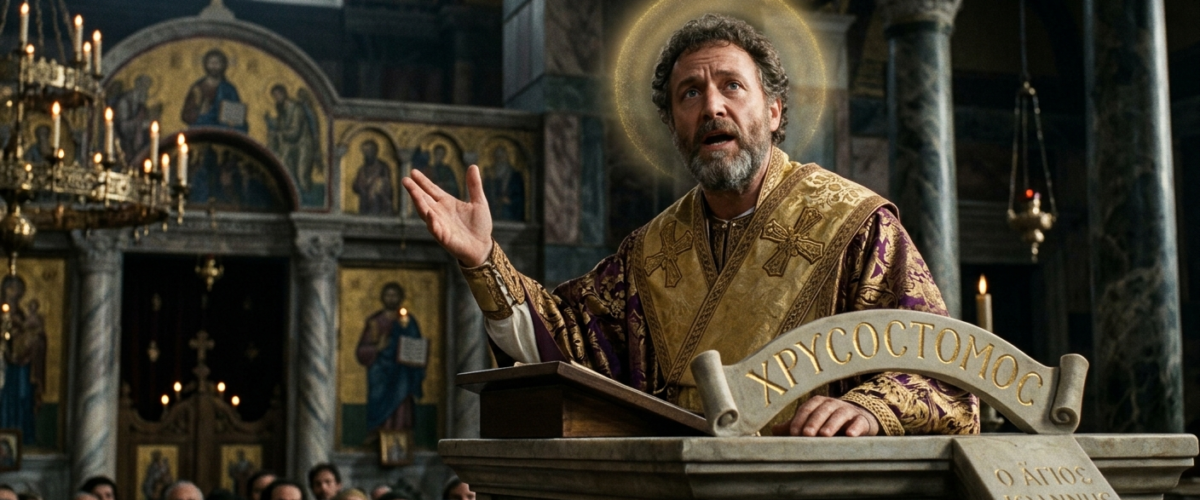
The Golden-Mouthed Father of Catholic Homilies
His life, his method, his legacy — and what every homilist can learn from the greatest preacher in Christian history
“Preaching improves me. When I begin to speak, weariness disappears; when I begin to teach, fatigue too disappears.”
— Saint John Chrysostom
His name was John. But the world would not call him simply John for long. The congregations of Antioch and Constantinople who heard him preach in the late fourth century gave him a title that no theological degree, no imperial appointment, and no Church council could confer — they called him Chrysostom: the Golden-Mouthed. It was not a surname. It was a verdict. And fifteen centuries later, it still stands.
Saint John Chrysostom (c. 347–407 AD) is universally regarded as the greatest preacher in Christian history. The medieval theologian Thomas Aquinas said that if he could choose only one book to read outside of Scripture, it would be Chrysostom’s commentary on Matthew. The Protestant Reformer John Calvin declared: “No one of sound judgment would deny that our Chrysostom excels all the ancient writers currently extant.” He is venerated as a Doctor of the Church by Catholics, and as one of the Three Holy Hierarchs by Eastern Orthodox Christians. His Divine Liturgy is still celebrated every Sunday by millions of Byzantine Catholics and Orthodox Christians around the world.
But what made him so extraordinary? What was his method? What can priests, deacons, and anyone who proclaims God’s Word today learn from the Golden-Mouthed? This article explores his remarkable life, his revolutionary approach to preaching, his most famous homilies, and the timeless principles that can transform every Sunday homily.
✦ ✦ ✦
Part OneThe Life of the Golden-Mouthed: From Antioch to Exile
🏛️ Born Into a World of Change
John was born around 349 AD in Antioch, Syria — one of the great cities of the ancient world, home to between 300,000 and 500,000 people, pagan and Christian alike. His father Secundus, a military officer, died shortly after John’s birth, leaving his mother Anthusa to raise him alone. Anthusa was a woman of deep Christian faith and extraordinary character. The pagan orator Libanius, who would later teach the young John rhetoric, reportedly said of her: “What remarkable women these Christians have!”
John received a first-class classical education. Between the ages of 14 and 18, he studied rhetoric and philosophy under Libanius himself — the finest pagan orator of the age. This training in the Greek art of persuasion would later give his preaching an extraordinary rhetorical power. But John was not destined for a career in the courts or the civil service. He was drawn to something far more demanding: the life of a Christian monk.
🏔️ The Desert Years: Formed in Silence
After his baptism and a period of intense study under Bishop Meletius and the theologian Diodorus of Tarsus, John withdrew to the mountains outside Antioch for approximately six years of monastic life — first in a community, then as a hermit alone in a cave. He memorised the entire New Testament. He fasted severely, slept little, and spent hours each day in prayer and Scripture study. He later wrote that these were the most formative years of his life.
But the harsh conditions broke his health. Forced to return to Antioch around 381, he was ordained a deacon, then a priest in 386 — the moment that would change the history of Christian preaching. He was approximately 37 years old. The congregation of Antioch was about to meet the Golden-Mouthed.
🎙️ The Antioch Years: The Golden Voice Awakens
For twelve years — from 386 to 398 — John preached in Antioch, and the city was never the same. His sermons drew enormous crowds. People arrived early to get a good position. They interrupted him with applause. They wept, they laughed, they argued with him, and they went home changed. Word spread across the empire: there was a preacher in Antioch whose words carried the weight of Scripture itself.
His most dramatic moment came in 387 AD, during what became known as the “Riot of the Statues.” Citizens of Antioch, furious over new taxes, toppled and destroyed imperial statues of Emperor Theodosius and his family — a crime punishable by the destruction of the entire city. For the weeks of Lent that followed, as the city trembled in fear awaiting the Emperor’s judgment, John preached more than twenty homilies urging repentance, calm, and trust in God. The homilies were so powerful that pagans converted to Christianity in large numbers. Bishop Flavian interceded with the Emperor. The city was spared. John’s reputation became legendary.
⭐ Did You Know?
Today we still possess 1,447 of Saint John Chrysostom’s sermons and 240 of his letters — the largest collection of writings surviving from any Greek Father of the Church. His commentaries on Matthew, John, Romans, Corinthians, Galatians, Ephesians, and many other books of Scripture remain in print and in use by preachers and scholars across every Christian tradition to this day.
👑 Archbishop of Constantinople: Power, Courage, and Exile
In 397 AD, John was appointed Archbishop of Constantinople — the imperial capital, the most powerful ecclesiastical see in the East. He accepted reluctantly. He immediately set about reforming the corrupt clergy of the capital, selling off the luxurious furnishings of the episcopal residence and giving the proceeds to hospitals for the sick. He reduced the lavish banquets of the bishops, redirected their wealth to the poor, and began visiting the sick in the slums personally.
But his uncompromising integrity made dangerous enemies. He clashed with the Empress Eudoxia, who interpreted his sermons against vanity and luxury as personal attacks. He confronted corrupt bishops. He defended the weak against the powerful. His enemies engineered a kangaroo court — the Synod of the Oak in 403 — and had him condemned and exiled. The people rioted in protest. He was recalled within days — but his enemies did not relent.
In 404 AD he was exiled a second time, to the remote town of Cucusus in the mountains of Armenia. Even from exile he continued to write — over 240 letters, many to his beloved deaconess Olympias, who had devoted her vast personal wealth to his ministry. Three years later, in 407 AD, his enemies decided even remote Armenia was too close. He was ordered to march to the furthest edge of the Black Sea coast. The journey, on foot in harsh weather, was clearly designed to kill him. It succeeded. John died on 14 September 407 AD — his feast day in the Latin Church. His last words, spoken as he lay dying by the roadside, were:
“Glory to God for all things.”
— The last words of Saint John Chrysostom, 407 AD
In 438, thirty-one years after his death, his relics were brought back to Constantinople in triumph. The Emperor Theodosius II publicly asked for the saint’s forgiveness on behalf of his mother Eudoxia. The crowds that lined the streets were beyond counting. The Golden-Mouthed had outlasted all his enemies.
✦ ✝ ✦
Part TwoThe Chrysostom Method: 7 Secrets of the Golden-Mouthed
What made Chrysostom’s preaching so powerful that it converted pagans, calmed riots, moved emperors, and is still studied by preachers sixteen centuries later? After careful study of his thousands of surviving sermons, seven core principles emerge — principles that are as alive and urgent today as they were in fourth-century Antioch.
📖 Secret 1: Scripture First, Scripture Always
Chrysostom believed with absolute conviction that the job of the preacher was not to entertain, not to showcase his own learning, and not to impose his own ideas — but to open the Scripture and let God speak. He preached through entire books of the Bible, verse by verse, word by word. He produced 90 homilies on Matthew, 88 on John, 32 on Romans, and scores more on nearly every book of the New Testament.
He typically began each homily with a general overview of the book’s argument, then went through the text in precise order, making sure nothing was skipped or glossed over. He believed that every word of Scripture had been placed there by God for a reason, and it was the preacher’s sacred duty to find that reason and present it to the people.
🔍 Secret 2: The Literal Meaning — No Fanciful Allegory
Chrysostom was the great champion of the Antiochene school of biblical interpretation — the school that insisted on taking the plain, literal, historical meaning of Scripture seriously. The rival school in Alexandria, led by great theologians like Origen, loved to allegorise: every number, colour, animal, and character in Scripture had a hidden spiritual meaning behind the literal one.
Chrysostom resisted this. He wrote: “Nowhere in Scripture do we find any mention of an earth which is merely figurative.” He used a principle called theoria — a Greek word meaning “insight” — which allowed him to connect the literal historical meaning of a text to its deeper spiritual significance, but always keeping both feet on the solid ground of the text’s actual words. This is why John Calvin, centuries later, adopted Chrysostom’s method of preaching the Bible book by book — a method still used in pulpits across every Christian tradition today.
⚡ Secret 3: Always End With a Moral Challenge
Chrysostom never let a congregation leave a homily without asking: What must you change this week? Every single sermon ended with what scholars call a “moral application” — a concrete, practical challenge drawn directly from the Scripture passage. He believed that a homily that informed the mind without transforming the life had fundamentally failed.
He was not moralistic in the sense of being cold or legalistic. He always preached moral challenge within a framework of hope and mercy. He once said: “Have you sinned? Go into the church and wipe out your sin. As often as you fall in the marketplace, you pick yourself up again. So too, as often as you sin, repent of your sin. Do not despair. Even if you sin a second time, repent a second time.” Challenge and compassion — always together.
🗣️ Secret 4: Speak to Ordinary People in Ordinary Language
Chrysostom had received the finest classical education money could buy. He could have preached in the elevated, ornate style of the great Greek orators. He chose not to. He spoke directly, warmly, and conversationally — as a friend talking to friends. He addressed the cobblers, the merchants, the mothers, the soldiers in his congregation by name and occupation.
He used everyday scenes his listeners recognised — the marketplace, the harbour, the dinner table, the workshop — as illustrations of eternal truths. He asked questions directly of his congregation. He anticipated their objections and answered them. He used humour, irony, vivid imagery, and storytelling — sometimes all in the same sermon. His congregation responded with spontaneous applause during his homilies — something almost unheard of in a church setting. He was not performing. He was communicating.
❤️ Secret 5: Champion the Poor — Always
If Chrysostom had one consuming passion beyond Scripture itself, it was the poor. He estimated that the very rich and the very poor each represented about one tenth of his congregation — and he made no secret of where his sympathies lay. He loved to extol the dignity of the humble — the shoemakers, smiths, weavers, and day labourers — while reserving his strongest words for the wealthy who ignored the suffering around them.
He once preached: “The rich man is not one who has much, but one who gives much.” He was deeply influenced by Acts 2 and the early Christian community’s radical sharing of possessions. As Archbishop of Constantinople, he sold the lavish furnishings of his episcopal palace and used the money to build hospitals. He did not preach what he did not live. This integrity gave his words an authority that mere rhetoric never could.
🔥 Secret 6: Preach With Personal Passion — From the Inside Out
Chrysostom was not a detached lecturer explaining theological propositions. He was a man on fire. He had spent years in the desert memorising Scripture, praying, fasting, weeping over the state of his own soul and the world’s. When he stood to preach, he was not sharing information — he was sharing himself. His sermons are full of personal address, personal emotion, and personal urgency.
He famously said: “Preaching improves me. When I begin to speak, weariness disappears; when I begin to teach, fatigue too disappears.” He preached extemporaneously — without a written manuscript — relying on his years of Scripture memorisation and his deep prayerful preparation. The congregation could feel that he believed every word he was saying. You cannot fake that. It comes only from a life of prayer and personal encounter with God’s Word.
🕊️ Secret 7: Something for Everyone — The Unity of Scripture
Chrysostom was not afraid to follow a passage wherever it led — even if it meant digressing from the main thread to address a related theme from a different part of the Bible. He consciously wove Old Testament references into his New Testament homilies to show his congregation the deep unity of the entire Scripture. “He also probably wanted to show them the unity of Scripture,” one scholar notes, “the proof of one Ultimate Author.”
He once explained his method of including many different strands in a single homily by saying he did it “so that there was something in it for everyone.” The shepherd in his congregation needed something. The widow needed something. The young man struggling with temptation needed something. The wealthy merchant needed something. Chrysostom made sure no one left empty-handed.
✦ ✦ ✦
Part ThreeHis Most Famous Homilies and Collections
The sheer volume of Chrysostom’s surviving work is staggering. Here are his most celebrated homily collections and why they matter to every Catholic homilist today:
The Paschal Homily of Saint John Chrysostom
Still Proclaimed at Every Easter Vigil
“Is there anyone here who is a devout lover of God? Let them enjoy this beautiful bright festival! Is there anyone who is a grateful servant? Let them rejoice and enter into the joy of their Lord! Are there any now weary with fasting? Let them now receive their wages! … Christ is risen, and the demons are fallen. Christ is risen, and the angels rejoice. Christ is risen, and life flourisheth. Christ is risen, and there is none dead in the grave.”
✦ ✦ ✦
Part FourWhat Every Homilist Can Learn From Chrysostom Today
The world has changed beyond recognition since the fourth century. But human nature has not. People still hunger for the Word of God. They still need to hear Scripture opened with clarity and conviction. They still need to be challenged to live differently — and comforted when they fall short. They still need a preacher who has personally wrestled with the text and brings not just information but transformation.
Chrysostom’s seven principles are not antiquated techniques from another age. They are the permanent architecture of great preaching. Here is how they translate directly into the Sunday homily today:
✅ Applying Chrysostom’s Method to Your Sunday Homily
- Begin with the text, not a topic. Let the Scripture set the agenda. Ask: what is God actually saying in this passage this Sunday? Start there.
- Take the literal meaning seriously. Before looking for deeper meanings, ask what the words actually say and what they meant to their original hearers. The deeper meaning grows from the ground up.
- Always end with a concrete challenge. What is one specific thing the congregation can do differently this week because of what they have heard? Make it real, make it achievable, make it urgent.
- Use everyday language and real-life illustrations. The cobblers in Chrysostom’s congregation are the nurses, teachers, and office workers in yours. Speak their language. Use their world.
- Preach mercy alongside challenge. Never leave people in despair. Every challenge Chrysostom delivered was wrapped in the certainty that God is merciful, that repentance is always possible, that it is never too late.
- Pray before you preach. Chrysostom’s eloquence flowed from his prayer life, not the other way around. No amount of rhetorical technique substitutes for personal encounter with the living God in the text. Prepare your heart before you prepare your homily.
Part FiveHis Enduring Legacy: The Golden Mouth Still Speaks
Fifteen centuries after his death on a roadside in Asia Minor, Saint John Chrysostom’s influence is felt in every Sunday homily preached in every Catholic church around the world. Not because preachers have all read his works — though many have — but because the tradition of expository, Scripture-rooted, morally engaged preaching that he embodied and perfected has become the very DNA of Christian proclamation.
The Divine Liturgy of Saint John Chrysostom is celebrated every Sunday by hundreds of millions of Eastern Orthodox and Byzantine Catholic Christians — making him present at the altar every week in a way few saints can claim. His Paschal Homily is still proclaimed at every Easter Vigil in the Eastern tradition, its words as electric today as the night he first preached them. His commentaries on Scripture are cited in theological journals, quoted in homilies, and read in the private prayer of priests and laypeople across the globe.
But perhaps his greatest legacy is the simplest one. He showed that the Word of God, faithfully opened, honestly applied, and passionately proclaimed, does not need the help of spectacle, entertainment, or political power. It simply needs a preacher who has prayed, who has listened, and who is willing to stand up and speak the truth in love — whatever the personal cost.
John died in exile, on a forced march, robbed of every human comfort and dignity. And his last words were not a complaint, not a curse, not a regret. They were the summary of a life lived in the presence of God:
The Last Words of the Golden-Mouthed
“Glory to God for all things.”
Saint John Chrysostom · 14 September 407 AD · Feast Day: September 13 (Latin Church) · November 13 (Eastern Church)
May every homilist who stands before a congregation this Sunday carry something of that spirit — the spirit of a man who believed, with every cell in his body, that the Word of God is living and active, sharper than any two-edged sword, and that the most important thing a human being can do with their mouth is speak it faithfully.
Saint John Chrysostom, Golden-Mouthed, Doctor of the Church, pray for us — and for all who preach the Word of God this Sunday. 🙏
✦ ✝ ✦
📋 Saint John Chrysostom — Key Facts
- ✦Born: c. 347–349 AD, Antioch, Syria
- ✦Died: 14 September 407 AD, Comana Pontica (in exile)
- ✦Feast Days: September 13 (Latin Church) · November 13 (Eastern Church) · January 30 (with the Three Hierarchs)
- ✦Title: Doctor of the Church · One of the Three Holy Hierarchs
- ✦Meaning of “Chrysostom”: Greek — “Golden-Mouthed” (given after his death)
- ✦Surviving works: 1,447 sermons · 240 letters · Commentaries on most of the New Testament
- ✦Patron Saint of: Preachers, Orators, and Educators
- ✦Legacy: The Divine Liturgy of Saint John Chrysostom is celebrated every Sunday by hundreds of millions of Eastern Christians worldwide
🔗 Continue Your Journey — Explore Our Homily Collections
→ Sunday Homilies Year A — Complete Lectionary Collection
→ Sunday Homilies Year B — Complete Lectionary Collection
→ Sunday Homilies Year C — Complete Lectionary Collection
→ Catholic Homily for US Catholics — Sunday Mass Reflections
→ 100 Moral Stories for Homily — Inspired by the Chrysostom Tradition

💬 Share Your Reflection