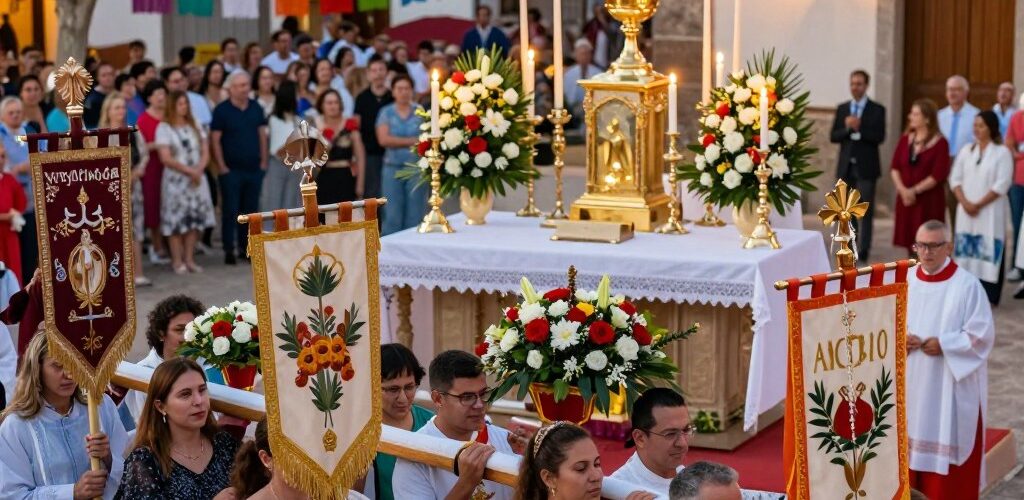
Catholics worldwide come together to celebrate the Solemnity of the Most Holy Body and Blood of Christ. This special day encourages believers to think deeply about the Eucharist. It reminds us of the Real Presence of Jesus in the bread and wine.
Looking at the liturgical readings for the feast of corpus christi year a helps us grow spiritually. These scriptures offer a deep look at the covenant made through sacrifice. By reading these texts, we can deepen our devotion and find new purpose in our faith journey.
Body and blood of Christ Homily for US Catholics

Key Takeaways
- The celebration highlights the profound mystery of the Eucharist.
- Believers honor the Real Presence of Christ in the Blessed Sacrament.
- Liturgical readings offer guidance for spiritual growth and reflection.
- This solemnity reinforces the unity of the Church through communion.
- Participants gain a deeper understanding of the sacrificial covenant.
Understanding the Significance of The Feast of Corpus Christi Year A
In the year a liturgical calendar, Corpus Christi stands out. It’s called the Solemnity of the Most Holy Body and Blood of Christ. This day is a key moment for believers to reflect on Jesus’ presence in the Eucharist.
This feast comes right after Easter and Pentecost. It marks a shift from Christ’s life events to a deeper look at his sacrificial love. It helps believers see the Eucharist as the heart of their faith.
Thinking about the feast of corpus christi year a connects us to the story of salvation. The Church teaches that the bread and wine are truly Jesus’ Body and Blood. This belief guides how the community worships and lives out their faith.
To grasp how this feast fits into the Church’s rhythm, look at this comparison:
| Liturgical Season | Primary Focus | Spiritual Goal |
|---|---|---|
| Lent | Penance and Fasting | Preparation for Easter |
| Easter | Resurrection | Celebrating New Life |
| Corpus Christi | Real Presence | Deepening Eucharistic Faith |
| Ordinary Time | Discipleship | Living the Gospel Daily |
This solemnity bridges the spring’s high feasts and Ordinary Time. It shows that Christ’s sacrificial love is always available in the tabernacle. Through it, the Church renews its dedication to the mystery of the altar.
Historical Origins and Development of the Feast
To understand the corpus christi history, we must look at St. Juliana of Liège. She was a humble nun in the thirteenth century. She had visions that led her to ask the Church to honor the Eucharist on a special day.
Her efforts caught the attention of church leaders. This was a big step towards the feast we know today.
The Miracle of Bolsena in 1263 was a turning point. A priest saw blood on the Host during Mass. This miracle showed the Real Presence and helped make the feast official.

In 1264, Pope Urban IV made the feast official with the papal bull Transiturus de hoc mundo. He wanted the Eucharist to be celebrated with joy and public devotion. This was different from the solemnity of Holy Week.
This change was a big deal for the Latin Church.
The table below shows important events in the feast’s history:
| Event | Year | Significance |
|---|---|---|
| Visions of St. Juliana | 1208-1258 | Inspired the need for a feast. |
| Miracle of Bolsena | 1263 | Confirmed the Real Presence. |
| Transiturus Bull | 1264 | Formalized the corpus christi history. |
| Universal Adoption | 1312 | Council of Vienne mandate. |
The feast has grown from its start in Liège to being a key part of Catholic life. By understanding its history, we can see the Church’s purpose in creating it. This history helps us today as we celebrate the Eucharist.
The Liturgical Importance of the Corpus Christi Celebration
The feast of Corpus Christi is a special time for believers to focus on Jesus Christ’s Real Presence. Holy Thursday marks the start of the Eucharist, but it’s often lost in the Passion’s shadow. This corpus christi celebration lets the Church shine a spotlight on the Blessed Sacrament, inviting joy and gratitude.
This feast is celebrated on the Thursday after Trinity Sunday. It’s a strategic choice, keeping the Easter joy alive. It helps the community move from the Resurrection and Pentecost to a deeper look at Christ’s Body, Blood, Soul, and Divinity.

The corpus christi liturgy puts the Eucharist at the heart of Catholic life. It encourages believers to go beyond the Last Supper’s story. This day gives the Eucharist the attention it deserves in the liturgical year.
This time set aside by the Church strengthens the community’s faith bond. It’s a solemn yet joyful event that shows the Eucharist’s power. It reminds us that the Eucharist is more than a ritual; it’s the essence of our spiritual journey.
Reflecting on Deuteronomy 8:2-3, 14b-16a: The Manna in the Desert
In the year a liturgical calendar, Deuteronomy gives us a glimpse of God’s care. It tells of the Israelites’ hard journey through the desert. They survived only because of God’s help.
The manna was more than food; it was a miraculous sign of God’s presence. It taught the people that life comes from God’s words, not just bread.

This story connects to the New Testament. Just as manna fed the Israelites, the Eucharist feeds the Church today. The year a liturgical calendar shows how the old covenant’s promise is fulfilled in Jesus.
The table below shows the link between the manna and the Eucharist:
| Feature | Manna (Old Testament) | Eucharist (New Testament) |
|---|---|---|
| Source | Sent from Heaven | The Bread of Life |
| Purpose | Physical survival | Eternal life |
| Nature | Temporary sustenance | Sacramental presence |
| Significance | God’s providence | God’s self-gift |
Reflecting on these scriptures shows God’s care never changes. The desert story teaches us to trust in God’s plan. This understanding makes us appreciate the Bread of Life at Mass even more.
The Theological Depth of Psalm 147:12-13, 14-15, 19-20
The Responsorial Psalm for this feast, Psalm 147:12-13, 14-15, 19-20, invites us to think about God’s greatness and His divine providence. These verses connect the physical world with the spiritual nourishment we find in the liturgy.
God’s power is not just distant or abstract. It’s a real force that keeps the world going and meets the needs of His people. By understanding this, we get ready to receive the Eucharist as God’s ultimate love for us.

The text touches on important themes that resonate during this celebration. These ideas help us grasp our connection with the Creator:
- Divine Sustenance: God takes care of our physical and spiritual needs.
- The Power of the Word: His message brings peace and order to our lives.
- Intimate Care: The Lord personally cares for His people’s well-being.
- Sacramental Gratitude: The Eucharist is how God lives among us.
This meditation encourages the Church to thank the Lord for the Sacrament. This sacred nourishment keeps the Church alive and strengthens our bond with God. As we finish, we focus on the special covenant God has with His people. This covenant makes them a community marked by God’s grace.
Analyzing 1 Corinthians 10:16-17: The Body of Christ as Communion
Looking at 1 Corinthians 10:16-17, we see how the bread we share connects us all. St. Paul explains that sharing in the Eucharist is more than a ritual. It’s a transformative experience that unites us as a community.
The Apostle Paul poses a question that makes us think deeply. He says the cup and bread we share are connected to Christ’s blood and body. This sacramental reality is the heart of the Church’s unity.

This teaching has a powerful message for us today. When we share the one bread, we become one Body of Christ. This idea touches on several important parts of being a Christian:
- Shared Identity: We are all nourished by the same spiritual food.
- Mutual Responsibility: Our joys and struggles are shared, affecting us all.
- Public Witness: Our unity at the altar should show in our daily lives.
This insight is key to understanding the Feast of Corpus Christi. It shows that the Eucharist is the ultimate source of reconciliation and peace. When we come to the altar, we pledge to stand together as one Church.
The bread is one, we, though many, are one body, for we all partake of the one bread.
St. Paul’s words are a call to action for every parish. The Eucharist teaches us to see beyond our differences. By embracing this, we live out the spirit of Corpus Christi every day.
The Gospel of John 6:51-58: The Bread of Life Discourse
The Bread of Life discourse in John 6:51-58 is a key part of the New Testament. It marks the climax of Jesus’ teaching. Here, Jesus says He is the living bread from heaven. He urges people to see beyond the physical and understand a deep spiritual truth.
Jesus’ words were shocking to his listeners. He said eating His flesh and blood was needed for eternal life. This bold statement made people choose between leaving or accepting a mystery that didn’t make sense.

Catholic teaching sees this passage as key for the Real Presence. The Church believes the Eucharist is not just a symbol. It’s actually Christ’s Body and Blood, given for the world’s life.
“I am the living bread that came down from heaven; whoever eats this bread will live forever; and the bread that I will give is my flesh for the life of the world.”
This teaching asks for a faith that goes beyond understanding. It calls for reverence and humility at the altar. By accepting these words, believers join a divine communion that supports their spiritual journey.
The discourse in John 6:51-58 is a key part of the liturgy. It shows the Eucharist is the source and summit of faith. Through this sacrament, eternal life’s promise becomes real for believers.
Common Corpus Christi Traditions and Observances
For centuries, people have found ways to honor the Eucharist in their daily lives. These traditions help connect the church to the home. They bring families closer to each other and to their faith during the corpus christi celebration.
One popular tradition is making floral decorations. Homes often display wreaths of fresh flowers on doors and windows. These colorful decorations show the neighborhood that the home is a place of prayer.

Each culture has its own corpus christi traditions that highlight the beauty of the Eucharist. These customs bring the community together. They can be grand street displays or quiet home prayers, keeping the spirit of reverence alive.
The table below shows how different places celebrate this feast:
| Region | Primary Tradition | Symbolic Meaning |
|---|---|---|
| Central Europe | Floral Wreaths | Public honor to the Eucharist |
| Latin America | Sawdust Carpets | Path for the Blessed Sacrament |
| Southern Europe | Window Altars | Inviting Christ into the home |
By joining in these traditions, people deepen their connection to the feast’s theological significance. When families decorate their homes, they make their spaces sacred. This shows that the corpus christi celebration is a key part of their spiritual journey.
Eucharistic Processions and Their Spiritual Meaning
The Eucharistic procession is a key corpus christi tradition. It shows the faith of the community. The Blessed Sacrament is carried in a monstrance through the streets. This act shows the belief in Christ’s Real Presence.

This procession reminds us that the Church is on a journey. It turns ordinary streets into a place for prayer. People sing hymns, say prayers, and follow the monstrance to honor the Eucharist.
- Singing traditional hymns that praise the mystery of the Bread of Life.
- Reciting prayers or litanies to maintain a spirit of reverence.
- Following the monstrance as a sign of unity and devotion to the Body of Christ.
The sight of the monstrance passing through the neighborhood invites onlookers to pause. It reminds them of Christ’s presence in their lives. These corpus christi traditions bring the community together.
The procession connects the liturgy to everyday life. It encourages believers to spread the grace of the Eucharist. Through this devout practice, the Church shines the light of Christ to the world.
How Parishes Prepare for the Corpus Christi Liturgy
Preparing for the corpus christi liturgy is a team effort. Parish leaders and volunteers work together. They make sure every detail shows the joy and solemnity of the day. This teamwork turns the church into a place of deep adoration.
Preparations start days before to make the church welcoming. Homes and streets are often decorated with birch trees and green boughs. These symbols represent new life and growing faith in the community.

The clergy lead the spiritual side of the corpus christi liturgy. They plan the prayers and hymns to match the feast’s depth. Meanwhile, the laity handles the practical tasks, like setting up the altar and planning the procession route.
Good planning keeps the celebration respectful and organized. Parishes use a plan to share tasks among different groups. Here’s a table showing key tasks for a great parish celebration:
| Ministry Role | Primary Responsibility | Goal of Task |
|---|---|---|
| Clergy | Liturgical Rites | Maintain spiritual focus |
| Altar Servers | Procession Support | Ensure smooth movement |
| Decorating Committee | Environmental Setup | Create a sacred atmosphere |
| Music Ministry | Hymn Selection | Enhance communal worship |
By focusing on these areas, parishes connect more deeply with the Eucharist. This effort not only honors the corpus christi liturgy but also strengthens the parish family. They see Christ’s presence among them.
The Role of the Eucharist in the Catholic Feast Day Experience
During any significant catholic feast day, the Eucharist is the main focus for spiritual renewal. It’s not just a symbol but the Real Presence of Christ. This includes His body, blood, soul, and divinity. It invites believers to pause and see the source and summit of their spiritual journey.
The catholic feast day experience is designed to reignite faith. The liturgy centers on the Blessed Sacrament, encouraging deeper devotion. This helps believers move beyond routine and approach the altar with gratitude and understanding.

“The Eucharist is the source and summit of the Christian life. The other sacraments, and indeed all ecclesiastical ministries and works of the apostolate, are bound up with the Eucharist and are oriented toward it.”
These celebrations let the community reflect on the Sacrament’s transformative power. A catholic feast day strengthens the bond between the individual and Christ’s Body. The table below shows the spiritual benefits of this devotion.
| Spiritual Practice | Primary Benefit | Focus Area |
|---|---|---|
| Eucharistic Adoration | Inner Peace | Real Presence |
| Frequent Communion | Spiritual Strength | Grace and Unity |
| Liturgical Reflection | Increased Wisdom | Scriptural Truth |
The goal of these observances is to create a lasting connection to the divine. By focusing on the Eucharist, believers keep their spiritual life vibrant. This commitment turns ordinary time into a continuous experience of grace and worship.
Modern Challenges in Observing Corpus Christi in the United States
The feast of Corpus Christi has its own set of challenges in the United States today. Traditionally, it’s celebrated on a Thursday. But many dioceses now hold it on the next Sunday. This change helps keep the catholic feast day alive and meaningful.
By moving the celebration to a weekend, more people can attend. Families and those with jobs can join in the liturgy and processions. It shows how old traditions can adapt to today’s needs.

The core of the corpus christi observance stays the same. It’s about showing deep love for the Eucharistic Lord. Whether on a weekday or Sunday, the focus is on Christ’s Real Presence in the Eucharist.
Church leaders carefully decide when to hold the feast. They want to honor it while making sure everyone can come together. In the end, the devotion of the people is what truly matters, not the exact day.
Conclusion
The Feast of Corpus Christi is a key moment for the Church to show its belief in Christ’s Real Presence. It’s a time for believers to see beyond everyday life. They learn to appreciate the Holy Eucharist as a divine gift.
Knowing the history of Corpus Christi helps us understand our faith today. It shows how devotion to the Blessed Sacrament has helped Catholics through many years. This connection to the past makes our spiritual journey richer.
Being part of a local Corpus Christi celebration strengthens our ties with the community. It turns a simple act of worship into a powerful statement of love. This act reminds us of the unity in Christ’s Body.
We should carry the spirit of this feast into our daily lives. By showing deep respect for the Bread of Life, the Church keeps spreading grace and peace. May this day inspire us to grow closer to the Lord.

💬 Share Your Reflection