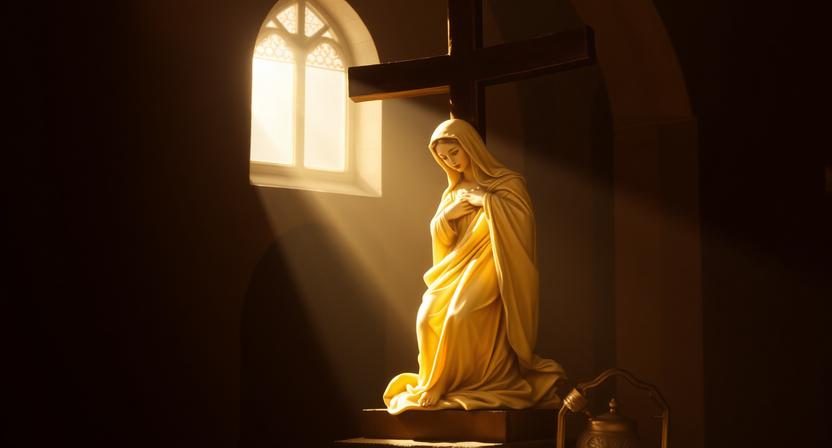
HomilySunday.com › Marian Homilies › Comfort Through Mary ✦ Marian Homily Series ✦
Comfort Through Mary: Our Lady as Mother, Intercessor, and Refuge
📅 June 2026 · ⏱ 34 min read
“Hail, Holy Queen, Mother of Mercy — our life, our sweetness, and our hope. To you do we cry, poor banished children of Eve; to you do we send up our sighs, mourning and weeping in this valley of tears.” — Salve Regina (9th century)
From the earliest centuries of the Church, Christians in distress have turned to Mary for comfort. Not as a substitute for God, but as the one who stands nearest to God, who knows what human suffering costs, and who has never been known to fail those who trust in her intercession. The tradition is vast, the testimonies are numberless, the devotions are ancient — and yet the experience they describe is utterly contemporary: in the darkness, when everything else has failed, the mother’s arms are still there. A Comfort Through Mary Homily opens the rich treasury of Marian doctrine and devotion to those who are struggling, grieving, searching, or simply in need of the kind of refuge that only a mother who has suffered can provide.
📋 Outline — Comfort Through Mary
- Why We Turn to Mary — The Human Need for a Mother
- Mary as Refuge of Sinners — The Tradition of Mercy
- The Wedding at Cana — “Do Whatever He Tells You”
- The Magnificat — Mary’s Own Experience of God’s Comfort
- Mary’s Apparitions — She Comes to Where We Are
- Our Lady of Guadalupe — Comfort for the Marginalised
- Our Lady of Lourdes — Comfort in Illness and Weakness
- Our Lady of Fatima — Comfort Through Repentance and Peace
- The Rosary — Resting in Mary’s Presence
- Marian Titles of Comfort — A Theological Treasury
- Mary and the Holy Spirit — The Source of Her Comfort
- Mary Leads to Jesus — The Goal of All Marian Comfort
- A Complete Comfort Through Mary Homily — Homily Text
- Closing Prayer of Consecration to Mary
Related Marian & Comfort Homilies
- Mary at the Foot of the Cross
- Mother of Sorrows Homily
- Marian Homily — Month of May
- Healing Homily
- Hope Homily
- Homily on God’s Mercy
- Homily on Prayer
1 Why We Turn to Mary — The Human Need for a Mother
There is something in the human heart — something very deep, perhaps primal — that longs for a mother in the moments of greatest distress. A father’s love is real and essential; but in the ancient and almost universal human experience, it is the mother who is sought first when the child is hurt, afraid, or overwhelmed. The maternal is the face of love that is unconditional, that does not ask whether the child deserves comfort, that simply holds.
The Church has always understood the veneration of Mary as, among other things, the spiritual fulfilment of this deep human longing. In Mary, God has given the Church a mother — not a metaphorical mother, not a symbolic mother, but a real human woman who has loved, suffered, prayed, and interceded, and who continues now from the fullness of heaven to care for every one of her children. “Behold, your mother” — the words of Jesus from the cross — are addressed not to one disciple alone but to every disciple in every age.
“When Jesus therefore saw his mother, and the disciple standing by whom he loved, he said to his mother, ‘Woman, behold your son!’ Then he said to the disciple, ‘Behold, your mother!’ And from that hour the disciple took her to his own home.” — John 19:26–27
Pope John Paul II — who lost his own mother when he was eight years old and whose Marian devotion was among the most personal and passionate of any modern pope — wrote in Redemptoris Mater that the gift of Mary as mother at the cross is “a gift that Christ himself makes personally to every individual.” Not a collective gesture, but a personal one: each person who comes to the cross receives Mary as their own mother, entrusted to them and entrusting herself to them in the same movement of love.
2 Mary as Refuge of Sinners — The Tradition of Mercy
One of the most beloved of all Marian titles is “Refuge of Sinners” — Refugium Peccatorum. This title captures one of the most distinctive and consoling aspects of Marian tradition: that Mary’s intercession is particularly powerful for those who feel least worthy of it. The saints have consistently testified that Mary does not ask whether those who come to her deserve her help. She asks only whether they have come.
St Bernard of Clairvaux — perhaps the greatest medieval preacher of Marian devotion — expressed this with characteristic beauty: “In dangers, in difficulties, in doubts, think of Mary, call upon Mary. Let the name never depart from your lips, never leave your heart… If she holds you, you will not fall; if she protects you, you need not fear; if she guides you, you will not grow weary; if she is propitious, you will reach your goal.” This is not an invitation to bypass Christ. It is an invitation to reach Christ through the mother he gave us — the shortest road, in the tradition’s understanding, to the mercy we need.
✦ St Bernard of Clairvaux on Mary as Refuge
“It was the will of God that we should have nothing which did not pass through the hands of Mary. Every grace that is communicated to this world has three steps: from God to Christ, from Christ to Mary, from Mary to us.” This theological framework — Mary as the channel of grace — has been repeated, refined, and developed by saints and theologians across the centuries, from Thomas Aquinas to Louis de Montfort to Pope John Paul II.
The ancient prayer Sub tuum praesidium — “We fly to your patronage, O Holy Mother of God” — is the oldest known prayer addressed to Mary, dating to approximately the third century. It begins not with praise or theological statement but with a cry of refuge: “We fly to your patronage.” This is the authentic Catholic instinct toward Mary: not theology first, but need first — the cry of the child to the mother — and the confidence that she will answer.
3 The Wedding at Cana — “Do Whatever He Tells You”
The scene at the Wedding at Cana (John 2:1–11) is the first public appearance of Mary in John’s Gospel and the occasion of Jesus’ first sign. It is also the most perfect illustration of how Marian intercession works. The wine runs out — a social disaster in a culture where hospitality was sacred. Mary notices. She does not make a scene. She goes to Jesus: “They have no wine.” Three words. No demand, no prescription, no theology. Just the need, placed before her Son.
Jesus’ response seems negative: “Woman, what does this have to do with me? My hour has not yet come.” But Mary does not interpret this as a refusal. She turns to the servants with complete confidence: “Do whatever he tells you.” And then the water becomes wine — “the best wine,” the master of the feast says, in astonishment. Mary has not forced Jesus’ hand. She has placed the need before him and trusted him to respond in his own way and in his own time. And he does.
“His mother said to the servants, ‘Do whatever he tells you.'” — John 2:5
These five words — “Do whatever he tells you” — are the last recorded words of Mary in the Gospels. They are her final instruction, her essential message, her permanent legacy. All Marian devotion that is authentically Catholic ends here: not with Mary as the destination but as the directional sign — pointing, always and entirely, to her Son. She does not draw attention to herself. She receives the need, places it before Jesus, and then steps back. This is the whole grammar of Marian intercession.
📖 A Story for the Homily
A woman who had stopped practising her faith for twenty years described returning to Mass. She said it was not a dramatic conversion experience but a single moment of desperation: her marriage was failing, her children were struggling, and she felt entirely alone. One evening, not knowing why, she walked into an empty church and found herself kneeling before a statue of Mary. “I didn’t pray in any formal way,” she said. “I just told her everything. All of it. I didn’t ask her to fix it — I didn’t think anyone could fix it. I just needed someone to hear it. And when I left, I felt — not better exactly, but less alone. As if someone had been listening who actually understood.” She came back the next evening. And the evening after that. Six months later, she received the Sacrament of Reconciliation for the first time in two decades. “She brought me back,” the woman said simply. “I didn’t know anyone else who had been through what I’d been through. She had.”
4 The Magnificat — Mary’s Own Experience of God’s Comfort
The Magnificat (Luke 1:46–55) is not only a hymn of praise. It is a testimony — Mary’s personal account of having been comforted by God. “He has been mindful of the humble state of his servant” (v.48). “He has helped his servant Israel, remembering to be merciful to Abraham and his descendants forever” (vv.54–55). The comfort Mary proclaims in the Magnificat is rooted in her own experience of being seen, chosen, and sustained by a God who “looks on those of low degree.”
Mary’s experience of divine comfort was not passive or abstract. She sang it — not from a position of ease and security, but from a position of vulnerability, uncertainty, and social risk. She was unmarried and pregnant in a culture that could condemn her for it. She was a peasant girl in an occupied country. She had just been given a task she could not accomplish on her own. And from within that situation — because of that situation, not despite it — she sang one of the most triumphant songs in all of Scripture.
“My soul glorifies the Lord and my spirit rejoices in God my Saviour, for he has been mindful of the humble state of his servant.” — Luke 1:46–48
The Magnificat is the song of a comforted heart — a heart that has received what it needed, not by being removed from difficulty, but by being filled with the presence of the One who is able to work with and through and in the difficulty. This is the theology of Marian comfort in its fullest form: not escape from the world’s pain but transformation within it, by the same God who filled Mary’s humble soul with the inexhaustible treasure of his presence.
5 Mary’s Apparitions — She Comes to Where We Are
The Catholic tradition records numerous apparitions of the Blessed Virgin Mary — approved and non-approved — across the centuries and across the globe. Whatever one’s theological evaluation of individual apparitions, the pattern they describe is remarkable and consistent: Mary comes to small, ordinary, often vulnerable people in places of need. She comes to peasants, to children, to the sick and the marginalised. She does not appear in palaces or to the powerful. She goes to the peripheries — which is exactly where her Son spent his ministry.
The approved apparitions recognised by the Catholic Church include Guadalupe (1531), Paris/Rue du Bac (1830), La Salette (1846), Lourdes (1858), Pontmain (1871), Knock (1879), Fatima (1917), Beauraing (1932–33), and Banneux (1933). Each of these apparitions has produced a distinctive Marian devotion, shrine, and tradition of comfort and healing. Together, they span five centuries and six continents — a testimony to the continuing maternal care of Mary for her children across all times and places.
| Apparition | Location & Date | Message of Comfort |
|---|---|---|
| Our Lady of Guadalupe | Mexico, 1531 | “Am I not here who am your mother? Are you not under my shadow?” — comfort for the poor and marginalised |
| Our Lady of Lourdes | France, 1858 | “I am the Immaculate Conception” — healing, conversion, the spring of water as sign of grace |
| Our Lady of Fatima | Portugal, 1917 | Repentance, prayer, consecration; peace amid the darkness of war; the Immaculate Heart as refuge |
| Our Lady of Knock | Ireland, 1879 | Silent presence to a suffering people; no words — only presence, the Lamb, the Book |
| Our Lady of Banneux | Belgium, 1933 | “I am the Virgin of the Poor” — special care for the economically marginalised |
6 Our Lady of Guadalupe — Comfort for the Marginalised
In December 1531, the Blessed Virgin Mary appeared to Juan Diego — a poor indigenous Mexican convert — on the hill of Tepeyac, near Mexico City. She appeared not as a European queen but in the form of a mestiza woman, her garments echoing indigenous Aztec symbolism, her message spoken in Nahuatl, the language of Juan Diego’s people. She asked that a temple be built on the hill, and she left the miraculous image of herself imprinted on Juan Diego’s tilma (cloak) as a sign.
The apparition at Guadalupe is one of the most studied and most celebrated in Catholic history — and its pastoral significance for comfort is immense. In it, God (through Mary) came to the poor, the conquered, the culturally displaced, and said: “Am I not here who am your mother? Are you not under my shadow and protection? Are you not in the folds of my mantle? In the crossing of my arms? Is there anything else you need?” These words — spoken to a grieving, marginalised man in his own language — have been a source of comfort to millions across five centuries, particularly to the poor and to those on the margins of society.
“Am I not here who am your mother? Are you not under my shadow and protection?” — Our Lady of Guadalupe to Juan Diego, 1531
7 Our Lady of Lourdes — Comfort in Illness and Weakness
On February 11, 1858, a fourteen-year-old peasant girl named Bernadette Soubirous was gathering firewood near a grotto on the banks of the Gave River in southern France when she saw a vision of a beautiful woman. The vision — which appeared eighteen times over several months — eventually identified herself as “the Immaculate Conception,” directed Bernadette to dig in the ground near the grotto (where a spring was found), and called for repentance and prayer.
Lourdes has become the most visited Catholic pilgrimage site in the world, drawing millions of pilgrims each year — many of them sick, disabled, dying, or caring for those who are. The Lourdes pilgrimages are among the most moving experiences in Catholic life: the candlelit processions, the immersion in the spring, the Blessed Sacrament procession over the sick, the prayer of the Church for her most vulnerable members. Lourdes is where the Church most visibly becomes what she is called to be: the community that tends the sick and accompanies the dying, guided by a mother who herself knows what it is to watch her child suffer.
✦ Lourdes and the Medically Inexplicable Healings
Since 1858, the Catholic Church has officially recognised 70 medically inexplicable healings at Lourdes — verified through the rigorous standards of the Lourdes Medical Bureau, which requires that any claimed healing be complete, durable, instantaneous, and unexplainable by current medical science. These 70 are a small fraction of the estimated 7,000 miracle claims that have been investigated. The healings are signs — not proofs — pointing to the mercy of God mediated through the intercession of Mary.
8 Our Lady of Fatima — Comfort Through Repentance and Peace
On May 13, 1917 — during the darkest years of the First World War — the Blessed Virgin Mary began to appear to three shepherd children near Fatima, Portugal: Lucia dos Santos and her cousins Francisco and Jacinta Marto. The apparitions continued monthly until October 13, 1917, when the “Miracle of the Sun” — witnessed by approximately 70,000 people — provided extraordinary public confirmation of the children’s experiences.
The Fatima message is a message of urgent compassion: repentance for sin, prayer (especially the Rosary), the consecration of Russia to the Immaculate Heart of Mary, and the Five First Saturdays devotion. But at its heart, Fatima is a message of comfort in darkness. Mary appeared in the middle of a catastrophic war, to children in a remote Portuguese village, to say: God has not abandoned the world. He knows the darkness. And he has sent his mother to call his children home.
“Finally, my Immaculate Heart will triumph. Russia will be converted, and a period of peace will be granted to the world.” — Our Lady of Fatima to Lucia, July 13, 1917
The message of Fatima is the message of every apparition, expressed with particular urgency for a century of unprecedented violence: do not be afraid. Pray. Return to God. The darkness is real — but the mother is more real. And the mother leads to the Son who has overcome every darkness.
9 The Rosary — Resting in Mary’s Presence
The Rosary is the most universal and most beloved of all Marian devotions — and it is, at its heart, a devotion of comfort. To pray the Rosary is to sit with Mary, holding her hand, and to walk with her through the mysteries of her Son’s life: the joyful, the luminous, the sorrowful, and the glorious. It is not primarily an intellectual exercise; it is a contemplative practice — allowing the mind to rest on the great events of salvation while the lips and fingers maintain the gentle rhythm of the Hail Marys.
Pope St John Paul II, who prayed the Rosary every day of his life and who added the Luminous Mysteries in 2002, described the Rosary as “a prayer of great significance, destined to bring forth a harvest of holiness” and “a school of Mary at which one can be formed in the school of Christ.” The Rosary has been the prayer of soldiers and prisoners, of mothers nursing sick children and of the dying in their final hours — a prayer that can be prayed anywhere, at any time, in any state of soul — and that always brings the one who prays it into the presence of the one who has promised to intercede for them.
- The Joyful Mysteries — The Annunciation, Visitation, Nativity, Presentation, Finding in the Temple. Mary’s joy, rooted in surrender to God, offered as a balm for anxious hearts.
- The Luminous Mysteries — Baptism of Jesus, Wedding at Cana, Proclamation of the Kingdom, Transfiguration, Institution of the Eucharist. Christ revealed in glory, with Mary pointing the way.
- The Sorrowful Mysteries — Agony in the Garden, Scourging, Crowning with Thorns, Carrying of the Cross, Crucifixion. Walking with Mary through the Passion; the comfort of knowing she has been here.
- The Glorious Mysteries — Resurrection, Ascension, Pentecost, Assumption, Coronation of Mary. The destination toward which every sorrow is moving; hope made visible in the glory of the Mother of God.
10 Marian Titles of Comfort — A Theological Treasury
The Church’s Marian tradition is rich with titles that express, from different angles, the comfort that Mary provides to her children. Each title is not mere sentiment — it is a theological statement about who Mary is and what she does for those who come to her.
| Marian Title | Latin / Origin | What It Offers |
|---|---|---|
| Refuge of Sinners | Refugium Peccatorum | The most unworthy find shelter in her maternal mercy |
| Comforter of the Afflicted | Consolatrix Afflictorum | Specific comfort in suffering, grief, and desolation |
| Help of Christians | Auxilium Christianorum | Active intercession in the battles of the spiritual life |
| Health of the Sick | Salus Infirmorum | Intercession for healing of body and soul |
| Cause of Our Joy | Causa Nostrae Laetitiae | Mary as the one through whom our joy came into the world |
| Our Lady Undoer of Knots | Maria Knotenloserin | Untangling the complex problems and burdens of human life |
| Tower of Ivory / Seat of Wisdom | Turris Eburnea / Sedes Sapientiae | Strength and wisdom found in her intercession |
| Queen of Peace | Regina Pacis | The peace that surpasses understanding, offered through her prayer |
11 Mary and the Holy Spirit — The Source of Her Comfort
It is crucial, in a homily on comfort through Mary, to be clear about the theological foundation of her comfort: Mary does not comfort from her own resources. She comforts because she is filled with the Holy Spirit — the Comforter, the Paraclete, the one Jesus promised would not leave his disciples orphaned (John 14:18). Mary is the “spouse of the Holy Spirit” — the first human being to have been completely surrendered to the Spirit’s action, the first fruits of the life of the Spirit that the whole Church is called to live.
The comfort we receive through Mary is, in the deepest sense, the comfort of the Holy Spirit — channelled through a human person who is uniquely transparent to his presence. When we bring our need to Mary, she brings it to the Spirit who filled her at the Annunciation and who fills the whole Church at Pentecost. She is not a barrier between us and God; she is the most transparent of all human beings to the divine love that flows through her and toward us.
“The Holy Spirit will come on you, and the power of the Most High will overshadow you.” — Luke 1:35
12 Mary Leads to Jesus — The Goal of All Marian Comfort
Every authentic Marian devotion, every genuine experience of comfort through Mary, ends at the same place: with Jesus. This is not a qualification that limits the value of Marian devotion; it is its deepest affirmation. Mary’s entire purpose — as mother, as intercessor, as refuge — is to bring her children to her Son. She has no agenda of her own, no glory she seeks for herself. Her Magnificat is not about her own greatness but about God’s. Her last words in the Gospel are “Do whatever he tells you.” Her every intercession is an act of pointing, of accompanying, of leading toward the One who alone can give what we truly need.
St Louis de Montfort, in his True Devotion to Mary, expressed this with characteristic ardour: “Mary is the safest, easiest, shortest and most perfect way of approaching Jesus.” The comfort we receive through Mary is the comfort of being brought home — not to her, but through her, to the house of the Father, to the arms of the Son, to the fire of the Spirit. She is the door. And the door is open, always, to every child who knocks.
“To Jesus through Mary — Ad Jesum per Mariam. This is the whole of Marian theology expressed in four words.”
13 A Complete Comfort Through Mary Homily — Homily Text
Suitable for any Marian feast, the month of May, the month of October (Rosary Month), Advent, or any pastoral occasion where the congregation needs comfort and hope. Adapt freely.
There is an ancient prayer — perhaps the oldest prayer to Mary in existence — that begins with three words: “We fly to you.” Sub tuum praesidium — “Under your protection.” It is not a sophisticated theological statement. It is a cry. The cry of someone who is in trouble and needs somewhere to go.
“We fly to your patronage, O Holy Mother of God. Despise not our petitions in our necessities, but deliver us always from all dangers, O glorious and blessed Virgin.”
Christians have been praying those words for nearly seventeen hundred years. In different languages, on different continents, in different centuries — always the same cry: Mary, we need you. Mary, help us. Mary, do not turn away.
And the testimony that comes back, across those seventeen hundred years, is always the same: she does not turn away.
“Can a mother forget the baby at her breast and have no compassion on the child she has borne? Though she may forget, I will not forget you!” — Isaiah 49:15
I want to speak today about what I think is one of the most undervalued resources in Catholic spiritual life: the comfort that comes through Mary. Not the theological arguments for devotion to Mary — those are important, and I will touch on them. But the lived experience of comfort through Mary, which millions of Catholics in every generation have known, and which the Church has always encouraged.
Let me tell you what comfort through Mary is not. It is not a substitute for God. Mary does not replace the Holy Spirit as the Comforter. She does not substitute her love for the love of the Father. She does not offer something that God withholds. Every grace that comes through Mary comes from the God she serves, the Son she bore, the Spirit who filled her. She is not a parallel system. She is the most transparent conduit in human history for the grace of God.
And let me tell you what comfort through Mary is. It is the experience of bringing your need — whatever it is — to someone who has been where you are. Someone who has grieved, who has been afraid, who has not understood, who has watched her child suffer and could not stop it. Someone who has passed through every darkness and come out, not into comfortable oblivion, but into the fullness of light. Someone who understands, from the inside, what it costs to trust God when everything visible contradicts belief.
At Cana, she noticed the need before anyone asked. She went to Jesus. She placed the need before him with three words: “They have no wine.” And then — this is the part I want you to hear — she trusted him to respond in his own way. She did not tell him what to do. She did not manipulate the situation. She placed the need in the hands of her Son and stepped back.
This is what Mary does with every need we bring to her. She takes it. She places it before her Son. And then she trusts him — as she has always trusted him — to respond in his own way, in his own time, with the particular grace that this particular situation needs. The answer may not be what we expected. It may come in a way we did not anticipate. But “the best wine” is saved for last — and those who trust the mother of the host will not be disappointed.
Brothers and sisters, what is the need you are carrying today? What is the wine that has run out in your life — the hope that has dried up, the relationship that has broken, the health that has failed, the faith that has grown thin? Whatever it is: bring it to her. Three words is enough. “I have nothing.” “I am afraid.” “I do not know how to go on.”
She is listening. She has always been listening. She has never failed those who trust in her — the whole tradition, from St Bernard to St John Paul II, from the early Church to the millions who stand today at the shrines of Guadalupe and Lourdes and Fatima, is unanimous on this point. She does not fail.
And she will bring you to him. That is her one great desire — the same desire she had on the night of his birth, and at the foot of the cross, and in the upper room at Pentecost: to give her children to her Son, and her Son to her children.
Fly to her. She is waiting. ✦ ✝
✦ Closing Prayer of Consecration to Mary
Holy Mary, Mother of God and our mother — we come to you today not with great words or great virtue, but with great need. We bring you what we carry: the fears we cannot name, the griefs we cannot heal, the knots we cannot untangle, the darkness we cannot see through.
Take us under your mantle. Cover us with your protection. Bring our needs before your Son — and trust him, as you have always trusted him, to respond with the grace we need and cannot yet see.
Teach us to pray as you prayed — simply, honestly, persistently, without demanding to know the outcome. Teach us to say with you: “Let it be done to me according to your word.” And when the wine of our courage runs dry, remind us of Cana — that the best is always in his hands, and the best is always yet to come.
Holy Mary, Mother of God, pray for us sinners, now and at the hour of our death. And lead us — as you led John, as you led the disciples in the upper room — to the Son who is the source of every comfort, every joy, and every grace. Amen.
✦ Sub tuum praesidium — Under your protection, Holy Mother of God. ✝
More Marian & Homily Resources on HomilySunday.com
- Mary at the Foot of the Cross
- Mother of Sorrows Homily
- Marian Homily — Month of May
- Healing Homily
- Hope Homily
- Homily on God’s Mercy
- Homily on Prayer
- Suffering Homily
- Funeral Homily
- Lenten Homily
- Easter Homily
- Gratitude Homily
- Peace Homily
- Discipleship Homily
- Resurrection Homily
- Eternal Life Homily
- Saints Homily
- Courage Homily
- Sunday Homilies Year A
- 100 Homily Stories
✦ HomilySunday.com · Catholic Sunday Homily Resources · All rights reserved.
