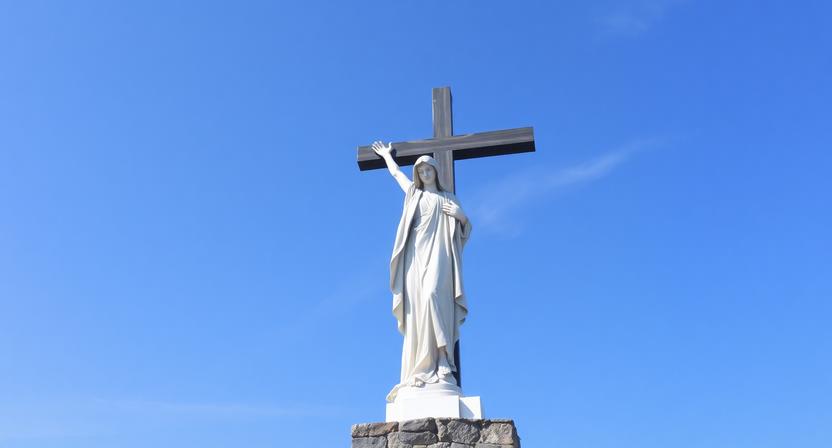
HomilySunday.com › Marian Homilies › Mary at the Foot of the Cross ✦ Marian Homily Series ✦
Mary at the Foot of the Cross: Standing Where No Mother Should Stand
📅 June 2026 · ⏱ 35 min read
“Near the cross of Jesus stood his mother, his mother’s sister, Mary the wife of Clopas, and Mary Magdalene. When Jesus saw his mother there, and the disciple whom he loved standing nearby, he said to her, ‘Woman, here is your son,’ and to the disciple, ‘Here is your mother.'” — John 19:25–27
Of all the images of Mary in the Gospels, none is more piercing, more theologically profound, or more humanly devastating than this one: a mother, standing at the foot of a cross, watching her son die. She did not run. She did not turn away. She did not collapse in the distance but was carried close. The Gospel of John tells us with stark simplicity that she stood — the Greek word heistekeisan carrying the sense of deliberate, sustained, willed presence. Mary at the Foot of the Cross is not a passive figure of grief. She is a woman of extraordinary courage, faith, and love — standing where faith meets its ultimate test, and refusing to leave.
📋 Outline — Mary at the Foot of the Cross
- The Scene at Calvary — Who Was There
- She Stood — The Meaning of Mary’s Posture
- Simeon’s Prophecy Fulfilled — “A Sword Will Pierce Your Soul”
- Mary and the Suffering Servant — Isaiah’s Shadow
- “Woman, Here Is Your Son” — The New Motherhood
- Mary as the New Eve at the New Tree
- The Theology of Co-Suffering — Compassio
- Mary’s Faith at the Cross — What She Believed in That Darkness
- The Church Fathers on Mary at the Cross
- What Mary at the Cross Teaches the Grieving
- The Stabat Mater — Art, Music, and Prayer
- Standing With Mary — A Spirituality of Presence
- A Complete Homily Text — Mary at the Foot of the Cross
- Closing Prayer at the Foot of the Cross
Related Marian & Passion Homilies
- Mother of Sorrows Homily
- Comfort Through Mary Homily
- Marian Homily — Month of May
- Suffering Homily
- Easter Homily
- Lenten Homily
- Hope Homily
1 The Scene at Calvary — Who Was There
The four Gospels all record the crucifixion of Jesus, but they differ in their accounts of who was present at the cross. The Synoptic Gospels (Matthew, Mark, Luke) describe the women who had followed Jesus from Galilee watching “from a distance” — a group that included Mary Magdalene, Mary the mother of James and Joseph, and the mother of Zebedee’s sons. Luke also notes that “all those who knew him” stood watching from afar.
John’s Gospel gives us the most intimate and theologically charged account. In John 19:25–27, a small group stands near the cross — not at a distance, but close enough to be spoken to by the dying Jesus. The group includes Mary the mother of Jesus, her sister, Mary the wife of Clopas, Mary Magdalene, and the Beloved Disciple. This proximity is significant. John is the only evangelist to record the presence of Mary at the actual foot of the cross — and it is this account that has shaped the entire tradition of Marian theology, devotion, and art surrounding Calvary.
“Near the cross of Jesus stood his mother, his mother’s sister, Mary the wife of Clopas, and Mary Magdalene.” — John 19:25
The contrast between the Synoptic “distance” and John’s “near” is not necessarily a contradiction. It may reflect different moments during the long hours of the crucifixion, or different theological emphases. What is consistent across all four Gospels is the faithfulness of the women — who, while the male disciples fled, remained present to the death of Jesus, standing as witnesses of the cross and the first witnesses of the resurrection.
2 She Stood — The Meaning of Mary’s Posture
The single verb that describes Mary’s posture at the cross — “she stood” — has generated a remarkable body of theological reflection across the centuries. In the ancient world, standing was the posture of one who was fully present, alert, and active. To stand at the foot of a cross, watching a loved one die, was not passive endurance. It was a deliberate act of solidarity, a refusal to abandon, a willed companionship in the darkest of places.
St Ambrose of Milan, writing in the fourth century, was among the first to draw attention to this detail: “I read that she stood — I do not read that she wept.” He did not mean that Mary felt no grief. He meant that her grief did not overcome her; that she stood before the cross with a dignity and a composure that transcended mere human endurance. She was not simply waiting for the suffering to end. She was present to it — fully, deliberately, without turning away.
✦ Theological Insight
The Church Fathers consistently distinguished Mary’s standing at the cross from ordinary human grief by attributing it to the same faith that animated her fiat at the Annunciation. She who said “yes” to the plan of God at the beginning said “yes” again at its most terrible cost. Her standing at the cross is her second fiat — the one that most fully proved the depth of the first.
This posture of standing has become central to a Marian spirituality of presence — the spirituality of accompanying others through their suffering without fixing it, explaining it away, or retreating from it. Mary at the cross is the model for every person who has ever sat at a bedside, or stood in a room of grief, or remained present to someone in a darkness they could not lighten. She teaches us that presence itself — simply being there, without words, without answers — is one of the deepest forms of love.
3 Simeon’s Prophecy Fulfilled — “A Sword Will Pierce Your Soul”
The moment at Calvary was not without preparation. Thirty-three years earlier, in the Temple, on the day of the Presentation of the infant Jesus, the old prophet Simeon had taken the child in his arms and spoken words of extraordinary joy — and then turned to Mary with a warning that must have lodged in her heart for all those years: “And a sword will pierce your own soul too” (Luke 2:35).
Simeon’s prophecy stands as one of the earliest shadows of the Passion in the New Testament. He has just described the child as “a sign that will be spoken against” — one who will cause “the falling and rising of many in Israel,” who will reveal “the thoughts of many hearts.” And then the sword. The sword that would pierce not only Jesus but his mother — not sparing her from the cost of the mission she had said yes to at the Annunciation.
“This child is destined to cause the falling and rising of many in Israel, and to be a sign that will be spoken against, so that the thoughts of many hearts will be revealed. And a sword will pierce your own soul too.” — Luke 2:34–35
The sword at Calvary is the fulfilment of Simeon’s prophecy. Catholic tradition has identified seven such “swords” — seven sorrows of Mary — of which the death of Jesus on the cross is the fifth and most central. But even in this darkest of moments, the tradition insists that the sword did not destroy her. It purified. It deepened. It prepared her for the role she was about to receive — not merely the grieving mother of the dead Jesus, but the living mother of the whole Church.
✦ The Seven Sorrows of Mary
1. The Prophecy of Simeon (Luke 2:34–35) · 2. The Flight into Egypt (Matthew 2:13) · 3. The Loss of Jesus in the Temple (Luke 2:43–45) · 4. Mary Meets Jesus Carrying the Cross (Luke 23:27) · 5. The Crucifixion and Death of Jesus (John 19:25–30) · 6. The Body of Jesus Taken Down from the Cross (Luke 23:53) · 7. The Burial of Jesus (John 19:40–42)
4 Mary and the Suffering Servant — Isaiah’s Shadow
Behind the Gospel account of Calvary lies the long shadow of Isaiah’s Suffering Servant poems (Isaiah 52:13–53:12) — the most remarkable prophetic anticipation of the Passion in the entire Old Testament. The Servant is despised and rejected, a man of sorrows, familiar with suffering. “He was pierced for our transgressions, he was crushed for our iniquities.” Christians have always read these poems as prophecy of Christ crucified.
But Isaiah 53:4 also speaks of the Servant’s companions in suffering: “Surely he took up our pain and bore our suffering.” Mary at the cross is the human being who stands closest to the Suffering Servant in his agony — the one who, more than any other, carries in her body the weight of what is happening. She does not bear the sins of the world, as Jesus does. But she bears, in her mother’s heart, the full human cost of what the bearing of those sins looks like — and she does not turn away.
5 “Woman, Here Is Your Son” — The New Motherhood
Among the Seven Last Words of Jesus from the cross, the words spoken to his mother and to the Beloved Disciple are among the most theologically rich in the entire Gospel. “Woman, here is your son… Here is your mother” (John 19:26–27). This is not simply a practical arrangement for Mary’s care after her son’s death. It is a theological declaration — one that John clearly intends his readers to understand at the deepest level.
The address “Woman” — striking on Jesus’ lips when speaking to his mother — echoes the address he used at the Wedding at Cana (John 2:4), and it carries a resonance with Genesis 3:15, where God speaks of the “woman” and her offspring who will crush the serpent’s head. Mary is being addressed not merely as an individual mother but as a figure — the Woman of the new covenant, the new Eve, the mother of all who live in Christ.
“When Jesus saw his mother there, and the disciple whom he loved standing nearby, he said to her, ‘Woman, here is your son,’ and to the disciple, ‘Here is your mother.’ From that hour the disciple took her into his own home.” — John 19:26–27
The Beloved Disciple in John’s Gospel represents every disciple — every believer who has followed Jesus and stands now at the cross. In giving his mother to this disciple, Jesus gives her to every disciple. In giving this disciple to his mother, Jesus gives every disciple the motherhood of Mary. The cross is thus the moment at which Mary’s motherhood is universalised — extended beyond the biological to the spiritual, from one son to all who believe. The Church is born at the cross, and Mary is given as its mother at the very moment of its birth.
📖 A Story for the Homily
A hospital chaplain described sitting with a mother whose adult son lay dying of cancer in the next room. She could not go in — the medical team were working — and so she stood outside the glass door, her hand pressed flat against it, her eyes on her son. She did not cry. She did not speak. She simply stood, as close as she could be, on the other side of the glass. The chaplain said: “I have never understood Mary at the cross so well as I did in that corridor. That woman was doing exactly what Mary did — standing at the boundary of suffering she could not enter and could not leave. Just being there. Just loving.”
6 Mary as the New Eve at the New Tree
One of the richest strands of patristic reflection on Mary at the cross is the typological connection between the tree of the cross and the tree of the knowledge of good and evil in Genesis 3. At the first tree, Eve was present at the moment of the fall — the moment when humanity turned away from God. At the new tree, the cross, Mary stands as the New Eve — present at the moment of redemption, when humanity is restored to God.
St Justin Martyr, St Irenaeus, and St Epiphanius all develop this parallel. “Eve,” Irenaeus writes, “having become disobedient, became the cause of death for herself and for the whole human race. So also Mary… becoming obedient, became the cause of salvation for herself and for the whole human race.” The disobedience of Eve at the tree is met by the obedience of Mary at the cross — her “yes” at the Annunciation reaching its fullest expression in her silent, standing presence at Calvary.
“The knot of Eve’s disobedience was untied by Mary’s obedience: what Eve bound through her disbelief, Mary loosed by her faith.” — St Irenaeus, Against Heresies
This typological reading does not diminish the uniqueness of Christ’s saving work. Mary does not redeem — Christ redeems. But she participates, in the way that every human being participates in what God does — by saying yes, by remaining present, by allowing her life to be ordered entirely toward the salvation that God is accomplishing. In this she is the model and the mother of the whole Church.
7 The Theology of Co-Suffering — Compassio
The Latin word compassio — “suffering with” — is the theological term the tradition has used to describe Mary’s participation in the sufferings of her Son. This is not the same as co-redemption in any technical theological sense; the Catholic Church has carefully distinguished Mary’s compassio from Christ’s atoning work. But it describes something real and important: that Mary’s suffering at the cross was not merely incidental but was a genuine participation in the mystery of salvation.
Pope Pius XII, in Mystici Corporis (1943), described Mary as the one who “offered him on Golgotha to the eternal Father together with the holocaust of her maternal rights and her maternal love.” Pope John Paul II, in Redemptoris Mater (1987), wrote that Mary’s presence at the cross was “a contribution unique in itself and of decisive importance to the salvific work of the Son.” Not redemption — that belongs to Christ alone. But cooperation, participation, the fullest possible human accompaniment of the divine saving act.
| Mary’s Role at the Cross | What It Involves | What It Does Not Involve |
|---|---|---|
| Compassio (Co-suffering) | Full, willed participation in the suffering of Christ; no consolation withheld | Atoning for sin; that belongs to Christ alone |
| Offering | Offering her Son freely to the Father, as she freely gave him at the Incarnation | Sacrificial priesthood; Mary is not a priest |
| Witness | First witness of the cross; passes on the testimony of what she saw | Authoritative teaching office; that belongs to the apostles |
| New Motherhood | Receiving all disciples as her children; interceding for the Church from glory | Divine motherhood; she is the Mother of God, not God |
8 Mary’s Faith at the Cross — What She Believed in That Darkness
What sustained Mary at the foot of the cross? Not certainty — the certainty of the resurrection was not yet available to her. Not the theological framework that the Church would develop over centuries. She stood at the cross in the same condition of faith that she had always occupied: trusting the God whose ways she did not fully understand, holding to the promises she had received without yet seeing their fulfilment.
At the Annunciation, the angel had said of Jesus: “He will be great and will be called the Son of the Most High. The Lord God will give him the throne of his father David, and he will reign over Jacob’s descendants forever; his kingdom will never end” (Luke 1:32–33). None of that looked true at Calvary. The throne was a cross. The reign was mockery. The kingdom looked like a three-hour agony ending in death. And yet Mary stood.
“Blessed is she who has believed that the Lord would fulfil his promises to her!” — Luke 1:45
Pope Benedict XVI, in his encyclical Spe Salvi, suggests that Mary at the cross practised the most demanding form of Christian hope — hope that holds on not because the evidence supports it, but because the God who promised is faithful, even when every visible sign points the other way. This is the faith of Abraham, who “against all hope, in hope believed” (Romans 4:18). It is the faith of Job, who refused to curse God in the darkness. And it is the faith of Mary, who stood.
9 The Church Fathers on Mary at the Cross
The theological and spiritual richness of the scene at the foot of the cross drew sustained reflection from the Church Fathers and medieval mystics. Their insights together form a treasury of Marian theology that remains as fresh and as challenging as the day it was written.
- St Ambrose of Milan (4th century) — “I read that she stood: I do not read that she wept… She stood before the cross, more than a martyr — the sword of grief had pierced her soul.” Ambrose introduced the language of Mary’s spiritual martyrdom — not death of the body but death through grief and love.
- St Augustine of Hippo (4th–5th century) — emphasised that Mary’s privilege at the cross was her faith before her motherhood: “She did more by believing than by conceiving.” Her spiritual maternity of the whole Church flows from her faith, not merely from her biological relationship to Jesus.
- St John Chrysostom (4th–5th century) — reflected on Mary’s human grief at the cross as entirely real and in no way unworthy: “What mother would not be overcome at such a sight? It was natural that grief should overwhelm her.” The tradition does not deny Mary’s grief; it holds it alongside her faith.
- St Bernard of Clairvaux (12th century) — gave perhaps the most beautiful of all medieval meditations on Mary at the cross, comparing her compassion to a second sword: “His wounds were open, yours more hidden, but no less piercing. Let the one who sees not feel.”
- St Bonaventure (13th century) — described Mary as the Co-sufferer whose love for her Son was such that she desired to die with him: “She desired to be crucified with her Son.” Her presence at the cross was not passive endurance but the fullest possible expression of her love.
10 What Mary at the Cross Teaches the Grieving
For those in the congregation who are carrying grief — the fresh grief of recent loss, or the long grief of chronic suffering, or the anticipatory grief of watching someone beloved move toward death — Mary at the cross is perhaps the most pastorally powerful of all Marian images. She does not offer a solution to suffering. She offers a presence in it.
She teaches us that it is possible to hold faith and grief together — that they are not opposites. She teaches us that love does not retreat from pain but stands in it. She teaches us that the darkness of Good Friday is not the last word — that the same woman who stood at the cross would stand again on the morning of the resurrection, and that her tears would become something altogether different. But crucially, she stands at the cross before she knows the ending. She does not have the luxury of Easter when she is living through Good Friday. And neither do we, in our dark seasons.
“Mary did not stand at the cross because she knew Sunday was coming. She stood because she loved him. That is the model for all who grieve.”
11 The Stabat Mater — Art, Music, and Prayer
The thirteenth-century Latin hymn Stabat Mater Dolorosa — “The Sorrowful Mother Stood” — is one of the most beautiful and most widely set pieces of sacred text in the history of Western culture. Its opening lines capture with devastating simplicity the scene at Calvary: Stabat Mater dolorosa / iuxta crucem lacrimosa / dum pendebat Filius — “The sorrowful Mother stood weeping beside the cross where her Son was hanging.”
The Stabat Mater has been set to music by Palestrina, Vivaldi, Pergolesi, Haydn, Rossini, Dvořák, Poulenc, and scores of other composers across six centuries — a testament to the inexhaustible power of this scene to move the human heart. In the Catholic liturgy, it is appointed for use during the Stations of the Cross and on the Feast of Our Lady of Sorrows (September 15). Its final stanzas express the prayer that flows naturally from contemplating Mary at the cross: that her compassion might become our compassion, that her sorrow might teach us to feel the weight of what Christ endured, and that standing with her at the cross might prepare us to share in the joy of the resurrection.
✦ Great Artists Who Depicted Mary at the Cross
Michelangelo — The Pietà (St Peter’s Basilica, 1499): Mary holding the body of Christ after the deposition. El Greco — multiple versions of the Crucifixion with Mary and John. Rubens — The Descent from the Cross (Antwerp Cathedral, 1612–14). Giovanni Bellini — Pietà (Brera, Milan). Fra Angelico — numerous Crucifixion scenes with Mary prominent at the foot of the cross. These masterworks are among the most visited objects in the world’s great museums — a measure of how deeply the scene of Mary at Calvary has shaped human culture.
12 Standing With Mary — A Spirituality of Presence
The spirituality that flows from contemplating Mary at the cross is a spirituality of presence — of remaining, of not turning away, of standing in the darkness with those who are suffering rather than offering premature consolations or retreating to a safer distance. It is a spirituality particularly needed in a culture that is deeply uncomfortable with suffering and death, that tends to medicate, distract, or optimise its way past grief rather than standing in it.
Mary’s way is different. She does not fix. She does not explain. She does not offer a silver lining. She stands. And in her standing, she communicates something more powerful than any word: I am here. I will not leave. You are not alone in this. This is the ministry of presence that flows from contemplating her at Calvary — and it is a ministry that every Christian, in every vocation, is called to practise toward those who are suffering around them.
13 A Complete Homily Text — Mary at the Foot of the Cross
Suitable for Good Friday, the Feast of Our Lady of Sorrows (September 15), the Stations of the Cross, or any occasion of pastoral grief and accompaniment. Adapt freely for your community.
There is a moment in the Passion narrative of John’s Gospel that I want to hold in front of us for a few minutes. It is easy to pass over it, because it is described in just a handful of words. But those words contain a world.
“Near the cross of Jesus stood his mother.”
She stood. Four soldiers cast lots for his garments. The two men crucified beside him hurled insults or begged for mercy. The crowd that had cried “Hosanna” five days earlier now mocked. Pilate posted a notice of accusation. And Mary stood. At the foot of the cross. Close enough to see his face. Close enough to hear him breathe. Close enough to be spoken to when speech was costing him everything.
“Near the cross of Jesus stood his mother.” — John 19:25
I want to ask you: what does it take to stand there? Not to run, not to collapse from a distance, not to watch from the edge of the crowd — but to stand near the cross of someone you love, and not turn away?
It takes a kind of love that has moved beyond self-protection. The mother who stands at the cross is not a woman who has decided that the pain is bearable. The pain is unbearable. It takes a kind of faith that has moved beyond certainty. Mary at the cross has no certainty. She has no guarantee that this is going somewhere other than a sealed tomb and the end of everything she hoped. She has the same faith she always had — the faith of her fiat, the faith of “let it be done to me according to your word” — but that faith is now being stretched to a breaking point she had never imagined when she said it.
And it takes a kind of courage that has been formed by a life of surrender. Mary did not suddenly become brave at Calvary. She had been practising this surrender for thirty-three years — from the astonishing vulnerability of the Annunciation, through the anxiety of the flight to Egypt, through the bewilderment of finding her twelve-year-old in the Temple, through all the years of watching a mission she did not fully understand unfold toward this. She was ready, as much as any human being could be ready, for this moment. Not because it hurt less. But because she had already said yes — and she was not going to unsay it now.
And then Jesus, dying, looks down and speaks to her. “Woman, here is your son.” He gives her John. And he gives John — and in John, every one of us who calls ourselves his disciples — to her. “Here is your mother.”
This is the moment at which Mary’s motherhood becomes universal. She came to Calvary as the mother of one man. She left it as the mother of all who belong to him. At the very moment of her greatest loss, God was giving her the greatest gift — not the return of the son she was losing, but the adoption of a whole new family of children she had not expected.
This is the mystery of the cross. Nothing is simply loss. Even at its most devastating, even when the hands are pierced and the breath is failing and the darkness is coming — God is doing something. Creating something. Giving something. And the woman who stood there and did not turn away was the first to receive what the cross was giving: a new and universal motherhood, born in the same moment as the Church itself.
There are people in this congregation today who are standing at crosses of their own — at the bedside of a sick child, at the grave of a marriage, at the edge of a grief that has no visible end. And to those people I want to say: you are not standing alone. Mary is standing with you. She knows what it is to stand here. She knows what it is to hold faith and grief in the same moment, in the same body, and not let go of either.
And one day — as it was for her — the standing will become something else. Not because the pain was not real, but because the God who works through crosses is not finished.
Stand with her. ✝
✦ Closing Prayer at the Foot of the Cross
Most Holy Mary, Mother of Sorrows, Woman of the Cross — we stand before you as people who have known something of the grief you carried at Calvary. Not its fullness — no one has known that — but something. The cross that takes what we love most. The silence where there should be answers. The God who seems absent at the moment we need him most.
Teach us to stand as you stood. Not with easy answers, not with premature comfort, not from a safe distance — but near. Near the cross. Near the suffering. Near the people in our lives who are being broken, and who need someone who will not turn away.
And when we cannot stand any longer — when the grief is too heavy, the night too long, the cross too close — hold us as you held the body of your Son. Let us rest in your arms until we can stand again.
Holy Mary, Mother of God, pray for us sinners, now and at the hour of our death.
Amen. ✦ ✝
More Marian & Homily Resources on HomilySunday.com
- Mother of Sorrows Homily
- Comfort Through Mary Homily
- Marian Homily — Month of May
- Suffering Homily
- Lenten Homily
- Easter Homily
- Hope Homily
- Funeral Homily
- Healing Homily
- Homily on God’s Mercy
- Forgiveness Homily
- Resurrection Homily
- Eternal Life Homily
- Peace Homily
- Gratitude Homily
- Discipleship Homily
- Courage Homily
- Saints Homily
- Sunday Homilies Year A
- 100 Homily Stories
✦ HomilySunday.com · Catholic Sunday Homily Resources · All rights reserved.
