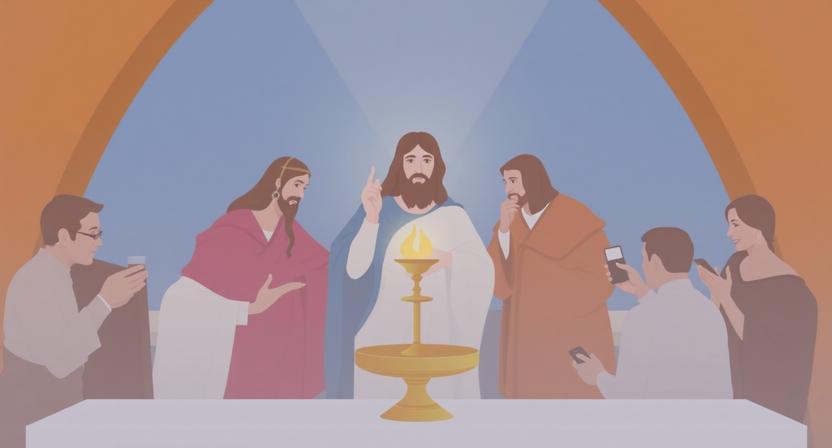
Catholic Homily on the Eucharist — Source and Summit
HomilySunday.com › Homilies › Eucharist Homily
🙏 ✝ 🙏
Catholic Homily on the Eucharist
“I am the living bread that came down from heaven. Whoever eats this bread will live for ever.” — John 6:51 | “This is my body, which is for you; do this in remembrance of me.” — 1 Corinthians 11:24
The Eucharist is the heart of Catholic life — “the source and summit of the Christian life,” in the words of the Second Vatican Council. Not one devotion among many, not a weekly ritual of religious observance, but the act in which heaven and earth meet; in which the once-for-all sacrifice of Calvary is made sacramentally present; in which the risen Lord gives himself — Body, Blood, Soul, and Divinity — to every person who receives him. A Homily on the Eucharist is among the most important a priest or deacon will ever preach, because how a congregation understands the Mass will shape everything else about their faith. To receive the Eucharist with full understanding is to receive the most astonishing gift in the history of the world. To receive it carelessly is to miss, in the words of St Paul, “the body and blood of the Lord.”
“The Eucharist is not a symbol of Christ’s presence — it is Christ himself, truly and really present: Body, Blood, Soul, and Divinity, given to us at every Mass.”
Related Homilies on HomilySunday.com
- Trinity Homily
- Word of God Homily
- Gratitude Homily
- Easter Homily
- Homily on the Holy Spirit
- Sunday Homilies Year A
1
“Source and Summit” — The Eucharist at the Heart of Catholic Life
The Second Vatican Council’s constitution on the Church, Lumen Gentium, contains a sentence that has become the defining description of the Eucharist in modern Catholic theology: the Eucharist is “the source and summit of the Christian life.” Not the source alone — as if everything flows from it but nothing returns to it. Not the summit alone — as if it were the peak toward which everything strives but from which nothing descends. Both: the fountain from which all grace and energy flow into the Christian life, and the height toward which all Christian striving is aimed.
Every other sacrament, every act of prayer, every work of charity, every effort of discipleship — all of these flow from the Eucharist and are ordered toward it. The sacraments of initiation (Baptism and Confirmation) lead to First Communion. The sacrament of Reconciliation restores the communion broken by sin so that the Eucharist may again be received worthily. Marriage and Holy Orders are lived out in the context of the Eucharistic community. The Anointing of the Sick finds its deepest meaning as Viaticum — the last Eucharist, food for the final journey. The Eucharist is not one sacrament among seven — it is the sacrament in which all others find their completion and their goal.
“For I received from the Lord what I also passed on to you: The Lord Jesus, on the night he was betrayed, took bread, and when he had given thanks, he broke it and said, ‘This is my body, which is for you; do this in remembrance of me.'” 1 Corinthians 11:23–24
A Homily on the Eucharist begins by recovering the congregation’s sense of what they are doing when they come to Mass. Not fulfilling a Sunday obligation. Not performing a religious routine. Not attending a community gathering with religious elements. They are coming to the table where the Lord of the universe gives himself — his very self — to be their food, their life, their union with God. If the congregation truly believed this, the churches would be full to overflowing and the atmosphere would be one of awe.
2
The Last Supper — Where It All Began
On the night before he died, Jesus gathered with his twelve apostles in an upper room in Jerusalem to celebrate the Passover. The meal that followed is the most theologically consequential meal in human history. In the midst of the familiar Passover rituals — the unleavened bread, the bitter herbs, the cups of wine, the retelling of the Exodus — Jesus did something new. He took the bread, gave thanks (eucharisteo), broke it, and said: “This is my body, which is given for you. Do this in remembrance of me.” After supper he took the cup and said: “This cup is the new covenant in my blood, which is poured out for you.” (Luke 22:19–20).
The words are staggering in their simplicity and their weight. “This is my body.” Not “this represents my body.” Not “this reminds you of my body.” The Catholic Church has always understood these words — and the identical words in Matthew, Mark, and Paul’s account in 1 Corinthians — as a straightforward identification: the bread becomes what Jesus says it is. He speaks with the authority of the one who said “Let there be light” and there was light — the creative word of God that does what it says. And the command “Do this in remembrance of me” is not merely an instruction to recall a past event. The Greek anamnesis means something stronger: a making-present, a re-presenting, a bringing of the past event into the present moment with its full power and reality.
“While they were eating, Jesus took bread, and when he had given thanks, he broke it and gave it to his disciples, saying, ‘Take and eat; this is my body.’ Then he took a cup… saying, ‘Drink from it, all of you. This is my blood of the covenant, which is poured out for many for the forgiveness of sins.'” Matthew 26:26–28
The Last Supper does not stand alone. It looks backward — fulfilling the Passover, reinterpreting the Exodus in the light of a greater liberation. It looks forward — to the cross that will be its completion, to the resurrection that will be its vindication, to the eternal heavenly banquet that will be its fulfilment. Every Mass is the Last Supper, made present again — not repeated, but re-presented — the once-for-all sacrifice of Calvary offered sacramentally until the Lord comes again. ✝ “This is my Body… This is my Blood” MATTHEW 26:26–28 Bread and Cup — the signs in which the risen Christ gives himself wholly to his people
3
The Bread of Life Discourse — “My Flesh Is Real Food”
The sixth chapter of John’s Gospel contains what many scholars regard as the most extended and most explicit Eucharistic teaching in the New Testament — the Bread of Life discourse. It begins with the miraculous feeding of the five thousand (the only miracle, besides the Resurrection, recorded in all four Gospels), moves through a dialogue about the manna in the wilderness, and arrives at a series of increasingly startling claims: “I am the bread of life… I am the living bread that came down from heaven. Whoever eats this bread will live for ever. This bread is my flesh, which I will give for the life of the world.” (John 6:48, 51).
The response of the crowd is immediate and scandalized: “How can this man give us his flesh to eat?” (John 6:52). This is exactly the question a symbolic interpretation would resolve — Jesus could simply clarify that he was speaking metaphorically. Instead, he intensifies: “Very truly I tell you, unless you eat the flesh of the Son of Man and drink his blood, you have no life in you.” (John 6:53). And then again: “For my flesh is real food and my blood is real drink. Whoever eats my flesh and drinks my blood remains in me, and I in them.” (John 6:55–56). The language is deliberately corporeal, deliberately shocking, deliberately literal.
“Whoever eats my flesh and drinks my blood has eternal life, and I will raise them up at the last day. For my flesh is real food and my blood is real drink. Whoever eats my flesh and drinks my blood remains in me, and I in them.” John 6:54–56
The result is stark: “From this time many of his disciples turned back and no longer followed him.” (John 6:66). Jesus does not call them back by clarifying that it was all a metaphor. He turns to the Twelve and asks: “You do not want to leave too, do you?” (John 6:67). Peter’s reply — “Lord, to whom shall we go? You have the words of eternal life” — is not an expression of understanding. It is an act of faith. This is the Eucharist in miniature: not comprehension, but surrender to the one whose word is sufficient, even when the mystery exceeds the capacity of the mind.
4
The Real Presence — Christ Truly Present, Body and Blood
The doctrine of the Real Presence — the teaching that in the Eucharist, Jesus Christ is truly, really, and substantially present under the appearances of bread and wine — is the most distinctive and most contested claim in Catholic sacramental theology. It is not a recent development. The earliest Christian writings outside the New Testament already affirm it. St Ignatius of Antioch, writing around 107 AD, rebuked those who “abstain from the Eucharist and from prayer, because they confess not the Eucharist to be the flesh of our Saviour Jesus Christ.” St Justin Martyr, around 150 AD, described the Eucharistic food as “not common bread and drink, but… the flesh and blood of that Jesus who was made flesh.”
The theological term the Church developed to describe the transformation of the bread and wine into the Body and Blood of Christ is transubstantiation — defined precisely at the Fourth Lateran Council (1215) and reaffirmed by the Council of Trent (1551). The word seeks to honour the philosophical distinction between the outward appearances of a thing (the “accidents” — colour, shape, taste, texture) and its inner reality (the “substance”). At the words of consecration, the substance of the bread and wine is transformed into the Body and Blood of Christ — while the outward appearances remain. The bread still looks, feels, and tastes like bread. But it is no longer bread. It is Christ.
“Is not the cup of thanksgiving for which we give thanks a participation in the blood of Christ? And is not the bread that we break a participation in the body of Christ?” 1 Corinthians 10:16
📖 The Gift Too Great to Grasp
A novice monk once approached his abbot and said: “Father, how can I believe that the Host is really Jesus? It looks like bread. It tastes like bread.” The abbot was silent for a long time. Then he said: “Do you believe he was born in a stable? That the Creator of the universe lay in a feeding trough?” “Yes,” said the novice. “Do you believe he died on a cross — that the all-powerful God hung helpless on two pieces of wood?” “Yes.” “Then,” said the abbot, “the Eucharist is the same mystery — the same incomprehensible humility of a God who hides himself in the ordinary and the small, so that we must come to him in faith rather than sight.”
5
The Mass as Sacrifice — Calvary Made Present
One of the most profound and most misunderstood aspects of the Catholic theology of the Mass is its sacrificial character. The Mass is not merely a memorial of Christ’s sacrifice on Calvary — as if we were simply remembering a past event that we were not present for. Nor is it a new sacrifice that adds to or repeats what was accomplished on Calvary — which would imply that Calvary was insufficient. The Church teaches something more nuanced and more extraordinary: the Mass is the one sacrifice of Calvary made sacramentally present — the same sacrifice, offered once in history on the cross, rendered present in every celebration of the Mass across all of time.
The Letter to the Hebrews is the key theological document here. It describes Christ as the eternal High Priest who entered “the greater and more perfect tabernacle… and did not enter by means of the blood of goats and calves; but he entered the Most Holy Place once for all by his own blood, thus obtaining eternal redemption.” (Hebrews 9:11–12). The sacrifice of Calvary is “once for all” — ephapax: complete, sufficient, never to be repeated. But the risen, glorified Christ “always lives to intercede” (Hebrews 7:25) — his sacrifice is not a past event locked in history but an eternal offering made before the Father in the heavenly sanctuary. The Mass makes that eternal offering present on earth.
“Day after day every priest stands and performs his religious duties; again and again he offers the same sacrifices, which can never take away sins. But when this priest had offered for all time one sacrifice for sins, he sat down at the right hand of God.” Hebrews 10:11–12
This understanding transforms the meaning of attending Mass. We are not watching a religious performance or fulfilling a weekly obligation. We are standing — mystically but really — at the foot of the cross. The congregation at every Mass is present at Calvary, through the veil of the sacramental signs. This is why the Mass is the most important event in any given week, in any given town: it is the place where the eternal sacrifice of the Son of God is made present, where heaven and earth intersect, where the Lamb who was slain continues his intercession for the world.
6
The Liturgy of the Word and Liturgy of the Eucharist — One Table, Two Forms
The structure of the Mass reflects the ancient understanding — rooted in the practice of the early Church — that the Christian assembly gathers around two tables: the table of the Word and the table of the Eucharist. Dei Verbum, the Second Vatican Council’s constitution on divine revelation, uses exactly this image: the Church presents to the faithful “the bread of life, taken from the one table of God’s Word and Christ’s Body.” The Liturgy of the Word and the Liturgy of the Eucharist are not two separate services bolted together — they are two movements of the one act of worship.
The Liturgy of the Word — the readings, the psalm, the Gospel, the homily — is not a preparation for the “real” part of the Mass. It is itself the living Word of God, nourishing the congregation with the bread of Scripture before they come to the bread of the Eucharist. The homily, properly understood, is the bridge between the two: the act of breaking open the Word so that it illuminates, challenges, and prepares the heart to receive the Body and Blood. A congregation that has been truly fed at the table of the Word is disposed to receive more deeply at the table of the Eucharist. The two are inseparable, and the Mass is impoverished when either is treated as secondary.
“They devoted themselves to the apostles’ teaching and to fellowship, to the breaking of bread and to prayer.” Acts 2:42
Acts 2:42 — the description of the earliest Christian community — already names both dimensions: “the apostles’ teaching” (the Word) and “the breaking of bread” (the Eucharist). From the very beginning, the two belonged together. When the early Christians gathered on the first day of the week, they gathered for both: to hear the Scriptures proclaimed and interpreted, and to break the bread in which the risen Lord made himself known, as he had at Emmaus. Introductory Rites Liturgy of the Word Liturgy of the Eucharist Communion Rite Go in Peace The Structure of the Mass — Heaven Meeting Earth Introductory Rites · Liturgy of the Word · Liturgy of the Eucharist · Communion · Dismissal
7
The Eucharistic Prayer — The Church’s Greatest Act of Praise
At the heart of every Mass stands the Eucharistic Prayer — the great prayer of thanksgiving and consecration that is the most sacred and most ancient act of Christian worship. It begins with the Preface Dialogue (“Lift up your hearts… Let us give thanks to the Lord our God”) and the Preface itself — a hymn of praise to the Father for the work of creation and redemption. It continues through the Sanctus (“Holy, holy, holy, Lord God of Hosts”), the epiclesis (the invocation of the Holy Spirit over the gifts), the Institution Narrative (the Words of Consecration), the Anamnesis (the memorial of Christ’s passion, death, resurrection, and ascension), and concludes with the great Doxology: “Through him, and with him, and in him, in the unity of the Holy Spirit, all glory and honour is yours, almighty Father, for ever and ever.”
The Eucharistic Prayer is Trinitarian through and through: addressed to the Father, through the Son, in the power of the Spirit. It is simultaneously the prayer of the whole Church — the entire Body of Christ, head and members — and the prayer of Christ himself, the eternal High Priest, offering himself through the ministry of the ordained priest. When the priest says the words of consecration — “This is my body… This is my blood” — he speaks not in his own person but in persona Christi: in the person of Christ, who is the true celebrant of every Mass.
“Let us give thanks to the Lord our God. It is right and just.” The Preface Dialogue — The Order of Mass
The Great Amen — the congregational “Amen” that concludes the Doxology and the entire Eucharistic Prayer — is, in the words of St Augustine, “the signing of the whole prayer.” The congregation, in that single syllable, ratifies and makes its own the entire Eucharistic prayer that the priest has proclaimed. Pope Benedict XVI called it “the most important Amen in the entire Mass.” It is the voice of the Body of Christ joining the prayer of its Head — the whole Church saying “Yes” to the Father’s gift of the Son.
8
Receiving Communion — “Become What You Receive”
St Augustine’s great homily on the Eucharist contains a sentence that has never been surpassed as a description of what happens in Holy Communion: “If you receive well, you are that which you receive.” And more fully: “Be what you see; receive what you are.” The Body of Christ is placed in the hands or on the tongue of the communicant — and the communicant, who is already the Body of Christ through Baptism, receives the Body of Christ sacramentally. The two bodies — the individual member and the sacramental Lord — are united in the most intimate possible act of grace.
The Church’s teaching on the dispositions required for fruitful reception of Communion takes this seriously. Canon 916 of the Code of Canon Law states that anyone conscious of grave sin must first receive the sacrament of Penance before receiving Communion. This is not legalism — it is reverence. Paul’s warning in 1 Corinthians 11:27–29 is sobering: “Whoever eats the bread or drinks the cup of the Lord in an unworthy manner will be guilty of sinning against the body and blood of the Lord… For those who eat and drink without discerning the body of Christ eat and drink judgment on themselves.” The reception of Communion is not a casual act. It is a claim — “I am in communion with Christ and with his Church” — and it demands that the life of the communicant be genuinely ordered toward that communion.
“Because there is one loaf, we, who are many, are one body, for we all share the one loaf.” 1 Corinthians 10:17
The Amen said at the reception of Communion — “The Body of Christ / Amen” — is among the most theologically rich acts a Catholic performs. It is a profession of faith in the Real Presence. It is an act of self-offering — “I give myself to the one I receive.” It is a declaration of ecclesial belonging — “I am part of this body.” It is an anticipation of heaven — “I am already beginning to receive what I will receive fully at the banquet of the Kingdom.” Four things said in one word. The most important word a Catholic says each week.
9
Eucharistic Adoration — Abiding With the One Who Abides
Catholic faith in the Real Presence has always expressed itself in adoration — the practice of remaining in the presence of the Blessed Sacrament outside of Mass, in wordless contemplation of the one who is truly there. This practice, which took developed form in the medieval period and was deepened by such figures as St Peter Julian Eymard (“the Apostle of the Eucharist”) and Mother Teresa of Calcutta, flows naturally from the conviction that the one who gives himself in the Mass continues to be present in the tabernacle — that “the God of the universe is hidden under the appearance of a small piece of bread,” as St Faustina wrote.
Jesus’s prayer in Gethsemane — “Could you not keep watch with me for one hour?” (Matthew 26:40) — has been heard by the tradition as an invitation to Eucharistic adoration: to return to the one who has given himself, and simply to be with him. Mother Teresa attributed the extraordinary fruitfulness of the Missionaries of Charity to the hour of daily Eucharistic adoration that every member was required to make. “One hour of adoration,” she said, “produces more good than all other activities.” Not because prayer is quantifiably productive, but because abiding in the presence of the one who is Love transforms the one who abides.
“Abide in me, as I also abide in you. No branch can bear fruit by itself; it must abide in the vine. Neither can you bear fruit unless you abide in me.” John 15:4
Eucharistic adoration is not a pious optional extra for those with a contemplative temperament. It is the natural extension of the Communion that is received at Mass — a deepening of the relationship that the sacrament initiates, a lingering at the table after the meal, a continued conversation with the one who has given himself. In a world of noise, speed, and distraction, the hour before the Blessed Sacrament is among the most countercultural and most transformative acts available to the Christian.
10
The Eucharist as Foretaste — Heaven Begun on Earth
The Eucharist is not only a memorial of what happened in the past and a source of grace for the present — it is an anticipation of what is to come. Every Mass looks forward, beyond itself, to the banquet of the Kingdom — the eternal feast of which the Eucharist is the foretaste, the beginning, the pledge. The acclamation sung or said after the consecration captures this beautifully: “We proclaim your death, O Lord, and profess your Resurrection, until you come again.” Until you come again — the Eucharist is the Church’s posture of expectation, her way of living in the tension between what has already been given and what is yet to come in its fullness.
The Book of Revelation describes the heavenly worship as an eternal Eucharistic feast: the Lamb who was slain stands at the centre of the throne (Revelation 5:6); the twenty-four elders fall before him in worship; the angels sing the Sanctus (Revelation 4:8) — the same Sanctus that echoes through every Mass. The liturgy of the Church on earth is a participation in and an anticipation of the liturgy of heaven. When the congregation sings “Holy, holy, holy” at the Mass, they join their voices with the angels and saints in the eternal worship of God — a worship that has been going on before the foundation of the world and will continue when the world as we know it has passed away.
“Then the angel said to me, ‘Write this: Blessed are those who are invited to the wedding supper of the Lamb!’ And he added, ‘These are the true words of God.'” Revelation 19:9
This eschatological dimension of the Eucharist gives every Mass a quality of joy that goes beyond the circumstances of any particular celebration. Whether the homily was excellent or poor, whether the music was beautiful or jarring, whether the congregation was large or small — the Mass is always the wedding supper of the Lamb, begun. The same Lord who will preside at the eternal feast is the one who gives himself in the consecrated host. Every communion is a foretaste of heaven. Every Mass is eternity touching time.
11
Seven Names for the Eucharist — One Mystery, Many Faces
The richness of the Eucharistic mystery has generated a remarkable variety of names across the history of the Church. The Catechism of the Catholic Church (§1328–1332) lists seven, each illuminating a different facet of the one sacrament:
| Name | Meaning | What It Emphasises |
|---|---|---|
| Eucharist | Greek: eucharistia — thanksgiving | The act of giving thanks to the Father for all his gifts — creation, redemption, sanctification |
| The Lord’s Supper | The meal Jesus instituted on the night before he died | The connection to the Last Supper and the anticipation of the heavenly banquet |
| The Breaking of the Bread | The earliest Christian term for the Eucharistic celebration (Acts 2:42) | The sign by which the risen Lord was recognised at Emmaus; the gesture of self-giving |
| The Eucharistic Assembly | The gathering of the Church around the altar | The communal, ecclesial dimension — the Body of Christ assembled to receive the Body of Christ |
| The Holy Sacrifice | The sacramental representation of Christ’s once-for-all sacrifice | The sacrificial character — Calvary made present; the one offering of the eternal High Priest |
| Holy Communion | The union with Christ and with one another in receiving him | The intimate personal dimension — “Whoever eats my flesh… remains in me, and I in them” |
| Holy Mass | From missa — the dismissal; “the sending” | The missionary dimension — “Go in peace” — the Eucharist received becomes the Eucharist lived |
12
The Saints and the Eucharist — Witnesses to the Real Presence
The history of the saints is saturated with Eucharistic devotion — men and women whose entire spiritual lives were organised around the Mass and their reception of Communion. St Thomas Aquinas composed the Tantum Ergo and Panis Angelicus — among the most beautiful Eucharistic hymns in the history of the Church — as part of the liturgy for the newly established feast of Corpus Christi in 1264. His intellectual genius, which produced the Summa Theologica, fell to its knees before the Blessed Sacrament: “I receive you, ransom of my soul,” he wrote on his deathbed, receiving Viaticum.
St Padre Pio celebrated Mass for hours — sometimes three or four hours — so profound was his contemplation of the mystery he was offering. Eyewitnesses reported that he wept at the consecration. St John Vianney, the Curé of Ars, spent many hours in adoration before the tabernacle each day — the peasants of his parish learning to find God by following the direction of the Curé’s gaze. St Imelda Lambertini, who died at the moment of receiving her first Communion, is the patron of first communicants. St Peter Julian Eymard dedicated his entire religious life to the propagation of Eucharistic devotion. The list is without end.
“Blessed are those who are called to the wedding supper of the Lamb!” Revelation 19:9
What these saints share is not a special charismatic gift unavailable to ordinary Catholics — it is a depth of faith in what the Church teaches: that Christ is truly present, that to receive him is the greatest grace available on this side of heaven, that the Mass is the most important thing that happens in any town on any given day. Their devotion is the fruit of belief taken seriously. A Eucharist Homily that calls the congregation to this depth of faith is inviting them to what the saints have always known: that everything begins and ends here.
13
“Go in Peace” — The Eucharist Sends Us Into the World
The name “Mass” comes from the Latin missa — a word related to “mission” and “dismissal.” The final words of the Mass — “Go in peace” or “Go and announce the Gospel of the Lord” or “Go in peace, glorifying the Lord by your life” — are not a signal that the important part is over and people can now leave. They are a commission. The Eucharist received is the Eucharist to be lived. What has been celebrated at the altar must now be enacted in the home, the workplace, the neighbourhood, the world.
This is why the Eucharist is not only the “source” but also the “summit” — and why the summit is not an ending but a sending. The person who has received Christ in Communion carries Christ out of the church into every encounter of the coming week. The Body of Christ received becomes the Body of Christ lived — in service, in love, in justice, in forgiveness, in witness. Mother Teresa used to say that she could serve the poorest of the poor because she had first received the poorest of the poor — in the appearance of the consecrated host. The Eucharist is not a retreat from the world — it is the fuel for the world.
“Go in peace, glorifying the Lord by your life.” The Dismissal — The Order of Mass
📖 The Curé and the Peasant
St John Vianney once noticed a peasant farmer who would stop in the church each day on his way to and from his fields, sitting silently before the tabernacle for long periods. One day the Curé asked him: “What do you say to the Lord during all that time?” The old man smiled and said: “I don’t say anything. I look at him and he looks at me.” This mutual gaze — Christ looking at the believer and the believer looking at Christ — is the simplest description of Eucharistic adoration, and perhaps of all prayer. And this man, who could neither read nor write, carried that gaze with him into his fields and his family, and his neighbours said he was the holiest man they knew.
14
How to Receive the Eucharist More Fully — A Complete Pastoral Guide
The Eucharist is received — but it can be received more or less consciously, more or less fruitfully, more or less transformatively. Here is a complete guide for deepening the reception of the greatest gift Christ has given his Church.
- 1 Prepare before Mass — read the readings in advance. The Liturgy of the Word prepares the heart for the Liturgy of the Eucharist. Read the Sunday readings on Thursday or Friday — slowly, prayerfully, with the question: what is God saying to me through this text this week? Come to Mass already engaged with the Word, and the homily and the Eucharistic prayer will land differently. Preparation is not a burden — it is the difference between a meal tasted and a meal consumed without attention.
- 2 Examine your conscience regularly and use the sacrament of Reconciliation. St Paul’s warning — “whoever eats the bread or drinks the cup in an unworthy manner will be guilty of sinning against the body and blood of the Lord” — is not intended to induce scrupulosity but to restore reverence. Make a regular practice of examination of conscience. If you are conscious of serious sin, receive the sacrament of Penance before receiving Communion. Reconciliation is not a hurdle before the Eucharist — it is the restoration of the communion that makes the Eucharist fully received.
- 3 Attend to the Words of Consecration with deliberate faith. In the midst of the Eucharistic Prayer, when the priest speaks the words “This is my Body… This is my Blood,” let those words land with their full weight. Silently profess: “Lord, I believe you are here. I believe this is you.” The act of faith at the consecration is not passive but active — a conscious assent, renewed at every Mass, to the mystery that is taking place. This act of faith changes the quality of everything that follows.
- 4 Make a thanksgiving after Communion — even five minutes. The moments after receiving Communion are among the most graced in the entire week — Christ is present within the communicant in the most intimate possible way. Yet many Catholics leave Mass immediately after Communion, or spend those moments distracted. Remain. Be still. Speak to the one you have received: “Lord, you are here. I receive you. I give myself to you. What do you want to say to me?” Five minutes of genuine thanksgiving after Communion, practised consistently, will transform the quality of one’s entire prayer life.
- 5 Practise Eucharistic adoration — even once a month. If your parish has Eucharistic adoration, make the commitment to spend at least one hour per month before the Blessed Sacrament. Bring nothing to do. Bring nothing to read (though Scripture is always welcome). Simply be present to the one who is present. The discipline of sitting with Christ without an agenda — without a list of requests, without a programme — is the school of contemplation from which all other prayer deepens.
- 6 Bring someone with you — the Eucharist is always communal. The Eucharist is “Holy Communion” — a communal act. The person who comes alone carries it back alone. Consider who in your family, your circle of friends, your workplace, is distant from the Eucharist — lapsed, drifted, never really introduced. Make a simple, personal invitation. “Come to Mass with me.” More people return to the Eucharist through a personal invitation from someone they love than through any programme or campaign. The community dimension of the Eucharist begins in the act of bringing someone with you.
- 7 Let the Eucharist shape your week — “Go in peace, glorifying the Lord by your life.” The Eucharist received at Mass is the Eucharist to be lived in the world. After Mass each Sunday, ask: how will what I have received shape the week ahead? One concrete act of service, one act of forgiveness, one relationship made more loving, one sacrifice offered in union with the sacrifice of Christ — these are the fruits by which the Eucharist proves its reality in a life. The Mass ends. The Eucharist does not.
15
“Lord, I Am Not Worthy” — The Humility That Opens the Heart
Before Communion, the congregation says words adapted from the Roman centurion’s response to Jesus: “Lord, I am not worthy that you should enter under my roof, but only say the word and my soul shall be healed.” (cf. Matthew 8:8). These words are not a formula of self-deprecation. They are the truest thing that can be said about the act of receiving Communion — the honest acknowledgment that no human life is adequate to what is being given, that the gift infinitely exceeds the capacity of the recipient, and that the only disposition that makes reception possible is not worthiness but faith.
The centurion did not ask Jesus to come to his house because he had merited it. He asked because he believed that Jesus’s word alone was sufficient — that the distance between them was no obstacle to the power of divine love. This is the faith with which every Communion is received: not “I deserve this” but “I believe you can do this — in me, despite me, through me.” The Eucharist is not the reward of the righteous. It is the medicine of the sick. It is the bread given to the hungry. It is Christ, given to sinners, because sinners are all there are — and the God who became flesh to save them has not stopped finding ways to be with them, in them, for them, until the Kingdom comes in its fullness. This is the Eucharist. This is the gift. This is the summit and the source. 🙏 ✝
“Lord, I am not worthy that you should enter under my roof, but only say the word and my soul shall be healed.” The Order of Mass — before Communion
“Lord, We Have Come to the Table — Feed Us”
Lord Jesus Christ — you who took bread and gave thanks and broke it and gave it to those who could not yet fully understand what they were receiving; you who said “This is my Body” with the authority of the Word by which the world was made; you who are truly present under the appearance of bread and wine in every tabernacle in every church in every corner of the world at this very moment — we come to you.
Forgive us for the times we have received you without attention, without preparation, without the faith that makes the gift fully received. Forgive us for walking past the tabernacle without acknowledgment, for receiving Communion as a routine rather than as the most astonishing event of our week. Restore our wonder. Rekindle our faith. Let us receive you as you deserve to be received — with the quiet awe of Thomas who touched the wounds and said “My Lord and my God,” with the desperate hunger of the disciples at Emmaus who would not let the stranger go.
And when we go from this place — “Go in peace, glorifying the Lord by your life” — let us carry you. Into our homes. Into our workplaces. Into the difficult conversation, the hospital room, the fractured relationship, the act of service that no one will see. Let the Eucharist we have received become the Eucharist we live — until the day when the foretaste becomes the feast, and we sit forever at the table you have been preparing since before the foundation of the world.
Amen. 🙏 ✝
Trusted External Resources for a Eucharist Homily
- Ecclesia de Eucharistia — St John Paul II on the Eucharist (Vatican.va)
- Sacramentum Caritatis — Pope Benedict XVI on the Eucharist (Vatican.va)
- Catechism of the Catholic Church §1322–1419 — The Eucharist (Vatican.va)
- USCCB Online Bible — All Scripture passages referenced
- USCCB — The Mass: Order and Explanation
- USCCB — The Real Presence: Basic Questions and Answers
More Homilies on HomilySunday.com
- Gratitude Homily
- Stewardship Homily
- Word of God Homily
- Suffering Homily
- Evangelization Homily
- Justice Homily
- Trinity Homily
- Saints Homily
- Hope Homily
- Faith Homily
- Love Homily
- Easter Homily
- Advent Homily
- Homily on Forgiveness
- Homily on God’s Mercy
- Healing Homily
- Homily on Prayer
- Homily on the Holy Spirit
- Peace Homily
- 100 Homily Stories
✝ HomilySunday.com · Catholic Sunday Homily Resources · All rights reserved.
