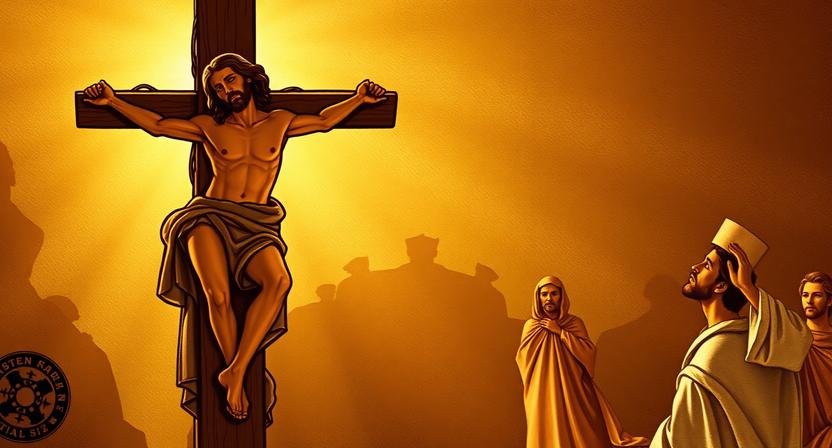
Catholic Homily on Suffering
“Now I rejoice in what I am suffering for you, and I fill up in my flesh what is still lacking in regard to Christ’s afflictions.” — Colossians 1:24 | “And we know that in all things God works for the good of those who love him.” — Romans 8:28
Suffering is the question that every human heart eventually brings to God — and the question that most severely tests every theology. It is the place where faith is either deepened into something real and tested, or abandoned as insufficient to bear the weight of lived experience. The Catholic tradition does not offer an easy answer to the problem of suffering. It offers something more demanding and more consoling: a God who enters suffering himself, who transforms it from within, and who promises that no pain received in love is ever wasted. A Homily on Suffering does not explain away the darkness. It does something harder and truer — it brings the light of the cross to bear on the darkness, and shows that the cross was not the end of the story.
The Question That Every Heart Brings — Why?
There is a question that no preacher can avoid, because no congregation is without it. It is whispered in hospital corridors and shouted in the middle of the night. It is written in the faces of parents at their child’s bedside, in the hunched shoulders of the person sitting alone after the diagnosis, in the hollow eyes of those who have lost someone they cannot imagine living without. The question is simply: Why? Why this suffering? Why this person? Why now? Why at all?
The honest answer of the Christian faith is that there is no complete answer to that question on this side of eternity. The cross does not explain suffering — it transforms it. The resurrection does not remove the memory of pain — it gives it a future. A Homily on Suffering that begins by pretending to explain everything will lose the congregation immediately — because the people in the pews know, from experience, that the easy answers are not true. But a Homily on Suffering that begins by honouring the question — by refusing to flinch from how hard it is — will create the space in which the Gospel can actually be heard.
That Jesus himself cried these words from the cross — “My God, my God, why have you forsaken me?” — is among the most important theological facts in the New Testament. God-in-the-flesh did not merely observe human suffering from a safe distance. He entered it. He cried out in it. He prayed the prayer of the abandoned, the deserted, the one for whom the silence of God seems total. This is where a Suffering Homily must begin: not with answers, but with the One who is present even in the question.
Job — The Courage to Lament Before God
The Book of Job is the Bible’s most sustained engagement with the question of suffering — and its most subversive. Job is a righteous man who loses everything: his children, his wealth, his health. His three friends arrive to offer comfort and promptly explain that Job must have sinned to deserve such punishment. Job refuses their theology. He insists on his innocence. He cries out to God, challenges God, accuses God of injustice. His lament is raw, prolonged, and unrestrained: “I will not keep silent; I will speak out in the anguish of my spirit, I will complain in the bitterness of my soul.” (Job 7:11).
The shocking conclusion of the Book of Job is that God vindicates Job — not his friends. “You have not spoken the truth about me, as my servant Job has.” (Job 42:7). The friends, with their tidy theological explanations, have spoken falsely about God. Job, who raged and questioned and refused to accept easy answers, has spoken truly. The lesson is shattering for anyone who has ever been told that their suffering must be a punishment, or that their anguish is a failure of faith: God is not offended by honest lament. He prefers it to pious platitude.
A hospital chaplain once sat with a woman whose husband had just died after a long illness. She was furious — at the illness, at the doctors, and at God. “Am I allowed to be angry at God?” she asked. The chaplain picked up the Book of Psalms and opened it to Psalm 88 — the darkest psalm in the Bible, which ends with the single word: “darkness.” He read it to her and said: “This is in the Bible. God put it there. He can take whatever you bring him.” She wept. Then she prayed — the most honest prayer of her life, she later said. The permission to lament was the beginning of her healing.
The Suffering Servant — Isaiah 53 and the Wounded Healer
Seven centuries before the crucifixion, the prophet Isaiah composed what has become the most astonishing prophecy in the Old Testament — the fourth Servant Song (Isaiah 52:13–53:12). It describes a figure who suffers not for his own sins but for the sins of others: “He was pierced for our transgressions, he was crushed for our iniquities; the punishment that brought us peace was on him, and by his wounds we are healed.” (Isaiah 53:5). This text was read by the early Church as a direct prophecy of the crucified Jesus — and its vision of vicarious, redemptive suffering became the theological foundation on which the whole Christian understanding of the cross was built.
The Servant in Isaiah 53 is not heroic in the way the world understands heroism. He has no beauty that we should desire him (v.2). He is despised and rejected (v.3). He is silent before his accusers (v.7). His suffering looks, to the watching world, like divine abandonment and human defeat. But the final movement of the poem reverses everything: “After he has suffered, he will see the light of life and be satisfied.” (v.11). The wound is not the end. The wound is the means of healing — not only for the servant, but for all those for whom he suffers.
Henri Nouwen’s concept of the “wounded healer” — the person who ministers to others not despite their own wounds but through them — is rooted in this biblical vision. The person who has suffered and has allowed that suffering to deepen rather than destroy them becomes capable of a ministry of presence and empathy that the untested person cannot offer. The wound becomes the credential of compassion. This is the mystery at the heart of a Suffering Homily: that God uses what is broken to heal what is broken.
Gethsemane — The Prayer That Was Not Answered as Asked
Among the most theologically significant moments in the Gospel is the prayer of Jesus in the Garden of Gethsemane on the night of his arrest. He prays with such intensity that, according to Luke, his sweat falls like drops of blood (Luke 22:44). The content of the prayer is simple and devastating: “Father, if you are willing, take this cup from me; yet not my will, but yours be done.” (Luke 22:42). Jesus prays for deliverance. The cup is not taken away. The prayer is not answered as asked. He goes to the cross.
This moment is one of the most important in the entire New Testament for those who suffer — because it establishes, beyond any doubt, that unanswered prayer is not a sign of divine indifference or human failure. Jesus himself prayed for relief and did not receive it. The one who taught “ask and it will be given to you” asked for something that was not given. And yet he did not conclude that God had abandoned him. He entrusted himself — “not my will, but yours” — to the Father whose wisdom exceeded his understanding of the moment.
Notice the detail Luke includes: an angel comes and strengthens him. God does not remove the suffering — but he does not leave Jesus alone in it. The strengthening that comes is not the removal of the cross but the sustaining presence of the Father through it. This is the pattern of divine help in suffering: not always deliverance from the pain, but always the promise of presence within it. “Even though I walk through the darkest valley, I will fear no evil, for you are with me.” (Psalm 23:4).
The Cross — God’s Answer Written in Flesh and Blood
The central claim of Christian faith in relation to suffering is not a philosophical argument. It is an event: the crucifixion of Jesus of Nazareth. On the cross, the Christian faith does not merely observe human suffering from a theological distance — it locates God at the very centre of it. The God of Christian faith is not the God who sits above suffering in serene impassibility. He is the God who, in the person of his Son, enters suffering, bears it, and transforms it from within.
The theological tradition speaks of this as the kenosis — the self-emptying of God (Philippians 2:7). God empties himself of the prerogatives of divinity — power, comfort, immunity from pain — and takes on the full weight of creaturely, mortal, vulnerable human existence. He is hungry (Matthew 4:2). He is tired (John 4:6). He weeps (John 11:35). He is afraid (Luke 22:44). He suffers. He dies. This is not a performance or a divine experiment in sympathy. It is the real thing — God genuinely suffering, in and through the human nature he has taken on, to the point of death on a cross.
A woman who had lost her young son to cancer was visited by a well-meaning neighbour who offered various consolations. Finally, frustrated, the grieving mother said: “Does God know what this feels like?” The neighbour was silenced. Later, a priest came to visit. She asked him the same question. He said quietly: “He knows exactly what it feels like. He buried his Son too.” She was silent for a long time. Then she said: “That’s the only thing I needed to hear.”
The cross does not explain suffering. But it answers the question that lies beneath all the others: Are you there? Do you know? And the answer is: I am here. I have been here. I know.
Redemptive Suffering — “Fill Up What Is Lacking”
Among the most mysterious sentences in the New Testament is Colossians 1:24, where Paul writes: “Now I rejoice in what I am suffering for you, and I fill up in my flesh what is still lacking in regard to Christ’s afflictions, for the sake of his body, which is the Church.” The phrase “fill up what is still lacking” has puzzled theologians for two thousand years. How can anything be lacking in Christ’s afflictions — in the cross that Scripture declares to be sufficient, complete, once-for-all?
The tradition’s answer is not that the cross was incomplete in its power, but that its application — its spread through time and space into the lives of every human being in every age — is the ongoing work of the Church, the Body of Christ. When Paul suffers for the Church, he is not adding to the atoning work of Christ. He is participating in it — becoming, in his own flesh, a conduit through which the transforming power of the cross reaches others. This is the doctrine of redemptive suffering: that human suffering, united to the cross of Christ in love, is not merely endured but transforms, heals, and intercedes for others in ways that exceed what is visible.
St John Paul II’s apostolic letter Salvifici Doloris — “On the Christian Meaning of Human Suffering” (1984) — is the most sustained magisterial treatment of this doctrine. Written by a man who had known great suffering personally, it presents suffering not as meaningless but as the place where the Christian is most deeply united to Christ, most deeply configured to the paschal mystery, and most powerfully able to participate in the redemption of the world. Suffering offered in love is, in the theology of the cross, never wasted.
The Psalms of Lament — God’s Permission to Cry Out
One of the most important gifts the Church can give to suffering people is the psalms of lament — the roughly one-third of the Psalter that consists of raw, unfiltered expressions of pain, abandonment, confusion, and complaint addressed directly to God. Psalm 22, Psalm 38, Psalm 88, Psalm 130 — these are not failures of faith. They are faith at its most honest: the faith that knows God is there, even when he seems absent, and therefore addresses him with everything that is true about the present moment.
The Church prays the Psalms every day in the Liturgy of the Hours — including the darkest of them. Jesus prayed them. The martyrs prayed them. The mystics who experienced the “dark night of the soul” prayed them. In doing so, the Church has always maintained that the full range of human experience — including its most desperate moments — is material for prayer; that God is not offended by our honesty; that the cry of desolation addressed to God is, paradoxically, an act of faith — because the one who cries out has not given up on the One to whom they cry.
A Suffering Homily that draws on the Psalms of lament gives the congregation an extraordinary gift: the realisation that their most desperate prayers are not outside the tradition but at the heart of it; that the Bible makes room for the full truth of what they are experiencing; and that the God who inspired these prayers is not frightened by them, but waiting for them — as a parent waits for a child who is struggling to find the words to say what is wrong.
St Thérèse of Lisieux — The Dark Night and the Little Way
Among the saints who have most powerfully illuminated the meaning of suffering in the Christian life, St Thérèse of Lisieux — the Little Flower, Doctor of the Church — holds a unique place. She is often presented as a saint of sweetness and simplicity. But the final eighteen months of her life were marked by a darkness of faith so profound that she described it as a “tunnel” in which she could not see the light she had always lived by — a darkness she embraced, she said, for the sake of souls who did not believe.
Thérèse’s theology of suffering is rooted in the “little way”: the conviction that small sufferings, accepted in love, are not inferior to great ones. The daily humiliations of communal life, the physical agonies of tuberculosis, the spiritual darkness of doubt — all were material, in her vision, for the same radical offering that the martyrs made in blood. She wrote in her autobiography: “I have always wanted to suffer for love, and to be consumed by love.” But she was not romanticising suffering. She struggled enormously. The difference was not that she felt no pain but that she refused to waste it.
The “little way” in suffering is a great gift for ordinary congregations — because most people will not face martyrdom. But everyone will face small and large sufferings: the grinding pain of chronic illness, the loneliness of old age, the daily humiliations of a difficult relationship, the grief that does not go away. Thérèse’s witness is that none of this is too small, or too ordinary, or too unspiritual to offer. Everything can be given. Everything can be transformed. The little cross, carried faithfully, is the same cross as the great one.
Romans 8 — Nothing Can Separate Us From the Love of God
The eighth chapter of Romans is, by almost universal acclamation, one of the greatest chapters in the New Testament — and its final movement is one of the most powerful responses to suffering in all of Christian literature. Paul has been building throughout the chapter toward a climax: the claim that the creation itself is groaning in its labour pains (v.22), that the Spirit intercedes for us with wordless groans (v.26), that God works in all things for the good of those who love him (v.28). And then, in the final verses (vv.35–39), he asks the question that every suffering person most needs answered:
“Who shall separate us from the love of Christ? Shall trouble or hardship or persecution or famine or nakedness or danger or sword?” (v.35). The list is not abstract — Paul knew each of these from personal experience. He had been shipwrecked, flogged, imprisoned, hungry, cold, and left for dead. He lists them not as rhetorical examples but as the actual content of his biography. And then he answers his own question: “No, in all these things we are more than conquerors through him who loved us.” Not after them. Not despite them. In all these things. The love of God does not remove the difficulty — it is present within it, making those who suffer “more than conquerors.”
This is the pastoral summit of the Suffering Homily: not a theology of suffering explained from the outside, but a love that holds from within. Whatever the suffering — however devastating, however long, however apparently meaningless — it cannot break this hold. The love of God in Christ Jesus is the one reality that suffering cannot touch, cannot diminish, cannot separate us from.
The Resurrection — Suffering Is Not the Last Word
Every Christian theology of suffering must be, ultimately, an Easter theology — because the cross is not the last word. “He is not here; he has risen!” (Luke 24:6). The resurrection of Jesus is not merely an inspiring postscript to his suffering. It is the theological declaration that death does not have the last word, that the grain of wheat that falls into the ground and dies does indeed bear much fruit (John 12:24), that the suffering of this present time is indeed “not worth comparing with the glory that will be revealed” (Romans 8:18).
Crucially, the resurrection does not erase the wounds. The risen Jesus still bears the marks of the nails in his hands and the spear in his side (John 20:27). The glorified body carries the history of the suffering body. This is a profound theological statement: that in the resurrection, nothing of what was suffered is lost or wasted or forgotten. The wounds are transformed — they become, in the risen Christ, the marks of identity, the credentials of love, the doors through which Thomas reaches in and finds the Lord. Our suffering, united to his, will be similarly transformed — not erased, but transfigured into something that bears witness to a love that was stronger than death.
The Easter faith does not make suffering easy. It makes it bearable — and more than bearable: meaningful, purposeful, shot through with a hope that is not wishful thinking but a conviction grounded in the empty tomb. The one who raised Jesus from the dead is the same one who holds every suffering person in his hands. And the empty tomb is his promise: this is not the end of your story either.
Seven Ways the Christian Tradition Understands Suffering
The Christian tradition does not offer a single explanation of suffering but a rich constellation of perspectives, each illuminating a different facet of what is always, at some level, a mystery. Here is a map of how the tradition has understood what suffering can mean and do:
| Understanding of Suffering | Key Scripture | What It Offers the Sufferer |
|---|---|---|
| Participation in Christ’s Passion | Colossians 1:24; Philippians 3:10 | The sense that suffering is not meaningless but a form of union with the crucified Christ |
| Formation of Character | Romans 5:3–5; James 1:2–4 | Suffering produces perseverance, character, and a hope that does not disappoint |
| Purification and Detachment | 1 Peter 1:6–7; Hebrews 12:10–11 | The stripping away of what is not essential; the refiner’s fire that purifies what remains |
| Compassionate Ministry | 2 Corinthians 1:3–4 | Those who have suffered become uniquely able to comfort others with the comfort they have received |
| Eschatological Hope | Romans 8:18; 2 Corinthians 4:17 | Present suffering set in the context of an eternal weight of glory that far surpasses it |
| Intercession for Others | Colossians 1:24; Isaiah 53:12 | Suffering united to Christ becomes a form of priestly intercession for the world |
| Honest Lament Before God | Psalm 22; Job 23; Psalm 88 | The raw cry of pain as itself an act of faith — keeping the relationship with God honest and open |
Accompanying the Suffering — What Not to Say
A Homily on Suffering must address not only the theological meaning of pain but the pastoral question of how to accompany those who suffer. One of the most damaging things the Church can do to suffering people is to reach too quickly for answers — to offer explanations that silence the pain rather than presence that holds it. The friends of Job provide the classic negative example: they arrive with theologies, they explain, they moralise, they suggest that Job must have deserved what happened to him. And God rebukes them.
The ministry of presence — simply being there, without explanation, without resolution, without the need to make things better — is among the most demanding and most valuable forms of Christian witness. It requires the willingness to sit in the discomfort of another person’s pain without fleeing into premature consolation. It requires trust that the God who is present in the silence does not need our words to make himself known. It requires the humility to recognise that what the suffering person most often needs is not an answer but a witness — someone willing to say, “I am here, and I am not leaving.”
Silent, faithful presence. Practical acts of love (meals, care, transport). Honest acknowledgment that this is hard. Prayer offered, not imposed. The ministry of listening without advice.
“Everything happens for a reason.” “God won’t give you more than you can handle.” “At least…” comparisons. Premature calls to gratitude. Treating suffering as a problem to be solved rather than a mystery to be accompanied.
St John Paul II — “Salvifici Doloris” and the Meaning of Suffering
No modern pope has engaged the question of suffering more personally and more profoundly than St John Paul II. He survived a Nazi occupation, endured the loss of his entire family before he was twenty, survived an assassination attempt, and spent the final years of his papacy suffering publicly and visibly from Parkinson’s disease — a suffering he accepted as his final apostolic act, a witness to the dignity of suffering human life that no words could have communicated as powerfully.
His 1984 apostolic letter Salvifici Doloris — “On the Christian Meaning of Human Suffering” — is the most comprehensive magisterial treatment of the theology of suffering in modern Catholic teaching. It argues that suffering is never meaningless for the Christian, because it is never outside the redemptive reach of the cross. Human suffering, when united to the suffering of Christ in love and faith, becomes a participation in the very act of redemption — not a secondary or marginal participation, but a real, efficacious sharing in the work of salvation. “Every man has his own share in the Redemption. Each one is also called to share in that suffering through which the Redemption was accomplished.”
John Paul’s own suffering in the final years of his pontificate became, for millions of people around the world, a living homily on the dignity of the suffering human person and the redemptive power of pain offered in love. He showed, not merely taught, what Salvifici Doloris described. His witness is itself a resource for a Suffering Homily — the testimony of a man who believed what he preached, at the cost of everything.
How to Hold Suffering in Faith — A Complete Pastoral Guide
Suffering cannot be managed from the outside. But it can be held — in faith, in community, in prayer. Here is a complete pastoral guide for those who suffer and for those who walk alongside them.
-
1
Give yourself permission to lament — honestly and fully. Do not perform acceptance before you have felt the pain. The psalms of lament, the cry of Job, the prayer of Jesus in Gethsemane — all give you permission to bring exactly what is true to God. “God, I am angry. God, I am frightened. God, I do not understand.” This is prayer. This is faith. This is infinitely better than the pious silence that isolates suffering in its own darkness.
-
2
Offer your suffering — don’t merely endure it. There is a difference between suffering that is simply undergone and suffering that is consciously offered to God in union with the cross of Christ. The act of offering does not remove the pain. But it transforms its direction: from something that is happening to you, to something you are bringing to God for him to use. “Lord, I don’t understand this. But I give it to you. Use it for whatever you are doing in this world.” This simple act of surrender is the beginning of redemptive suffering.
-
3
Stay connected to the Body of Christ — resist isolation. Suffering has a strong gravitational pull toward isolation — the sense that no one could understand, that no one would want to hear, that it is better to suffer alone than to burden others. This is one of the enemy’s most effective strategies. The Body of Christ is specifically designed for this: “If one part suffers, every part suffers with it.” (1 Corinthians 12:26). Let the community in. Receive care. Be known. Let the sacraments — especially Anointing of the Sick and the Eucharist — be the points where Christ meets you most concretely in your pain.
-
4
Seek the Sacrament of Anointing of the Sick — not only for the dying. The Anointing of the Sick is not a preparation for death — it is a sacrament for anyone who is seriously ill or suffering, in which the Church prays for healing, strength, forgiveness, and peace. It is one of the most neglected sacraments in Catholic life, and one of the most powerfully consoling. Ask for it. Receive it. Let the Church pray over you with the oils of Christ’s compassion.
-
5
Find one story — a saint, a scripture, a witness — who has been where you are. You are not the first person to suffer this way. The communion of saints is specifically a community of those who have known great darkness and found God faithful in it: Job, the psalmists, Paul in prison, Thérèse in her dark night, John Paul II in public decline. Find the one whose story is closest to yours. Read it. Pray with them. Let their faith speak to yours across the centuries.
-
6
Hold on to Romans 8:28 — not as a quick answer but as a long-term anchor. “We know that in all things God works for the good of those who love him.” This verse is not a promise that everything will feel good or be explained. It is a promise that nothing — not even this — is outside God’s sovereign love and purpose. It may take years to see how. It may not be visible in this lifetime. But the anchor holds: God is at work. In this. Even in this.
-
7
Look for the one person more suffering than you — and serve them. This is not a technique for ignoring your own pain. It is a discovery that the mystics and the saints have made across the centuries: that the person who reaches out to another in need, even from within their own suffering, often finds that something has shifted. The widow who feeds Elijah from her last handful of flour is the one whose jar never empties. Suffering that becomes compassionate service begins to lose some of its power to isolate and destroy. It finds, instead, a strange and unexpected companionship.
“He Will Wipe Every Tear” — Suffering’s Final Horizon
The last word of a Suffering Homily belongs not to suffering but to the God who promises its ending. The Book of Revelation — written by a man in exile, for communities facing persecution — contains one of the most beautiful sentences in the entire Bible: “He will wipe every tear from their eyes. There will be no more death or mourning or crying or pain, for the old order of things has passed away.” (Revelation 21:4). This is the eschatological promise — the final word of the Christian story — and it is a word of radical comfort and radical hope.
Notice the intimacy of the gesture: God himself wipes the tears. Not a servant, not an angel — God himself. The one who entered suffering on the cross is the one who, at the end of all things, tenderly removes its final traces from the face of every person who suffered and held on and believed and gave their pain to him. Nothing will be lost. Every tear is remembered. Every pain that was offered in love has been stored up, as it were, in the heart of God — and at the last, it will be transformed into something so glorious that Paul, having tried to describe it, gave up and said simply: “No eye has seen, no ear has heard, no mind has conceived what God has prepared for those who love him.” (1 Corinthians 2:9). This is the ground on which the Church stands when it dares to preach a Suffering Homily: not that suffering is good, but that God is good — and the last word is his. ✝ 🌹
“Lord, Be With Us in the Dark”
Lord Jesus Christ — you who prayed in the garden until your sweat was like blood, you who cried out from the cross “My God, my God, why have you forsaken me?”, you who took on the full weight of human pain and carried it into death — we bring you ours. The grief we have been carrying alone. The illness we are afraid to name aloud. The loss that will not leave us. The question that has no answer. The darkness we did not choose and cannot escape.
We do not ask you to explain it. We ask only that you be in it with us — as you were in the garden, as you were on the cross, as you were in the sealed tomb from which you rose. Be the angel who strengthens without removing the cup. Be the voice that says, from within the darkness: I am here. I know. I have been here before you. And I have not left.
For those in this congregation who are suffering beyond what they can bear: hold them. For those who are accompanying a suffering person without knowing what to say: give them your presence to give. For those who have been suffering so long that hope is nearly gone: let them hear, one more time, the word from the empty tomb — He is not here; he has risen. The story is not over. The wound is not the last word. The tear will be wiped away. Come, Lord Jesus. Come into our pain.
Amen. ✝ 🌹
Trusted External Resources for a Suffering Homily
- Salvifici Doloris — St John Paul II on the Christian Meaning of Human Suffering (Vatican.va)
- USCCB Online Bible — All Scripture passages referenced
- Charter for Health Care Workers — Pontifical Commission (Vatican.va)
- USCCB — Anointing of the Sick: The Sacrament of Healing
- Ignatian Spirituality — Facing Illness and Death Resources
- World Day of the Sick — St John Paul II’s Message (Vatican.va)
More Homilies on HomilySunday.com
- Gratitude Homily
- Stewardship Homily
- Word of God Homily
- Hope Homily
- Faith Homily
- Love Homily
- Easter Homily
- Advent Homily
- Homily on Forgiveness
- Homily on God’s Mercy
- Healing Homily
- Homily on Prayer
- Homily on the Holy Spirit
- Discipleship Homily
- Humility Homily
- Divine Mercy Homily
- Peace Homily
- Wedding Homily
- Funeral Homily
- 100 Homily Stories
