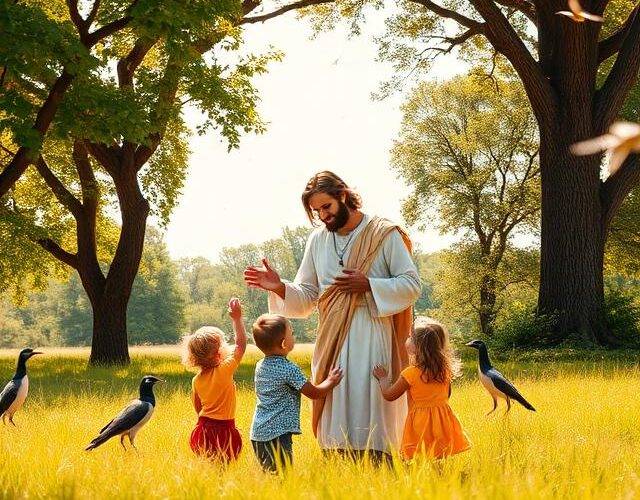
Catholic Homily for Children
“Let the little children come to me, and do not hinder them, for the kingdom of heaven belongs to such as these.” — Matthew 19:14 | “A child’s heart is the most open door to God.” — Traditional
Children are not simply smaller adults waiting to grow up before they can encounter God. They are already, in Jesus’s own words, the model for the Kingdom of Heaven. A Homily for Children is one of the most important and most joyful things a preacher can be called to do — because in speaking to the youngest hearts in the congregation, we are speaking to the hearts that are often most open, most honest, and most ready to receive the Good News. This page offers a complete, Scripture-rooted, theologically faithful, and practically warm guide for preaching to children — whether at Children’s Liturgy of the Word, school Mass, First Communion, or a Sunday when the little ones stay in for the whole homily.
Why Children Need Their Own Homily — Jesus Made This Clear
In every Gospel, the moment when the disciples try to keep children away from Jesus stands as one of the most revealing episodes of his ministry. The disciples — responsible, well-meaning, protecting their Teacher from interruption — saw children as a distraction from the serious business of the Kingdom. Jesus saw them as its defining image. “Let the little children come to me, and do not hinder them, for the kingdom of heaven belongs to such as these.” (Matthew 19:14). And then he did something extraordinary: he stopped what he was doing, placed his hands on them, and blessed them.
This is the theological foundation of every Children’s Homily: children are not a lower-priority audience. They are the audience Jesus explicitly prioritised. When we preach to children — with care, with preparation, with genuine respect for their intelligence and their spiritual capacity — we are doing exactly what Jesus did. We are welcoming them. We are placing our hands on their heads in blessing. We are saying: the Kingdom is yours.
A well-crafted Homily for Youth addresses teenagers at the threshold of adult faith. A Homily for Children addresses those who are, in Jesus’s own words, already closest to the Kingdom — and calls them by name into the joy of belonging to God.
How Children Learn — Understanding the Young Heart and Mind
Before we can preach well to children, we must understand how they receive and process truth. Children are not passive recipients of abstract information — they are active, embodied, relational learners. They learn through story before argument, through image before concept, through feeling before analysis. This is not a limitation to work around: it is actually the way all human beings learn best, and children simply make it more obvious.
| Age Group | How They Think | What Works in a Homily |
|---|---|---|
| Ages 4–6 | Concrete, magical thinking. Everything is personal and immediate. God is a real friend. | Very short stories (1–2 minutes). Simple questions. One clear idea. Wonder and warmth. |
| Ages 7–9 | Beginning logical thinking. Love of fairness. Strong moral sense. Ask “Why?” | Stories with a clear lesson. Analogies to everyday life. Involve them with questions. |
| Ages 10–12 | More abstract capacity developing. Beginning to question. Identity forming. | Deeper stories. Honest questions. Connect faith to real life. Treat them as capable. |
| Mixed ages | Wide range of capacities simultaneously present. | Anchor in a simple story that works on multiple levels. The youngest follow the story; the oldest follow the meaning. |
The great preachers to children — and the great children’s writers — have always known that a good story works on several levels simultaneously. The youngest child follows the adventure; the older child begins to grasp the meaning; the adult in the room is often the most moved of all. Aim for the heart first. The mind will follow.
The Power of Story — The Method Jesus Used
Jesus did not give children a different method of teaching from adults — he used the same method for everyone: story. The parables are not a concession to those who cannot handle abstract theology. They are the most sophisticated theological communication ever devised. A story creates an experience; it draws the listener inside the truth rather than presenting the truth from outside. When you emerge from a good story, you have not merely understood something — you have felt it, lived it, been changed by it.
For children, this is even more essential. Before a child can say “God loves me unconditionally,” they need to hear a story that makes them feel what unconditional love is. Before they can understand “repentance and forgiveness,” they need to hear the Prodigal Son — and feel the hug of the father who ran. Good stories do theological work that definitions cannot do, because they engage the whole person — imagination, emotion, memory, and will — not just the intellect.
“Imagine you had a hundred fluffy sheep — and at the end of the day, when you counted them all up, you found that one was missing. Just one, out of a hundred. Would you leave the 99 safe ones and go looking for that one lost little sheep? Jesus says yes — that is exactly what the Good Shepherd does. And when he finds the lost sheep, he doesn’t tell it off. He picks it up gently, puts it on his shoulders, carries it home, and calls all his friends to celebrate. That lost sheep — that is you. And that shepherd who never stops looking? That is Jesus.”
Follow with: “Has anyone ever felt a bit lost? Like they made a mistake and weren’t sure if anyone would still love them? That’s the moment Jesus is closest.”
The Homily on Forgiveness explores the Prodigal Son for adult congregations. For children, the Lost Sheep is often the more accessible image — because a sheep is tangible, the search is active and urgent, and the celebration is joyful. Always choose the most concrete, most vivid, most feelable image available.
God Loves You — The First and Most Important Message
If a children’s homily could have only one message — one truth to plant in a young heart that might grow for a lifetime — it would be this: God loves you. Personally. By name. Unconditionally. Right now. This is not a simple message in the sense of being shallow. It is the most profound truth in the universe, presented with the directness and simplicity that children deserve and that adults have often forgotten.
Many children carry, even at very young ages, a quiet anxiety about whether they are loved — by parents, by peers, by God. The world is full of conditional love: “I love you if you behave, if you succeed, if you are good enough.” A children’s homily that plants the seed of unconditional divine love — “God loves you not because of what you do but because of who you are — his child” — is doing some of the most important pastoral work imaginable.
“Jesus once said something amazing. He said that God notices every single sparrow — and sparrows are tiny, and there are millions of them. If God notices every sparrow, how much more does he notice you? Jesus said: ‘You are worth more than many sparrows.’ God knows your name. He knows your favourite colour. He knows what makes you laugh and what makes you sad. And he loves you — not because you’re always good, but because you’re his.”
Jesus Is Your Friend — Not Just a King Far Away
Children often receive two unhelpful images of Jesus: either the distant, stained-glass figure on a throne — too holy and important to be approached — or a vaguely nice man from a long time ago who said some kind things. Neither image invites a living relationship. The Gospel presents something far more radical and far more personal: Jesus as friend. “I no longer call you servants… Instead, I have called you friends.” (John 15:15). This was addressed to adults — but it is even more startlingly true for children, who understand friendship intuitively and hunger for it.
In a children’s homily, one of the most important things a preacher can do is humanise Jesus — not diminish him, but make him real and approachable. He was tired (John 4:6). He was hungry (Matthew 4:2). He cried (John 11:35). He laughed at parties (John 2). He got frustrated (Matthew 21:12). He asked questions (Luke 2:46). He needed sleep (Mark 4:38). He was, in the full mystery of the Incarnation, fully human as well as fully God — which means children can relate to him in a way that is completely real and completely true.
“Jesus wept” is one of the most powerful verses to share with children. It shows them that it is okay to cry. That sadness is not a sin. That Jesus knows what loss and grief feel like from the inside — and that he is not far away from us when we are sad, but right there, crying with us.
Prayer — Talking to God Like a Friend
One of the most practical gifts a children’s homily can give is a living, accessible, personal understanding of prayer. Many children (and many adults) have been given the impression that prayer is a formal activity — reciting set words in set postures at set times. These forms are valuable and should be taught. But the deeper truth — that prayer is simply conversation with a God who loves you and is always listening — is the foundation without which all the forms remain hollow.
When the disciples asked Jesus to teach them to pray, he gave them the Our Father — which begins not with formal address but with the most intimate Aramaic word for father: Abba, which is closer to “Daddy” than to “Father.” This is not irreverent — it is the most reverent thing imaginable, because it is the prayer Jesus himself used (Mark 14:36). And it tells children something essential: you can come to God exactly as you are, with your real feelings, your real questions, and your real needs.
“There was once a little boy who had never been taught to pray. One night, his grandmother asked if he wanted to say a prayer before bed. He didn’t know what to say. So he started reciting the alphabet — A, B, C, D, E… all the way to Z. His grandmother said, ‘What are you doing?’ He said, ‘I’m giving God all the letters, and asking him to put them in the right order — because he knows what I need better than I do.’ God heard that prayer. God always hears the honest heart.”
For a deeper exploration of prayer for all ages, see the Homily on Prayer. For children, the key message is always: prayer is not a performance. It is a conversation. And God is always on the other end, listening with love.
The Mass — Understanding What We Are Doing Here
Many children attend Mass week after week without really understanding what is happening or why it matters. A children’s homily at Mass has the remarkable opportunity to open up the meaning of what the child is actually participating in — not as a lecture but as an invitation into wonder. The Mass is, in the simplest terms, the most extraordinary thing that happens on earth every day: Jesus gives himself to us, completely, in bread and wine.
For younger children, the most important thing is to name what they can see and connect it to something they already love. The altar is a table — because God invites us to his family meal. The priest wears special clothes — because this is the most important moment in the world. We sing — because when you love someone, sometimes words aren’t enough and you have to sing. We sit and stand and kneel — because our bodies are part of our worship, not just our minds. Each element of the Mass is a gift waiting to be unwrapped.
For children approaching First Holy Communion, the homily is a profoundly important moment. Connect it to the Baptism Homily — because at Baptism, they became members of God’s family, and at First Communion, they come to the family table for the first time. Both are moments of welcome, of belonging, of being embraced by a God who never tires of giving himself.
Kindness, Sharing, and the Golden Rule — Gospel Ethics for Young Hearts
Children have an extraordinarily well-developed sense of fairness — and a profound instinct for kindness that adults sometimes spend years trying to recover. A children’s homily on how to live the Gospel can build on these instincts rather than working against them. The Golden Rule — “Do to others what you would have them do to you” (Matthew 7:12) — is one of the most immediately accessible ethical principles in Scripture precisely because children already know what it feels like to be treated well or poorly.
The story of Zacchaeus (Luke 19:1–10) is a wonderful homily text for children: a small man who climbed a tree to see Jesus, was personally noticed and called by name, and was so transformed by the encounter that he immediately offered to give away half his wealth and repay anyone he had cheated four times over. For children: “Zacchaeus was not very popular — people didn’t like him. But Jesus saw him up in the tree and said, ‘Come down! I want to come to your house!’ Being chosen by Jesus changed everything for Zacchaeus. And it changes everything for us too — when we know we are chosen, we want to be kind.”
God Forgives — You Can Always Come Back
Children need to know, from as early an age as possible, that their mistakes do not define them and do not separate them permanently from God. The Parable of the Prodigal Son (Luke 15) works for children if it is told vividly and personally: the son who ran away and wasted everything and was too ashamed to come home — until he did, and found his father had been watching and waiting and ran toward him the moment he appeared on the horizon.
“Imagine you had a huge argument with your mum or dad. You said something you really shouldn’t have said. You ran to your room, and you were so ashamed you didn’t want to come out. But then — you heard footsteps in the hallway. And before you could say anything, the door opened, and it was your mum or dad — not angry, not with a lecture, but just with arms open, saying, ‘I love you. Come here.’ That is what God is like. Every single time. You never have to be too ashamed to come home to him.”
This connects naturally to preparing children for their first Confession — not as something frightening, but as the most loving encounter imaginable: walking up to a God who already knows what you did and has already forgiven you before you finished the sentence. For a full exploration of forgiveness for adults, see the Homily on Forgiveness.
Saints — Real People Who Loved God
Children respond powerfully to stories of real people — and the saints are one of the richest resources the Church offers for children’s homilies. The saints are not distant, impossibly perfect marble figures. They were real people — often young, sometimes frightened, frequently funny, always human — who loved God with their whole hearts and whose stories still have the power to light up young imaginations and inspire young lives.
The real bishop behind Father Christmas — known for secretly throwing bags of gold through windows to help poor families. A saint whose generosity was so joyful it became legendary across the whole world.
The rich young man who gave everything away to follow God, talked to birds and wolves, wrote poems about Brother Sun and Sister Moon, and showed the world that holiness can be joyful and free.
The “Little Flower” who entered a convent as a teenager and found that the path to holiness was not great deeds but small acts of love — her “Little Way” is the most accessible spirituality for children.
An Italian teenager who died in 2006 and was beatified in 2020 — a computer-loving, football-playing, perfectly ordinary young person who loved the Eucharist with extraordinary depth. The patron of the internet generation.
The key principle when preaching saints to children: make them human first, then show the holiness. Children do not need perfect marble heroes — they need friends who have walked a human road and found that God was with them every step of the way.
The Holy Spirit — The Friend Inside You
The Holy Spirit is perhaps the hardest Person of the Trinity to explain to children — and perhaps the most important for them to know in a personal, experiential way, because the Holy Spirit is the One who is most immediately, most intimately present to them. Jesus promised: “I will ask the Father, and he will give you another advocate to help you and be with you forever — the Spirit of truth.” (John 14:16–17). That Spirit is not far away in heaven. That Spirit is within — in the heart of every baptised child.
For children, the most accessible images of the Holy Spirit are the ones Jesus and the tradition have given us: a dove (peace, gentleness, beauty), fire (warmth, light, energy, the power to melt what is frozen), wind (invisible but real — you can feel it even if you can’t see it), water (life-giving, refreshing, cleansing). Any of these can be the entry point to a rich and lively discussion with children about the Spirit who lives in them and helps them to be brave, kind, wise, and loving.
The “Fruits of the Spirit” from Galatians 5 are particularly good for children — because they are all things children understand and experience: love, joy, peace, patience, kindness. Ask children: “Which of these fruits do you already have? Which one would you like more of?” For a full adult exploration, see the Homily on the Holy Spirit.
You Are Made in God’s Image — You Are Precious
One of the most important truths a child can carry through life is this: they are made in the image and likeness of God (imago Dei — Genesis 1:27). This is not a theological abstraction. It is a declaration of infinite, irreducible worth. Every child — regardless of how they perform at school, how they look, how popular they are, what mistakes they have made — bears the image of God. They are precious not because of anything they do but because of who they are.
In a world that tells children their worth depends on their grades, their appearance, their social media presence, or their athletic performance, this is a radical and desperately needed counter-message. The Church has the extraordinary privilege and responsibility of being the place where every child hears: “You are precious. You are irreplaceable. You are made in the image of God — and no one can take that from you. Ever.”
“Imagine the most famous painting in the world — like the Mona Lisa. Even a tiny scratch on it would horrify people, because it is priceless. Now — you are not a painting. You are much more precious than any painting. God himself made you, by hand, with love. Every part of you — your laugh, your curiosity, your kindness, even the things about yourself you don’t like yet — was made by the One who makes masterpieces. You are not an accident. You are a work of art.”
Practical Tips for Preaching to Children — The Craft
A Homily for Children is a distinct art form. Here are the most important practical principles for preaching it well.
Sit down, crouch down, or come out from behind the ambo. Eye contact at the same height says: I am here for you, not performing above you. This simple physical change transforms the dynamic.
Children’s answers are often the most theologically honest things said in the whole Mass. Ask, wait, listen. Their responses will teach you as much as you teach them. Never brush off a child’s answer.
Adults can hold multiple threads. Children cannot. Choose one truth, one story, one image — and go deep rather than wide. End with the same truth you began with, simply stated.
For ages 4–7: three minutes maximum. For ages 7–10: five to seven minutes. For ages 10–12: eight to ten minutes. Better to end while they are still engaged than to continue until they are lost.
A coin (the Lost Coin parable), a seed (the mustard seed), a candle (you are the light of the world), a piece of bread — these make abstract truths tangible and memorable.
The best children’s homily is one that the adults in the room also receive. Preach to the children in a way that also reaches the grown-ups who have often forgotten the simplest truths.
A Complete Sample Homily for Children — The Good Shepherd
Here is a complete, ready-to-use homily for a Children’s Liturgy of the Word or a Sunday when children are present for the homily. It is designed for ages 6–10, takes approximately five minutes, and requires no props (though a picture of a shepherd would enrich it).
-
1
The Question (30 seconds): “Has anyone here ever been lost — in a shop, or a car park, or somewhere you didn’t know? What did it feel like? And what happened when someone found you?” (Wait for answers.)
-
2
The Story (2 minutes): “In the time when Jesus lived, shepherds took care of sheep all day and all night. They knew every single sheep by name. Jesus told a story: a shepherd had a hundred sheep, and one got lost. He left the 99 safe ones and went looking — across hills, through bushes, calling and searching — until he found it. And when he did, he didn’t tell the sheep off. He picked it up, put it on his shoulders, and carried it home, singing. And then he called his friends to have a party: ‘My sheep was lost and now it’s found!'”
-
3
The Connection (1 minute): “Jesus says: I am the Good Shepherd. And you — every single one of you — is one of my sheep. I know your name. If you ever feel lost — if you make a mistake, if you feel alone, if something bad happens and you don’t know where to turn — I come looking for you. I never give up. I carry you home.”
-
4
The Challenge (30 seconds): “This week, can you do one thing for someone who might be feeling a bit lost or left out? Sit next to them at lunch. Say hello. Be a little bit like the Good Shepherd.”
-
5
The Prayer (30 seconds): “Lord Jesus, Good Shepherd — thank you for knowing our names and never giving up on us. Help us to look after each other this week the way you look after us. Amen.”
The Future of the Church — Every Child Is a Seed
A Homily for Children is never only for the children in the room. It is an investment in the future — in the faith that will carry forward the Gospel into the next generation. Every child who hears, in a homily, that they are loved by God, that Jesus is their friend, that the Church is their home — is a seed planted. Many of those seeds will take years, even decades, to flower. Some will lie dormant through difficult teenage years and return in adulthood. Some will never sprout. But the sowing matters — and it matters enormously.
The research on adult faith consistently shows that the most significant factor in lifelong religious practice is the quality of a person’s childhood religious experience — not the quantity of religious instruction, but the warmth, the belonging, the sense of being known and loved by God. A single homily remembered — a single image that planted something — can matter across a lifetime. When we preach well to children, we are not filling a slot on the programme. We are participating in something eternal.
Go and preach to the children. Tell them that they are loved. Tell them that Jesus knows their name. Tell them that the Kingdom of Heaven is theirs. You may be the most important voice they hear today — and the echo of what you say may last for the rest of their lives. Go — and preach the Good News. 🌿 ✝ 🌿
“Lord, Let the Children Come”
Lord Jesus, you who stopped for the children when everyone else was in a hurry — stop for them again today. Stop for the little ones in our congregations, our schools, our families, who are looking for you with honest, open hearts.
Give us, who are called to preach to them, the humility to get down to their level, the patience to hear their answers, the creativity to find stories that carry the truth, and the love to show them — above all else — that they are known, they are precious, and they are deeply, unconditionally, permanently beloved.
May every child who hears a homily today leave knowing one thing more clearly than they knew it before: that Jesus is their friend, their shepherd, their light — and that his door is always, always, always open.
Amen. 🌿
Trusted External Resources for a Children’s Homily
- USCCB — Directory for Masses with Children and Liturgy of the Word Resources
- USCCB Online Bible — All Scripture passages referenced
- Catechism of the Catholic Church — On the Faith of Children (§1250–1252) (Vatican.va)
- Blessed Carlo Acutis — Official Website for the Patron of Youth and the Internet
- Loyola Press — Children’s Liturgy of the Word Resources (Weekly)
- Familiaris Consortio — John Paul II on Faith Formation of Children (Vatican.va)
