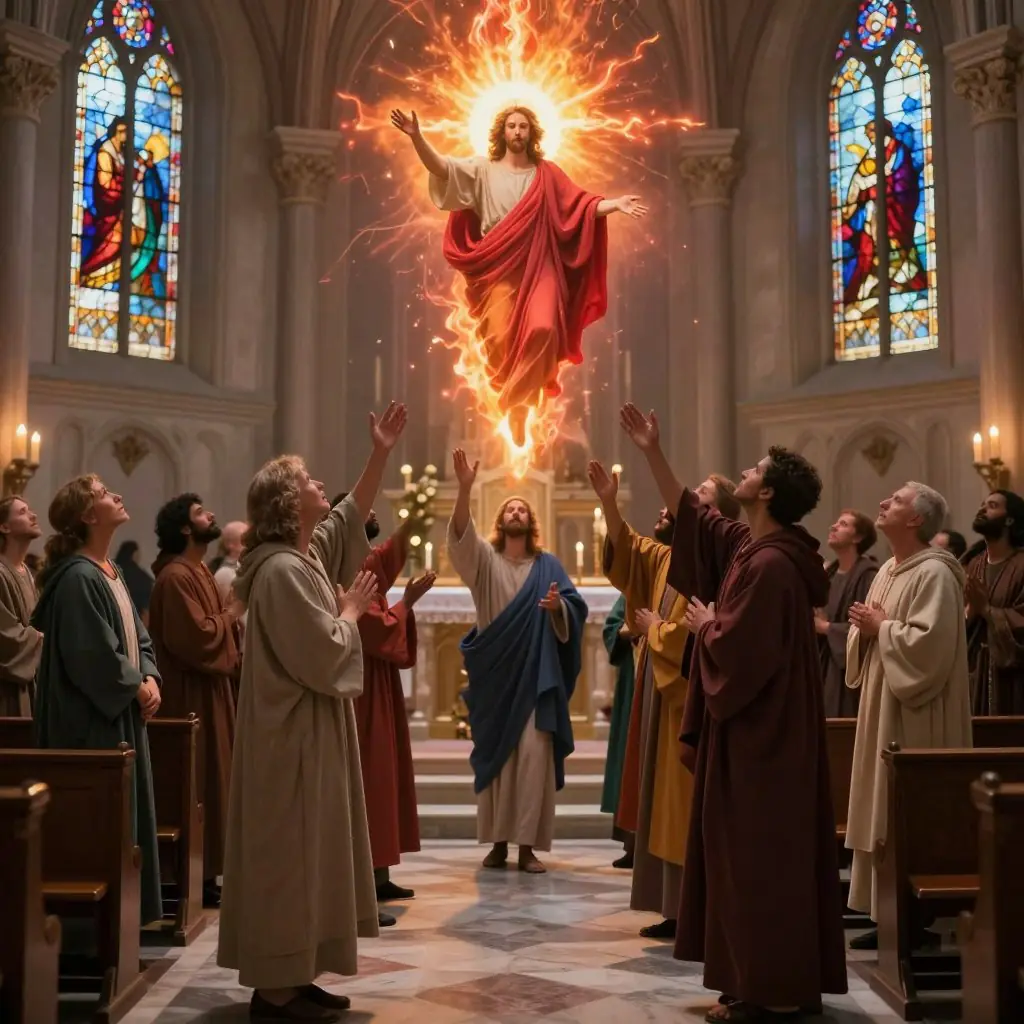
Pentecost Sunday Homily – Vigil Mass
The Vigil reflection by Fr. Chris Pedley SJ frames a future season of renewal for the community. He connects the ancient readings — from Genesis through John — to a living hope that shapes how people gather, pray, and work together.
The holy spirit is portrayed as breath and fire that changes hearts. The narrative points to a shared mission that crosses language and place. By using words and scripture, the community finds a way to love one another and to seek living water for a thirsty world.
The reading of scripture offers light in times of loss and points toward life beyond death. Thanks are given to the priests who guide prayer during these sacred days. This brief introduction prepares readers to explore how the spirit forms disciples and sends them out in mission.
Key Takeaways
- The Vigil reflection highlights the descent of the holy spirit as mission and renewal.
- Scripture readings offer hope and a way to face death with faith.
- Community prayer and the words of scripture unite people across languages.
- The breath of God transforms hearts and calls for service to the world.
- Gratitude is owed to priests and leaders who guide communal prayer in these days.
Understanding the Pentecost Sunday Homily – Vigil Mass
Pope Leo XIV spoke at St. Peter’s Square on 7 June 2025 about how the holy spirit moves in everyday moments. He framed the visit as an invitation to notice the spirit at work in each person’s life.
The address called this day a time to turn toward the Kingdom of God. It urged people to open themselves and to receive guidance that is near at all times.
Through focused prayer, the pope asked the holy spirit to enlighten minds and stir the senses to God’s presence. He taught that the spirit links individual life to Jesus and brings new things into being.
“The spirit is not an idea but a living presence that strengthens and grants peace.”
- The celebration on this day highlights unity and shared mission.
- The spirit acts quietly but with steady force.
- Attentive prayer makes the Kingdom feel close and real.
Holy Mass Readings
Reading I
Genesis 11:1-9
The whole world spoke the same language, using the same words.
While the people were migrating in the east,
they came upon a valley in the land of Shinar and settled there.
They said to one another,
“Come, let us mold bricks and harden them with fire.”
They used bricks for stone, and bitumen for mortar.
Then they said, “Come, let us build ourselves a city
and a tower with its top in the sky,
and so make a name for ourselves;
otherwise we shall be scattered all over the earth.”
The LORD came down to see the city and the tower
that the people had built.
Then the LORD said: “If now, while they are one people,
all speaking the same language,
they have started to do this,
nothing will later stop them from doing whatever they presume to do.
Let us then go down there and confuse their language,
so that one will not understand what another says.”
Thus the LORD scattered them from there all over the earth,
and they stopped building the city.
That is why it was called Babel,
because there the LORD confused the speech of all the world.
It was from that place that he scattered them all over the earth.
OR:
Exodus 19:3-8a, 16-20b
Moses went up the mountain to God.
Then the LORD called to him and said,
“Thus shall you say to the house of Jacob;
tell the Israelites:
You have seen for yourselves how I treated the Egyptians
and how I bore you up on eagle wings
and brought you here to myself.
Therefore, if you hearken to my voice and keep my covenant,
you shall be my special possession,
dearer to me than all other people,
though all the earth is mine.
You shall be to me a kingdom of priests, a holy nation.
That is what you must tell the Israelites.”
So Moses went and summoned the elders of the people.
When he set before them
all that the LORD had ordered him to tell them,
the people all answered together,
“Everything the LORD has said, we will do.”
On the morning of the third day
there were peals of thunder and lightning,
and a heavy cloud over the mountain,
and a very loud trumpet blast,
so that all the people in the camp trembled.
But Moses led the people out of the camp to meet God,
and they stationed themselves at the foot of the mountain.
Mount Sinai was all wrapped in smoke,
for the LORD came down upon it in fire.
The smoke rose from it as though from a furnace,
and the whole mountain trembled violently.
The trumpet blast grew louder and louder, while Moses was speaking,
and God answering him with thunder.
When the LORD came down to the top of Mount Sinai,
he summoned Moses to the top of the mountain.
OR:
Ezekiel 37:1-14
The hand of the LORD came upon me,
and he led me out in the spirit of the LORD
and set me in the center of the plain,
which was now filled with bones.
He made me walk among the bones in every direction
so that I saw how many they were on the surface of the plain.
How dry they were!
He asked me:
Son of man, can these bones come to life?
I answered, “Lord GOD, you alone know that.”
Then he said to me:
Prophesy over these bones, and say to them:
Dry bones, hear the word of the LORD!
Thus says the Lord GOD to these bones:
See! I will bring spirit into you, that you may come to life.
I will put sinews upon you, make flesh grow over you,
cover you with skin, and put spirit in you
so that you may come to life and know that I am the LORD.
I, Ezekiel, prophesied as I had been told,
and even as I was prophesying I heard a noise;
it was a rattling as the bones came together, bone joining bone.
I saw the sinews and the flesh come upon them,
and the skin cover them, but there was no spirit in them.
Then the LORD said to me:
Prophesy to the spirit, prophesy, son of man,
and say to the spirit: Thus says the Lord GOD:
From the four winds come, O spirit,
and breathe into these slain that they may come to life.
I prophesied as he told me, and the spirit came into them;
they came alive and stood upright, a vast army.
Then he said to me:
Son of man, these bones are the whole house of Israel.
They have been saying,
“Our bones are dried up,
our hope is lost, and we are cut off.”
Therefore, prophesy and say to them: Thus says the Lord GOD:
O my people, I will open your graves
and have you rise from them,
and bring you back to the land of Israel.
Then you shall know that I am the LORD,
when I open your graves and have you rise from them,
O my people!
I will put my spirit in you that you may live,
and I will settle you upon your land;
thus you shall know that I am the LORD.
I have promised, and I will do it, says the LORD.
OR:
Joel 3:1-5
Thus says the LORD:
I will pour out my spirit upon all flesh.
Your sons and daughters shall prophesy,
your old men shall dream dreams,
your young men shall see visions;
even upon the servants and the handmaids,
in those days, I will pour out my spirit.
And I will work wonders in the heavens and on the earth,
blood, fire, and columns of smoke;
the sun will be turned to darkness,
and the moon to blood,
at the coming of the day of the LORD,
the great and terrible day.
Then everyone shall be rescued
who calls on the name of the LORD;
for on Mount Zion there shall be a remnant,
as the LORD has said,
and in Jerusalem survivors
whom the LORD shall call.
Responsorial Psalm
Psalm 104:1-2, 24, 35, 27-28, 29, 30
R. (cf. 30) Lord, send out your Spirit, and renew the face of the earth.
or:
R. Alleluia.
Bless the LORD, O my soul!
O LORD, my God, you are great indeed!
You are clothed with majesty and glory,
robed in light as with a cloak.
R. Lord, send out your Spirit, and renew the face of the earth.
or:
R. Alleluia.
How manifold are your works, O LORD!
In wisdom you have wrought them all —
the earth is full of your creatures;
bless the LORD, O my soul! Alleluia.
R. Lord, send out your Spirit, and renew the face of the earth.
or:
R. Alleluia.
Creatures all look to you
to give them food in due time.
When you give it to them, they gather it;
when you open your hand, they are filled with good things.
R. Lord, send out your Spirit, and renew the face of the earth.
or:
R. Alleluia.
If you take away their breath, they perish
and return to their dust.
When you send forth your spirit, they are created,
and you renew the face of the earth.
R. Lord, send out your Spirit, and renew the face of the earth.
or:
R. Alleluia.
Reading II
Romans 8:22-27
Brothers and sisters:
We know that all creation is groaning in labor pains even until now;
and not only that, but we ourselves,
who have the firstfruits of the Spirit,
we also groan within ourselves
as we wait for adoption, the redemption of our bodies.
For in hope we were saved.
Now hope that sees is not hope.
For who hopes for what one sees?
But if we hope for what we do not see, we wait with endurance.
In the same way, the Spirit too comes to the aid of our weakness;
for we do not know how to pray as we ought,
but the Spirit himself intercedes with inexpressible groanings.
And the one who searches hearts
knows what is the intention of the Spirit,
because he intercedes for the holy ones
according to God’s will.
Alleluia
R. Alleluia, alleluia.
Come, Holy Spirit, fill the hearts of the faithful
and kindle in them the fire of your love.
R. Alleluia, alleluia.
Gospel
John 7:37-39
On the last and greatest day of the feast,
Jesus stood up and exclaimed,
“Let anyone who thirsts come to me and drink.
As Scripture says:
Rivers of living water will flow from within him who believes in me.”
He said this in reference to the Spirit
that those who came to believe in him were to receive.
There was, of course, no Spirit yet,
because Jesus had not yet been glorified.
The Scriptural Foundation of the Vigil
These readings join powerful images—fire, breath, and dry bones—to explain how God renews life and speech among people.
The first reading from Genesis 11:1-9 tells of the Tower of Babel, a tale about pride and the confusion of language. It warns against building to make a name for oneself.
Ezekiel 37:1-14 gives a vision of dry bones that live again when the breath of God enters them. The scene shows how the holy spirit can raise what seemed dead.

The Genesis Narrative
The Tower story explains how division in languages separated people and place. It sets the stage for why a shared language matters for community and service to one another.
Read: How St. Benedict medal protects from evil spirit today
The Prophetic Vision of Joel
Joel 3:1-5 promises that God will pour forth spirit upon all men and send light in these days. Exodus presents God in a form of fire to guide the people.
- The readings call the community to prayer and to live by the word, not by seeking fame.
- They show that the holy spirit brings water for thirst and breath for bones, renewing face earth.
Overcoming Division Through the Holy Spirit
The spirit’s coming gave the disciples the courage and the words to reach diverse crowds.
The holy spirit works in the world to break down barriers that separate people. It fosters unity and mutual understanding so communities may share common purpose.
On this day, believers are reminded that the spirit enables them to overcome divisions in modern life. By embracing the love of Christ, they find clear words to communicate the Gospel to every background.

- The holy spirit transforms hearts and brings new life that heals division.
- It empowers followers to speak words of peace that meet the deepest needs of people.
- The church’s mission is to share life and ensure love reaches every corner of the world.
- Prayer keeps communities vigilant, asking the spirit to guide acts of reconciliation.
| Challenge | Spirit Action | Result |
|---|---|---|
| Language and cultural barriers | Gives words and courage | Clear communication across groups |
| Social division | Transforms hearts | Greater unity and mutual aid |
| Isolation of communities | Inspires mission | Life shared within the wider world |
Fire and Breath as Symbols of Divine Presence
Wind and flame serve as visible signs that God moves among a gathered people. These images help readers grasp how the invisible becomes real in communal moments.
The Symbolism of Fire and Wind
The word for breath and wind in scripture is the same as the word for Spirit. That linguistic link shows how breath gives motion and meaning to faith.
Read: Discover Holy Rosary Miracles and Their Powerful Impact
In the account where the holy spirit appears, the spirit comes in the form of tongues of fire. This sign points to a power that cleanses and sets hearts ready for mission.

Just as the breath raised dry bones to new life, the same breath infuses the community with renewed life. The wind that moves through the room marks a turning point for the disciples.
“The fire of God purifies and the wind of God awakens.”
On this day, believers are invited to watch how the holy spirit acts like both wind and fire. That presence transforms ordinary people and equips them for the work that lies ahead.
Prophecy and Dreams in the Modern World
The holy spirit inspires prophecy and dreams that give the community a shared vision for the future.
These visions call people to look beyond immediate concerns and imagine a world shaped by compassion and justice.
The spirit encourages bold speech and action when the message faces resistance. It helps believers speak with clarity and courage.
By listening to this guidance, communities can discern the signs of the times and respond with the steady courage of the early disciples.

The dreams the holy spirit plants are not fantasies. They rest on the reality of God’s love for all people and point toward concrete change.
On this day, the faithful are invited to share those dreams so the Gospel reaches every corner of society and becomes a force for renewal.
Finding Hope in Times of Struggle
In the midst of trials, Paul offers a steady voice that points believers toward active hope.
Reading II (Romans 8:22-27) shows that creation shares in the groaning of the present age. St. Paul writes that the holy spirit comes to help in weakness and to give voice to prayer when words fail.
Navigating Global Challenges
As the world faces social and environmental strain, this promise frames a way forward. The spirit works to renew face earth and to keep hearts fixed on God.
- St. Paul teaches hope sustains people during struggle and suffering.
- The holy spirit intercedes, expressing our deepest prayer beyond speech.
- Trusting the spirit helps communities see the face of Christ in the poor and to care for creation.
“The Spirit helps us in our weakness, interceding with sighs too deep for words.”
The Role of the Spirit in Our Daily Mission
When people yield their plans to the Spirit, every day gains a new purpose. The holy spirit empowers disciples so that regular tasks become part of a wider mission.
Work in the parish, at home, or in public life is not merely human effort. It is the spirit working through people to bring creation toward its fulfillment.
By trusting this guidance, communities overcome fear and find the courage to share faith. The holy spirit gives strength to persevere even when results are unseen.
Believers are invited to be co-workers with the spirit, using gifts to serve the community and build up the Body of Christ. Surrendering personal plans lets God direct steps and shape how life unfolds.

- Empowerment: The spirit enables disciples to carry the church’s work forward.
- Guidance: Mission is the Spirit’s work acting through ordinary life.
- Perseverance: Strength for service comes when people remain faithful.
Building Community Through Synodality
Synodality invites believers to walk the road together, listening as companions rather than commanders. It shapes how a community discerns, decides, and lives out mission in a divided world.
The Meaning of Synodality
Syn means “with” and hodós means “road.” Together they point to a journey shared in faith. The holy spirit teaches the church to travel that road in unity.
Through prayer and consultation, people learn to hear one another. This practice ensures that the community reflects the face of Christ and honors the dignity of every person.
- Synodality is how the holy spirit shapes the community, calling it to love and unity.
- The prefix “syn” reminds the people that they journey together across the earth.
- Prayer, listening, and the word guide decisions each day.
- A common language of love helps overcome divisions between languages.
- By walking this road, the church becomes a sign of hope to the world.
Living Water and the Thirst for God
The Gospel of John (7:37–39) frames a simple image: “Let anyone who thirsts come to me and drink.” That invitation shows how the holy spirit is poured out as living water to satisfy deep longings.
Jesus names the holy spirit as the water that renews life and steadies the heart. This water does more than soothe; it transforms hearts so people may carry grace into the world.
On this day, believers acknowledge their need and receive a gift that refreshes the soul. The love of God flows through the spirit, renewing affection for neighbor and strengthening service to others.
- The living water meets the inner void and gives spiritual vitality.
- Those who drink become channels of compassion for all people.
- Believers are called to invite others to this fountain and share its joy.
Cultivating a Life of Faith and Service
A life shaped by faith turns ordinary tasks into service that blesses the world. The gift of baptism anchors people in a mission that calls for care, prayer, and practical action.
The Gift of Baptism
Baptism unites each person to Christ and to the mission of the church. It forms disciples who use their words and deeds to bring hope to others.
Through baptism, people accept a way of life that makes faith visible in home, work, and public places.
Stewardship of the Earth
Care for creation is a clear sign of love for neighbor and for the earth. Communities act to renew face earth by protecting resources and teaching sustainable habits.
At Resurrection Parish, Msgr. John Dietzenbach led the building of a parish center that serves the poor and models stewardship in practice.
Works of Mercy
The holy spirit inspires works of love that stand as living witnesses to Christ. Acts of mercy answer the needs of people in pain and bring light to dark places.
“Service that honors baptism shows the face of God to those who suffer.”
- Practical facilities and shared work meet needs and renew face in community life.
- The first reading reminds builders to glorify God, not to seek a name for themselves.
- Thanks is due to priests and volunteers whose work lifts hope in these days.
Conclusion
Ultimately, the readings call the faithful to translate insight into steady action that heals and unites.
The reflection invites trust that the spirit will renew hearts and the face of the earth. Hope grows when prayer leads to service and when small acts of mercy become public witness.
Through attentive listening and shared work, people can build a future of unity and justice. May this outpouring inspire sustained faith and a generous readiness to serve the world.

💬 Share Your Reflection